Portrait of Luís Gonzaga
El Greco · 1583
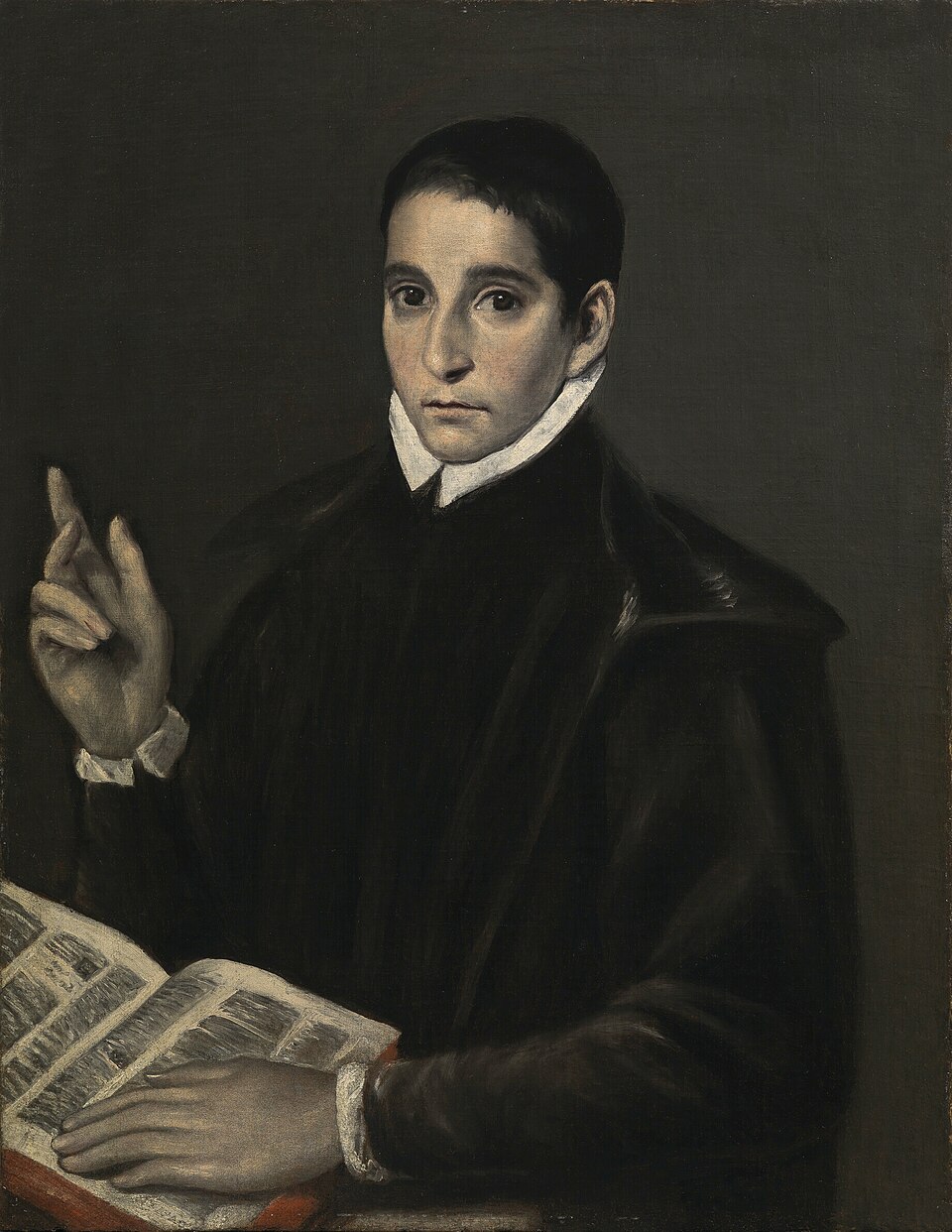
A teenage boy in student's black, one hand raised as if explaining a theory, the other resting on a book. He may be the young Luis Gonzaga, future saint, painted by El Greco about 1582. A halo once added around his head has been removed.
The story behind the painting
Luis Gonzaga, known in English as Aloysius Gonzaga, was in Spain between 1581 and 1584 as a page to Diego of Austria, son of Philip II of Spain. Because of his exemplary life he was beatified by Paul V on 19 October 1605 and canonised on 13 December 1726 by Benedict XIII. It is therefore plausible that El Greco painted the future saint at about fourteen, although there is no certainty that this canvas shows him. The Spanish Wikipedia dates the work to about 1582, while Wikidata gives 1583. The painting is unsigned and is number 195 in Harold Wethey's catalogue of the artist.
What to look for
The adolescent's expression has an overwhelming intensity, that of a young mystic. His head is very like those of the page and the angels in El Greco's The Martyrdom of Saint Maurice, which supports the attribution. He wears student's dress; his right hand gestures like a teacher setting out a theory, and his left rests on a book that is probably the Summa Theologica of Thomas Aquinas. The muted tones, modelled in light and shade almost like grisaille, recall El Greco's Portrait of a Physician. The black of the suit is very dense, with small grey touches that bring out the lines of light. The canvas measures 74 by 57 cm.
Meaning and intent
Despite its apparent lack of expression, the face seems full of will, decision and inner fire, a way of painting faces that recalls El Greco's Roman period. On the back of the frame a red wax seal shows a crown of thorns hanging from a cross; as this emblem belongs to no religious order, it probably refers to a confraternity. The reddish ground shows through the black suit and the greenish background, and the raised right hand has been clumsily repainted. Photographs from 1902 show a halo that El Greco could not have painted: he never used such a nimbus, and Luis was not yet a saint.
Legacy
That false halo was removed in a later restoration. Around 1902 the left hand was hidden under a page of the book, and it was probably restored around 1908. The provenance runs from Pablo Bosch in Madrid in 1902, Trotti and Cie in Paris in 1908, Marcell Nemes in Budapest, Stephan von Auspitz in Vienna in 1926, the Bachstitz Gallery in The Hague in 1937, to Leo van der Bergh in Santa Barbara, California, between 1938 and 1955. The sources disagree on where it is now: the Spanish article says a private collection, while Wikidata lists the Museum of Fine Arts in Budapest.
Lo sapevi?
- Attributed to El Greco, about 1582 (Wikidata: 1583).
- Possibly the young Luis Gonzaga, page at the Spanish court 1581-1584.
- A later halo, visible in 1902 photographs, was removed in restoration.
- Location disputed: private collection or Museum of Fine Arts, Budapest.
L'artista
El Greco (1541-1614)
portrait · Museum of Fine Arts, Budapest
Altre opere di El Greco
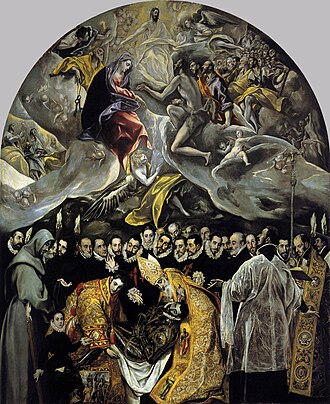 The Burial of the Count of Orgaz - El Greco (1586)
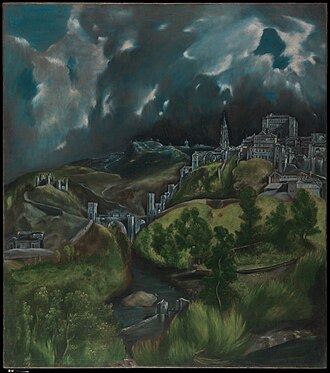 View of Toledo - El Greco (1596)
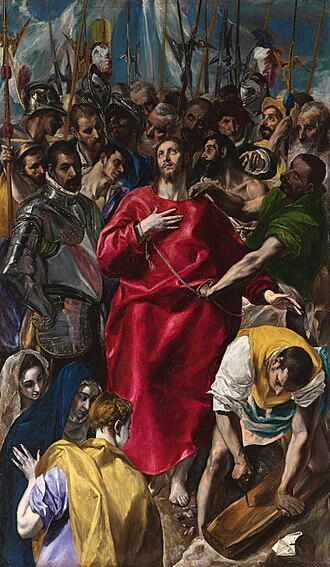 The Disrobing of Christ - El Greco (1570s)
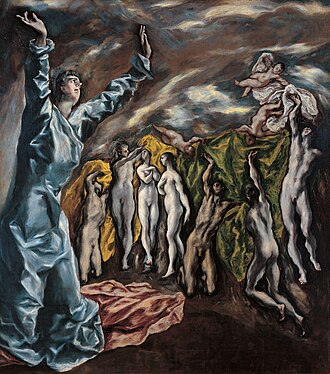 Opening of the Fifth Seal - El Greco (1610)
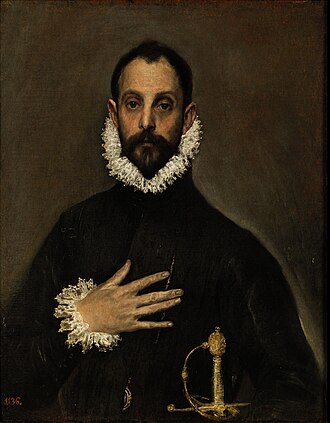 The Nobleman with his Hand on his Chest - El Greco (1580)
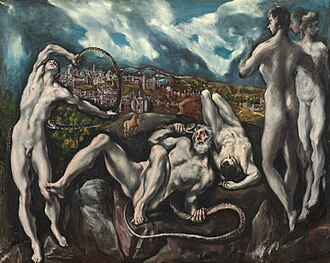 Laocoön - El Greco (1610s)
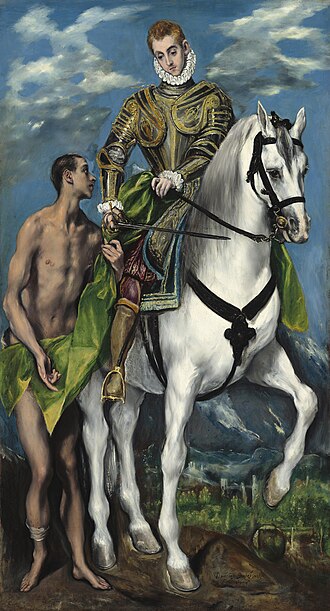 Saint Martin and the Beggar - El Greco (1597)
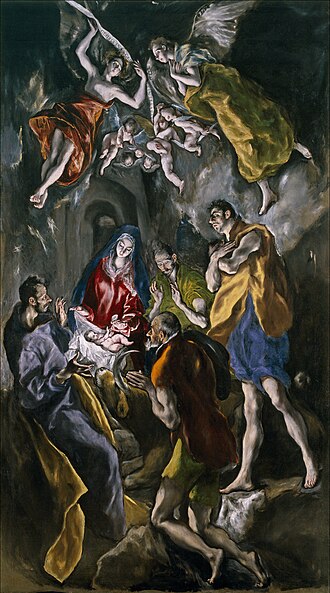 Adoration of the Shepherds - El Greco (1612)
Dipinti di artisti collegati
 The Wedding at Cana - Paolo Veronese (1560s)
 The Feast in the House of Levi - Paolo Veronese (1573)
 Last Supper - Jacopo Tintoretto (1563)
 Miracle of the Slave - Jacopo Tintoretto (1540s)
 Venus of Urbino - Titian (1538)
 Assumption of the Virgin - Titian (1510s)
 Supper at Emmaus - Caravaggio (1601)
 La vocazione di San Matteo - Caravaggio (1609)
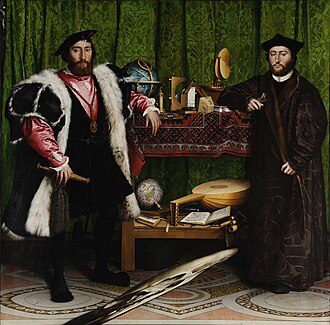 The Ambassadors - Hans Holbein the Younger (1533)
 The Body of the Dead Christ in the Tomb - Hans Holbein the Younger (1520s)