Portrait of a Man
El Greco · 1570
.jpg)
A scholar rests one hand on a book marked with red and white ribbons and lifts the other as if to speak. For more than a century this portrait passed as a self-portrait by Tintoretto, until a hidden Greek signature was found in 1898.
The story behind the painting
El Greco painted this portrait in Rome, around 1570 to 1575, when the young Cretan painter had become friends with the Farnese household and moved in an intellectual circle interested in Renaissance humanism. Wethey dates it about 1572, while the National Gallery of Denmark gives 1570 to 1575, and Wikidata 1570. The sitter's identity is unknown. He is often identified as the architect Andrea Palladio, but according to Harold Wethey he is Giovanni Battista della Porta. The painting is also known simply as Portrait of a Gentleman.
What to look for
The canvas measures 116 by 98 cm. The man is shown frontally, a little more than half-length, against a grey background. His left hand rests on a book lying on an elaborate armrest, its white and red bookmarks suggesting an intellectual. His right hand makes an eloquent gesture, like an orator's. The face is the most striking part: extraordinarily real, drawn and modelled with perfect objectivity. Note the dense handling of the flesh, as in El Greco's portraits of Vincenzo Anastagi and Giulio Clovio, and the white touches on the hands, a novelty for him.
Meaning and intent
Together, the two hands recall the poet Horace's famous saying ut pictura poesis, as is painting so is poetry. El Greco captures the man's true character with great fidelity to his features, moving completely away from the stiff, cold attitude of portrait painters two or three decades earlier. The influence of Jacopo Bassano is clear, while the three-quarter composition on a grey ground and the position of the right hand belong to Titian's style. The few objects around the man act as attributes, telling us who he is without naming him.
Legacy
The painting probably came from the sale of Rubens's estate in Antwerp in 1641, listed as a Tintoretto. It then belonged to the Comte de Vence in Paris, again as a Tintoretto, and entered the Danish Royal Collection at Christiansborg Palace in Copenhagen in 1763. Only in 1898 was the fragmentary signature in Greek capitals, Doménikos Theotokópoulos, discovered on the table at lower right, and the work was recognised as El Greco's; before that it was thought to be a self-portrait of Tintoretto. It now hangs in the National Gallery of Denmark.
Lo sapevi?
- Painted in Rome about 1570-1575.
- Sitter unknown: often called Palladio, Giovanni Battista della Porta per Wethey.
- Thought to be a Tintoretto self-portrait until the Greek signature was found in 1898.
- In the National Gallery of Denmark, Copenhagen.
L'artista
El Greco (1541-1614)
portrait · man · Mannerism · book
Altre opere di El Greco
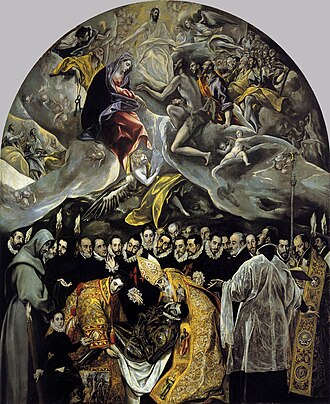 The Burial of the Count of Orgaz - El Greco (1586)
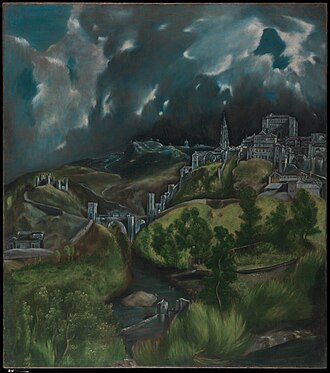 View of Toledo - El Greco (1596)
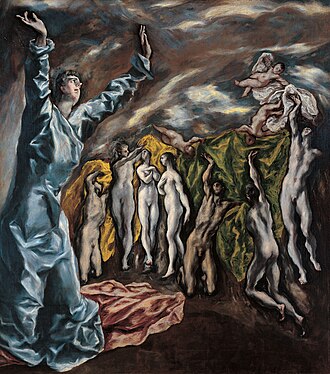 Opening of the Fifth Seal - El Greco (1610)
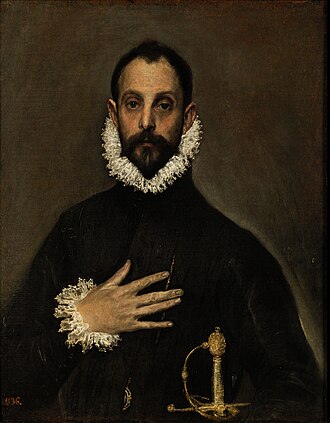 The Nobleman with his Hand on his Chest - El Greco (1580)
%20-%20Laoco%C3%B6n%20-%20Google%20Art%20Project.jpg) Laocoön - El Greco (1610s)
Laocoön - El Greco (1610s)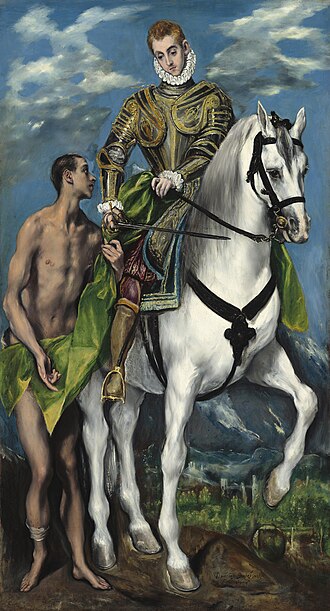 Saint Martin and the Beggar - El Greco (1597)
.jpg) Adoration of the Shepherds - El Greco (1612)
Adoration of the Shepherds - El Greco (1612)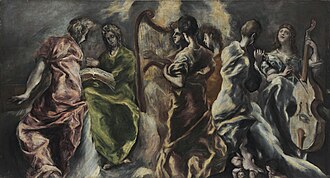 The Concert of the Angels - El Greco (1600s)
Dipinti di artisti collegati
.jpg) Venus of Urbino - Titian (1538)
Venus of Urbino - Titian (1538)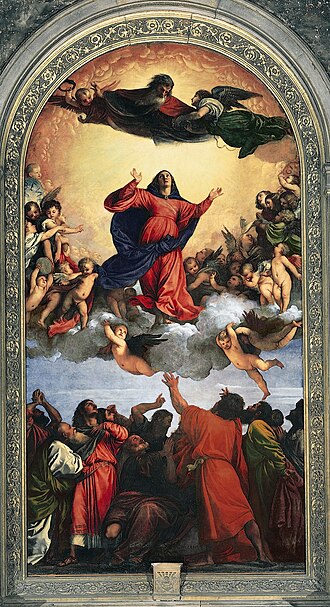 Assumption of the Virgin - Titian (1510s)
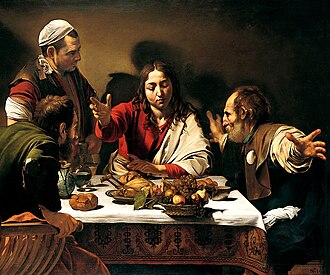 Supper at Emmaus - Caravaggio (1601)
 La vocazione di San Matteo - Caravaggio (1609)
 The Ambassadors - Hans Holbein the Younger (1533)
 The Body of the Dead Christ in the Tomb - Hans Holbein the Younger (1520s)