Edvard Munch
1863-1944
Edvard Munch set out to paint not what he saw but what he felt, and from a childhood of illness and grief he made The Scream, one of the most recognisable images in Western art. His 'soul paintings' of love, anxiety and loss opened a path the Expressionists would follow.
Origins
Munch was born on 12 December 1863 in a farmhouse in Ådalsbruk, in Løten, Norway. His father, Christian, was a doctor and medical officer; his mother, Laura, was artistically gifted and half her husband's age. In 1864 the family moved to Christiania, the city now called Oslo. His mother died of tuberculosis in 1868, and his favourite sister, Sophie, died of the same disease in 1877, at fifteen. Often ill through the winters and kept home from school, the boy drew to pass the time. His father, deeply pious, told the children ghost stories and the tales of Edgar Allan Poe. The family lived in genteel poverty, moving from one cheap flat to another. At thirteen Munch saw the Norwegian landscape painters at the new Art Association, went back to copy them, and soon began to paint in oils.
Life and turning points
In 1879 he entered a technical college to study engineering, but a year later he left, determined to be a painter, to his father's dismay. In 1881 he enrolled at the Royal School of Art and Design in Kristiania, where Christian Krohg taught him. He fell in with the city's bohemians and the nihilist Hans Jæger, who urged him to 'write his life'. The Sick Child (1886), based on Sophie's death, was his first 'soul painting'. A state scholarship took him to Paris in 1889, and in 1892 an exhibition in Berlin caused such a scandal that it closed after a week. In Berlin and Paris he shaped The Frieze of Life, a cycle on love, anxiety and death. In 1908 a breakdown sent him to Daniel Jacobson's clinic for eight months. He spent his last two decades at his estate at Ekely, near Oslo, and died there on 23 January 1944.
Style and technique
After trying Naturalism and Impressionism, Munch decided the Impressionist idiom was too superficial to carry real emotion. His mature style used simplified forms, heavy outlines, sharp contrasts and colour loaded with meaning, describing a state of mind rather than outward reality. Figures stand frontally in a shallow space, like actors holding a pose, each embodying one feeling. He used shadows and rings of colour around figures to suggest fear or intensity, and from the 1890s he let thinned paint drip down the canvas, an effect later artists adopted. He reworked his motifs again and again in paintings, pastels, lithographs and woodcuts; from 1896 woodcut became a favoured medium, and he is counted with Nikolai Astrup as an innovator of it in Norway. After his recovery in 1909 his palette brightened, with broad, loose strokes, more white and rarely black. More than half his paintings are landscapes, though he is seldom thought of as a landscape painter.
Stories and anecdotes
Munch described the moment behind The Scream: walking with two friends at sunset, the sky turned 'as red as blood', and he lagged behind, shivering, until he 'heard the enormous, infinite scream of nature'. Four versions exist, two painted and two in pastel, and two of them have been stolen and recovered. When his Berlin show was shut down in 1892, he wrote that it was incredible something as innocent as painting could cause such a stir. He hated parting with his paintings, which he saw as one body of work, so he made prints to earn a living. At Åsgårdstrand he bought a small fisherman's cabin he called the 'Happy House', and said walking there was like walking among his paintings. A quarrel with Tulla Larsen ended in an accidental shot that injured two of his fingers, and he later sawed a double portrait of them in half.
Legacy
On his death Munch left his remaining works to the city of Oslo, which opened the Munch Museum in 1963; it holds about 1,100 paintings, 4,500 drawings and 18,000 prints, the largest collection of his art. He taught little and his symbolism was intensely private, yet he deeply influenced the German Expressionists. The Nazis labelled his work 'degenerate' and removed 82 pieces from German museums; 71 came back to Norway through collectors, among them The Scream and The Sick Child. Munch refused to lend himself to the occupiers' cause, though after his death they staged a funeral against his wish for a private one. Art historian Martha Tedeschi placed The Scream beside the Mona Lisa as one of the few paintings that communicate their meaning almost instantly to nearly every viewer. More than a century on, it still speaks for the anxiety of modern life.
Lo sapevi?
- Munch's earliest drawings showed the inside of his family's flats, down to medicine bottles.
- He was made a Knight of the Royal Order of St. Olav 'for services in art'.
- In his late years he painted his farm horse, named Rousseau, as a model.
- He survived the Spanish flu of 1918.
Dipinti di Edvard Munch
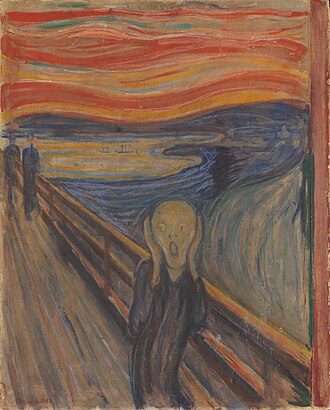 The Scream - Edvard Munch (1893)
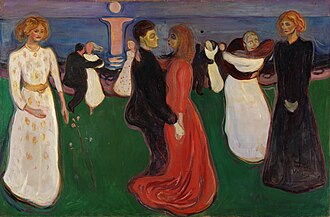 Dance of Life - Edvard Munch
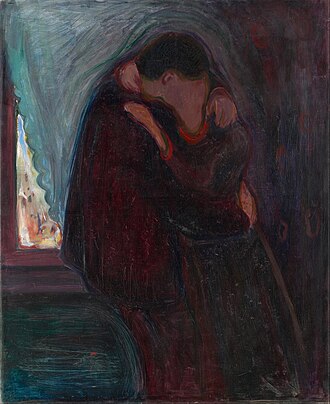 The Kiss - Edvard Munch (1897)
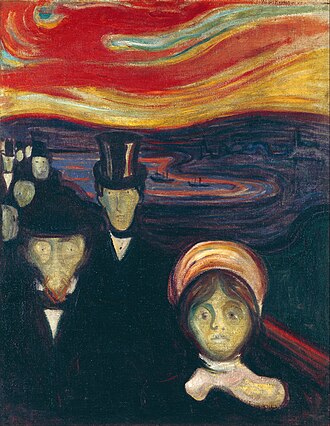 Anxiety - Edvard Munch (1894)
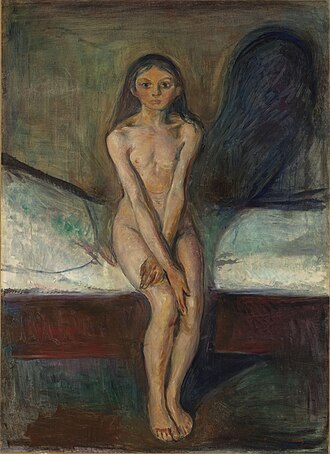 Puberty - Edvard Munch (1895)
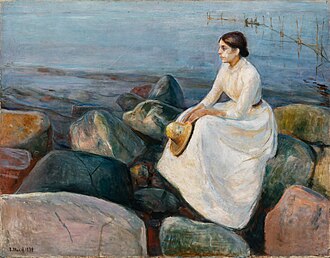 Inger on the Beach - Edvard Munch (1889)
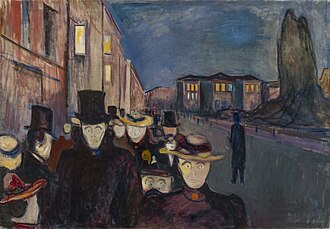 Evening on Karl Johan - Edvard Munch (1892)
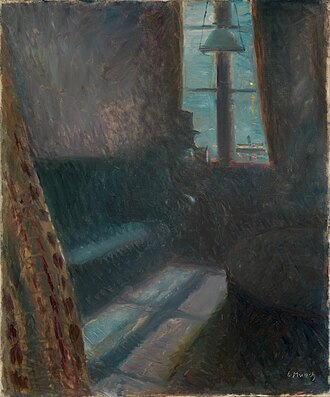 Night in Saint-Cloud - Edvard Munch (1890)
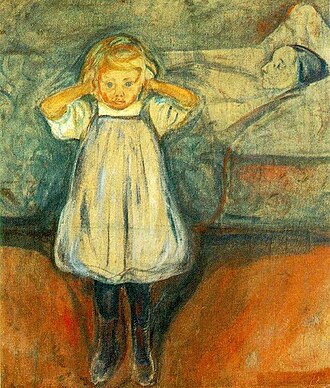 Death and the Child - Edvard Munch (1899)
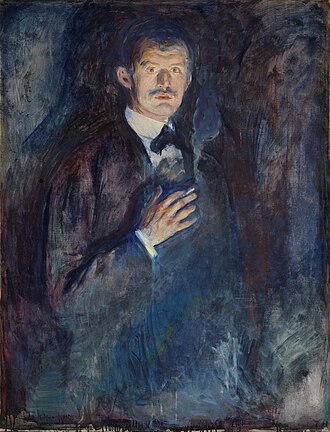 Self-Portrait with Cigarette - Edvard Munch (1895)
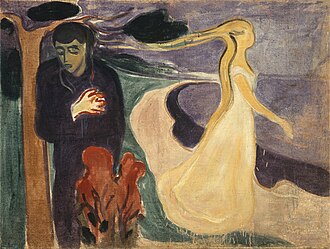 Separation - Edvard Munch (1896)
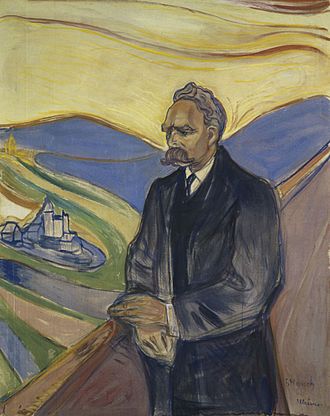 Friedrich Nietzsche - Edvard Munch (1906)
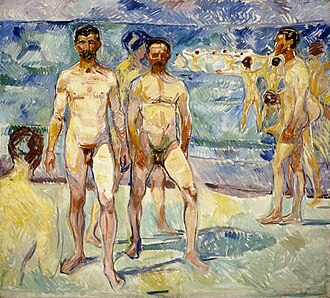 Bathing Men - Edvard Munch (1908)
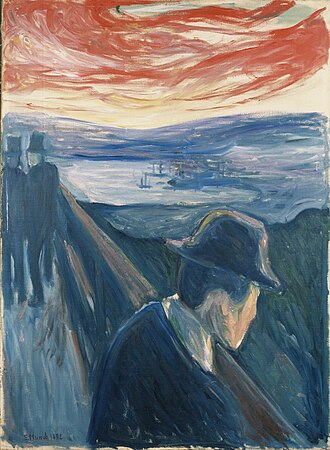 Despair - Edvard Munch (1892)
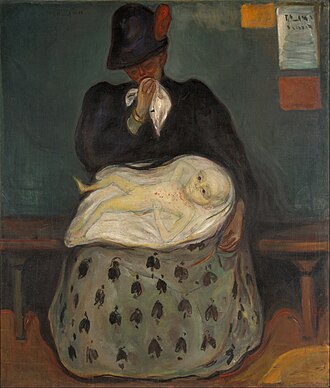 Inheritance - Edvard Munch (1890s)
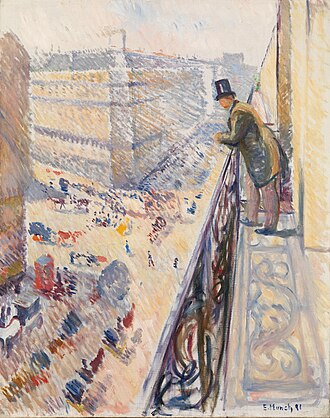 Rue Lafayette - Edvard Munch (1891)
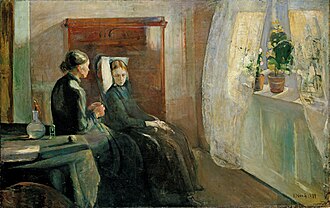 Spring - Edvard Munch (1889)
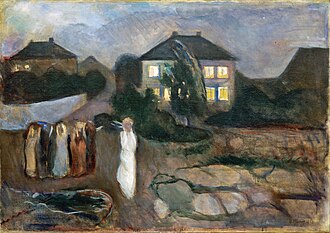 The Storm - Edvard Munch (1893)
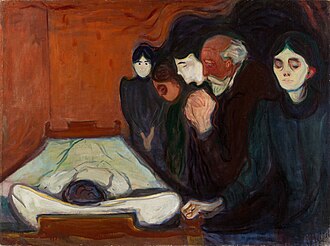 At the Deathbed - Edvard Munch (1895)
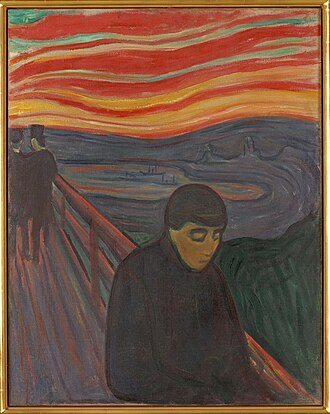 Despair - Edvard Munch (1894)
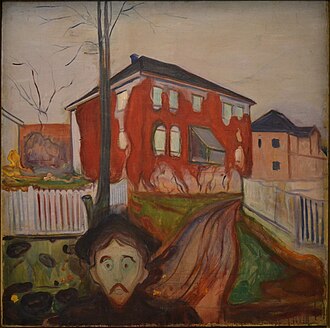 Red Virginia Creeper - Edvard Munch (1890s)
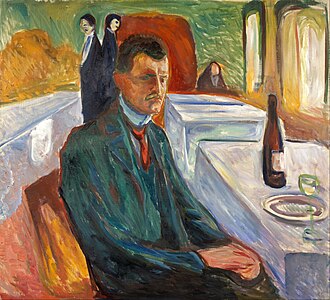 Self-Portrait With a Bottle of Wine - Edvard Munch (1906)
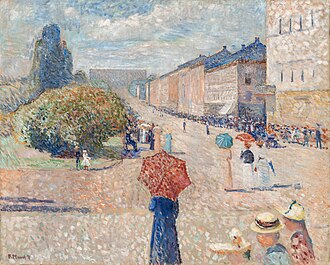 Spring Day on Karl Johan - Edvard Munch (1890)
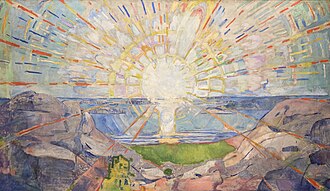 The Sun - Edvard Munch (1911)