Rue Lafayette
Edvard Munch · 1891
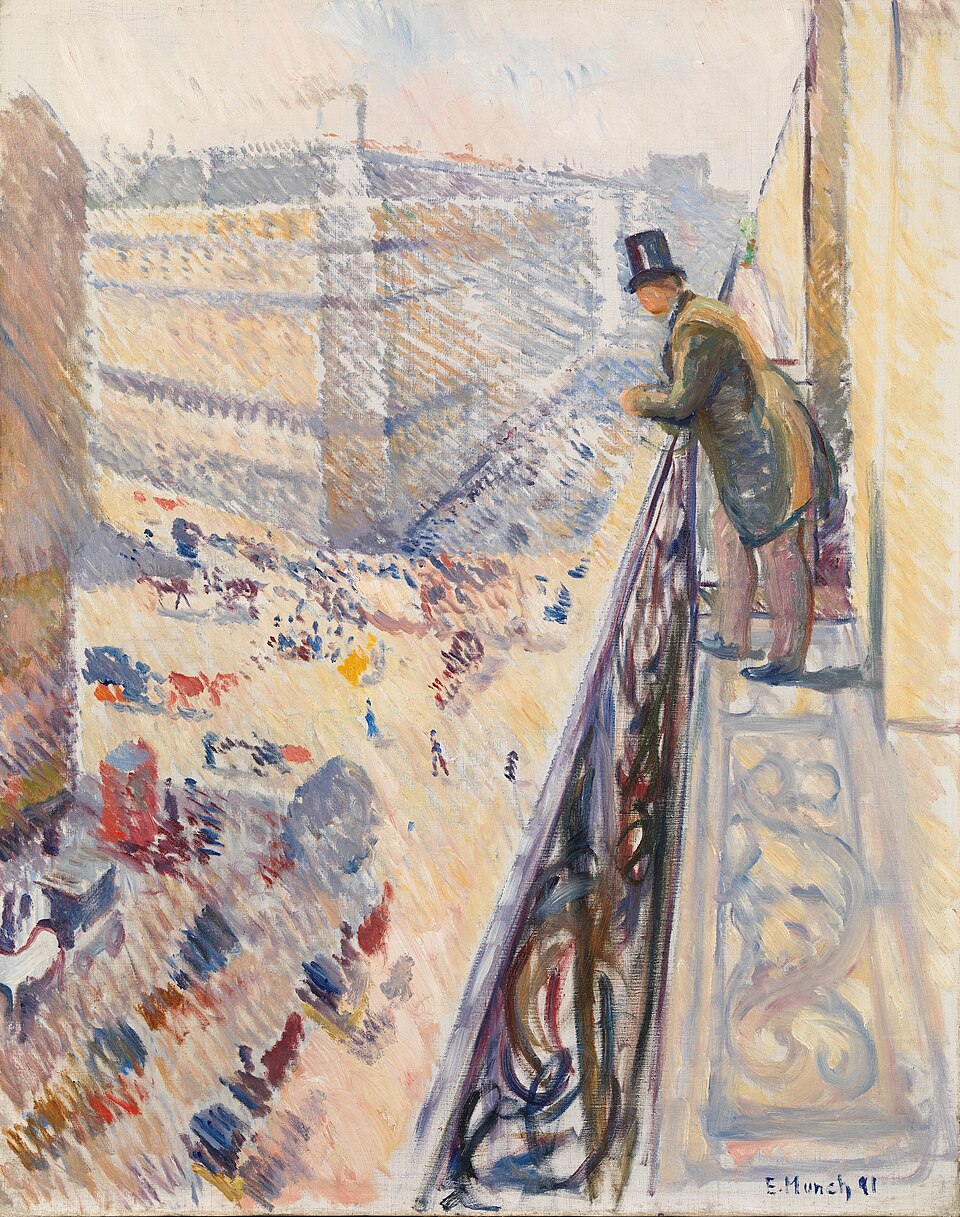
A man in a top hat leans over a balcony rail and looks down into a rushing Paris street. Munch painted it in 1891, in a brief impressionist moment, and the steep, dizzy view already hints at the anxiety of his later work.
The story behind the painting
In autumn 1889 Edvard Munch travelled to Paris to study its art scene, and stayed in France, with breaks, until 1892. There he saw works by Gauguin, van Gogh, Toulouse-Lautrec, Caillebotte, Whistler and the Neo-Impressionists. Rue Lafayette was painted in 1891 from the hotel at Rue Lafayette 49, where Munch lodged in April that year. Oskar Bätschmann places the balcony on the fifth or sixth floor. Many writers guessed Munch had painted from Caillebotte's flat, because the compositions are alike, but Caillebotte's balcony pictures were never shown while Munch was in Paris, and no acquaintance between them can be proven.
What to look for
On the left, house fronts and a busy crossing full of carriages and passers-by are painted in short, parallel diagonal strokes of clear red, blue and yellow, with blue dominating and bare primed canvas showing between them. The strokes follow roughly the angle of the sunlight and suggest a crowd pushing forward. On the right, the man and the balcony are painted differently, with thinned paint, firmer outlines, rounder lines and darker colours that give weight and stability. The rail lines drive the eye steeply into depth. You can make out the forks toward Rue Drouot and Rue du Faubourg Montmartre, and the Opéra Garnier as a blue mass behind.
Meaning and intent
Munch later called such pictures a brief flicker of his impressionist period, and already in spring 1890 he had turned away from naturalism in his Saint-Cloud manifesto. Reinhold Heller finds calm in the street views of Monet and Caillebotte, but agitated movement here: Munch uses the dotted strokes not for brighter colour but to catch the speed of city life, as a tribute to the modern metropolis twenty years before Futurism. For Oskar Bätschmann the picture is more than an exercise: the lone watcher and the abyss below create feelings of alienation and danger, and introduce melancholy and despair, later used in works such as The Scream.
Legacy
Munch took up the same composition and technique once more in 1891 in a view of the Rue de Rivoli, this time mirrored, so that the diagonal drops into depth with almost dramatic speed, according to Ulrich Bischoff. Rue Lafayette, oil on canvas measuring 92 by 73 cm, belongs to the National Museum of Art, Architecture and Design in Oslo, which includes the former National Gallery of Norway. It remains a rare record of the short time when Munch tried out the tools of Impressionism before turning to Synthetism, Symbolism and Expressionism.
Lo sapevi?
- Painted in Paris in 1891.
- Seen from Munch's hotel at Rue Lafayette 49.
- Munch called it a brief flicker of his impressionist period.
- Held by the National Museum in Oslo.
L'artista
Edvard Munch (1863-1944)
man · National Museum of Art, Architecture and Design · National Gallery of Norway
Altre opere di Edvard Munch
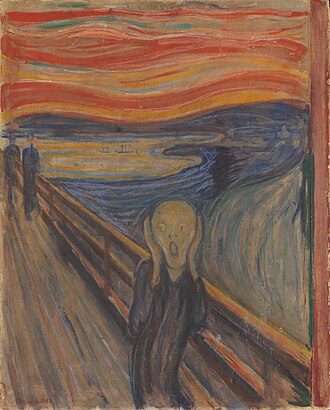 The Scream - Edvard Munch (1893)
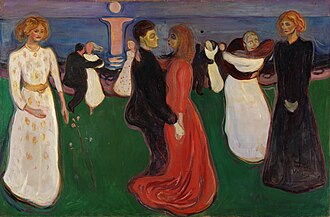 Dance of Life - Edvard Munch
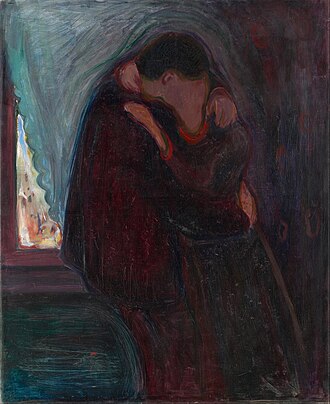 The Kiss - Edvard Munch (1897)
 Puberty - Edvard Munch (1895)
 Anxiety - Edvard Munch (1894)
 Inger on the Beach - Edvard Munch (1889)
 Evening on Karl Johan - Edvard Munch (1892)
 Night in Saint-Cloud - Edvard Munch (1890)