Anxiety
Edvard Munch · 1894
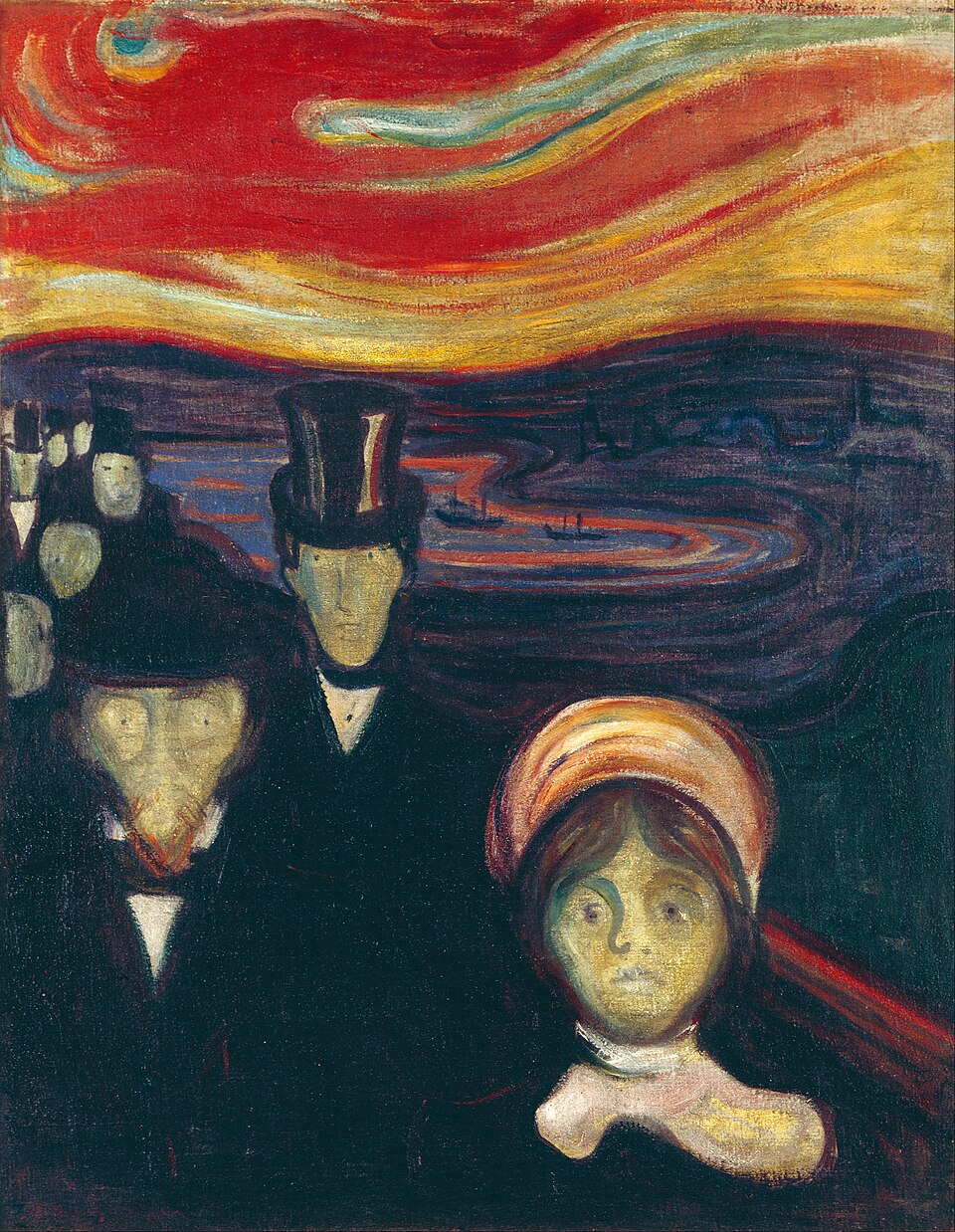
Under the blood-red sky of The Scream, a crowd of pale faces walks straight toward you. In Anxiety, Munch turned one panicked evening of his youth into a procession that seems to stare back at every viewer.
The story behind the painting
Edvard Munch painted Anxiety in 1894 as a synthesis of two earlier motifs: Evening on Karl Johan of 1892 and The Scream of 1893. The art historian Arne Eggum traces the crowd to a memory from Munch's youth. At 22, he walked restlessly along Karl Johans gate in Kristiania, now Oslo, looking for his lover Milly Thaulow, the married wife of his cousin. A stream of people came toward him and he had an anxiety attack, feeling his legs would not carry him and that all those pale faces were staring at him. Of the affair's end he wrote that he gave up all hope of ever being able to love.
What to look for
The setting comes from The Scream: a railing slicing diagonally from top left to bottom right, a steep drop to a city and a fjord with ships, and a blood-red sky with stormy clouds. On the bridge a group of people with greenish-pale faces and wide-open eyes stares at the viewer and seems to press forward. Three stand out: a woman in a bonnet or halo-like hat, a man in a top hat, and a man with a hat and goatee. Eggum sees the woman and the top-hatted man as Milly and her husband, and the goatee figure as the Polish writer Stanislaw Przybyszewski, Munch's friend in Berlin.
Meaning and intent
Gerd Woll reads the work less as memoir than as a concentrated mood, typical of Symbolism, and notes how the signal colours and contrasts create alarm and uncertainty. Reinhold Heller sees the green-faced, dark-clad crowd as recalling a funeral procession, modern city dwellers cut off from the majestic nature before them; Eggum speaks of a funeral procession of ghosts. Munch himself wrote of seeing all people behind their masks, smiling, calm faces, pale corpses hurrying along a winding path whose end is death. Oskar Kokoschka said Munch's greatness lay in diagnosing the panic beneath so-called progress.
Legacy
Anxiety belongs to Munch's Frieze of Life, and at its first showing within the frieze he titled it Red Clouds. In 1896 he made a lithograph, mirrored from the painting, and a woodcut. In both the railing is gone, the figures fill the foreground, and the goatee man is replaced by three women in bonnets around the man in the top hat. Munch contributed a black and red print to Ambroise Vollard's 1896 album Les Peintres-Graveurs, and Eggum found the woodcut even more concentrated and unreal. The painting is exhibited at the Munch Museum in Oslo.
Lo sapevi?
- Painted in 1894, about 94 by 74 cm.
- Combines motifs from Evening on Karl Johan and The Scream.
- Part of the Frieze of Life, first shown as Red Clouds.
- Reworked as a lithograph and a woodcut in 1896.
woman · genre art · man · bridge
Altre opere di Edvard Munch
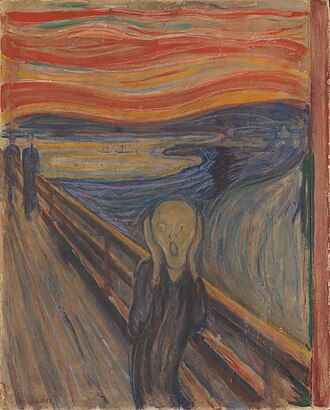 The Scream - Edvard Munch (1893)