Friedrich Nietzsche
Edvard Munch · 1906
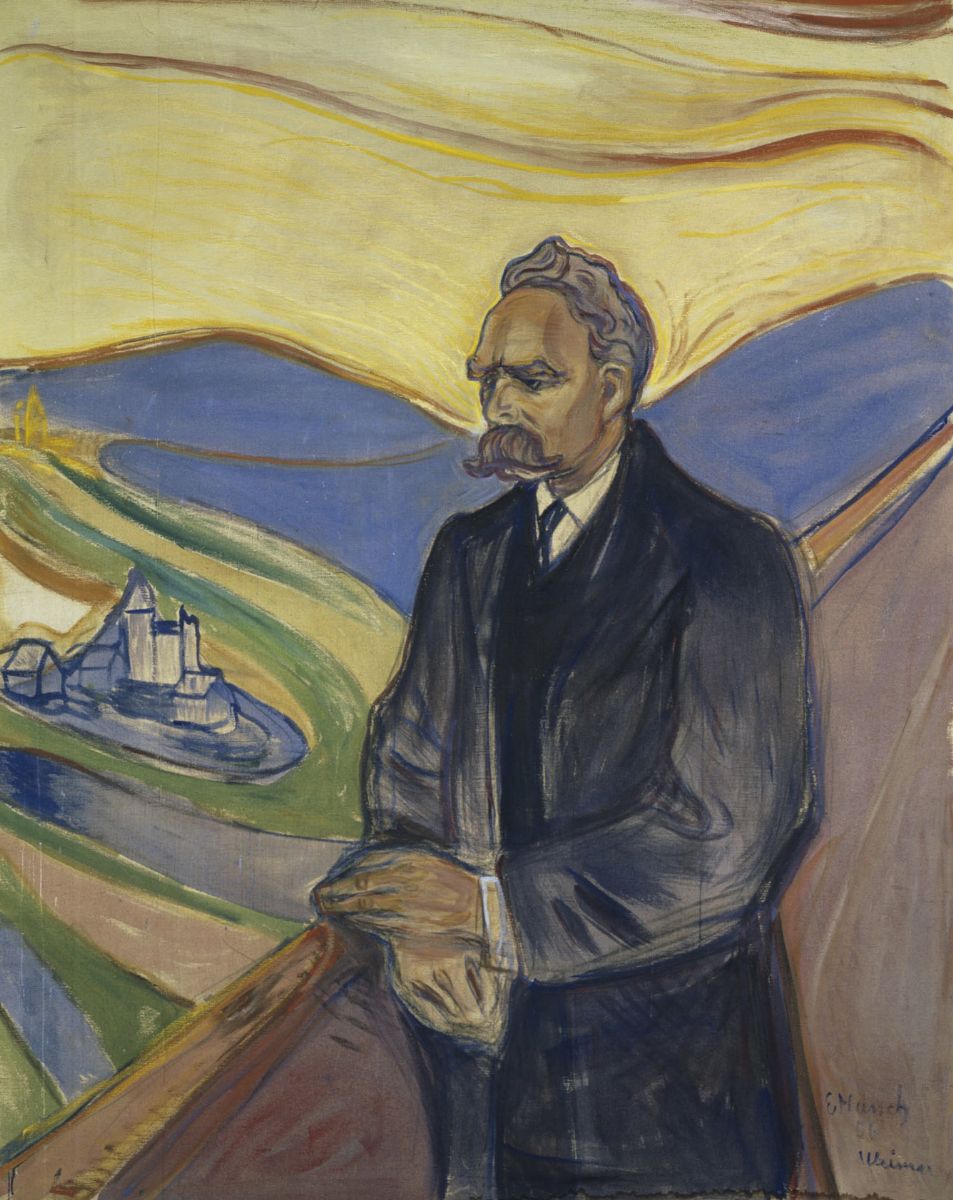
Larger than life, Nietzsche leans on a railing above a valley, under a yellow sky that recalls The Scream. Munch never met him: the philosopher had died six years before, so the painter worked from photographs.
The story behind the painting
Munch painted this portrait in 1906, six years after Friedrich Nietzsche's death, so against his usual habit he had to rely on photographs. The idea came from Nietzsche's sister, Elisabeth Förster-Nietzsche, and the work was commissioned by the Swedish businessman and collector Ernest Thiel. In those years Munch spent summers in Norway and winters in Berlin, and had become a sought-after portrait painter who stayed with his clients while he worked. In spring 1904 he first went to Weimar to paint Count Harry Kessler, and through the architect Henry van de Velde he met Nietzsche's sister.
What to look for
The canvas is about two metres high, showing Nietzsche larger than life from the waist up. He wears a waistcoat, tie and long coat in shades of dark blue, leans his right arm on a railing and looks down in three-quarter profile at the landscape. Look at the hands: Munch first made them too large and reduced them with black and white paint. The railing cuts a steep diagonal from the lower left. The sky, yellow and white with a few red streaks, recalls The Scream but feels calmer. In a bend of the river stands a white castle, and blue hills behind his shoulders look like wings.
Meaning and intent
Munch explained that he showed Nietzsche as the poet of Zarathustra among the mountains by his cave, standing in the light yet longing for the dark. He was thinking of the Night Song in Thus Spoke Zarathustra, a passage he had marked in his own copy. Hilde Rognerud reads the figure as a winged Zarathustra between beast and Übermensch. Reinhold Heller sees an idealised self-portrait and the emotional antithesis of The Scream: lines rising instead of falling, a calm, upright figure instead of a terrified one, perhaps a dream of health for the troubled painter.
Legacy
Scholars disagree about how much Nietzsche shaped Munch. Writers such as Stanisław Przybyszewski, whom Munch knew in Berlin from 1892, stressed the philosopher's influence, and later interpreters followed. Detlef Brennecke points out that Munch's notes barely mention Nietzsche before this portrait, and that in 1918 Munch denied any German influence on his Frieze of Life. Brennecke even called the picture both a pseudo-Munch and an anti-Nietzsche. The painting hangs today in the Thiel Gallery in Stockholm. In the same year Munch painted a second, narrower version, which he kept and which is shown in the Munch Museum in Oslo.
Lo sapevi?
- Painted in 1906, six years after Nietzsche's death, from photographs.
- Suggested by Elisabeth Förster-Nietzsche and commissioned by Ernest Thiel.
- The sky deliberately echoes The Scream.
- In the Thiel Gallery, Stockholm; a second version is in the Munch Museum.
L'artista
Edvard Munch (1863-1944)
Altre opere di Edvard Munch
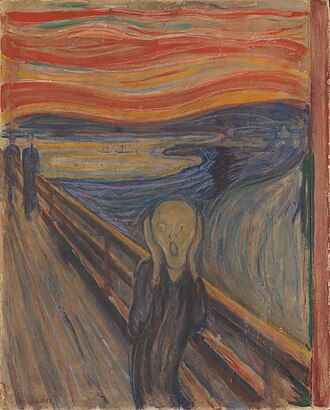 The Scream - Edvard Munch (1893)
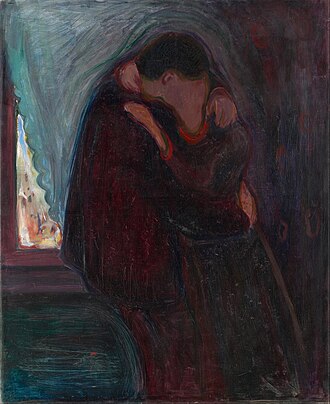 The Kiss - Edvard Munch (1897)
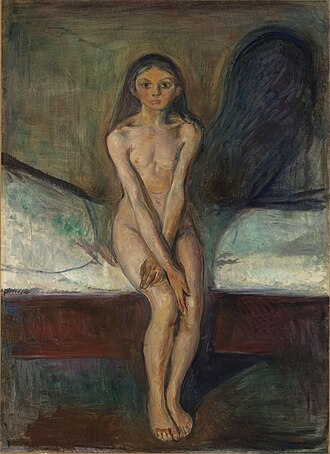 Puberty - Edvard Munch (1895)
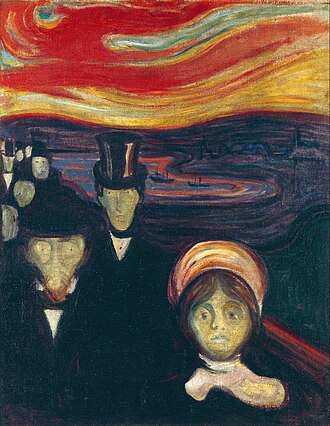 Anxiety - Edvard Munch (1894)
.jpg) Inger on the Beach - Edvard Munch (1889)
Inger on the Beach - Edvard Munch (1889).jpg) Evening on Karl Johan - Edvard Munch (1892)
Evening on Karl Johan - Edvard Munch (1892)%2C%20NG.M.01111.jpg) Night in Saint-Cloud - Edvard Munch (1890)
Night in Saint-Cloud - Edvard Munch (1890)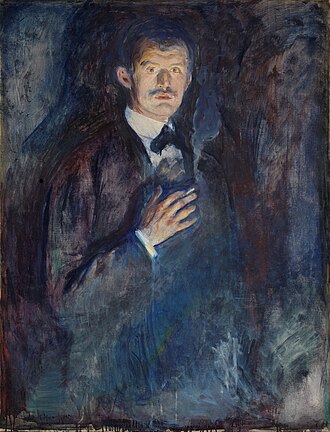 Self-Portrait with Cigarette - Edvard Munch (1895)