Vuelo de brujas
Francisco Goya · 1797
.jpg)
Three witches in pointed caps lift a writhing naked man into the dark sky, while peasants below hide their eyes and ears. Goya painted superstition so that it would turn back on its accusers.
The story behind the painting
Witches' Flight, also known as Witches in Flight or Witches in the Air, is an oil on canvas by the Spanish painter Francisco Goya. Wikipedia says it was completed in 1798, while Wikidata gives 1797. It was part of a series of six paintings on witchcraft acquired by the Duke and Duchess of Osuna, who bought it on 27 June 1798 to decorate their villa, La Alameda, on the outskirts of Madrid. The small canvas, about 43.5 by 30.5 cm, has been described as the most beautiful and powerful of Goya's Osuna witch paintings.
What to look for
At the centre, three half-naked witches wearing either penitential corozas or dunce caps carry aloft a writhing nude figure, their mouths close to him as if to devour him or suck his blood. Below, two figures in peasant clothes recoil from the sight. One has thrown himself to the ground, covering his ears. The other tries to escape under a blanket and makes the fig hand gesture to ward off the evil eye. Finally, on the right, a donkey emerges, seemingly unaware of everything happening around it. The bright group floats against a black sky.
Meaning and intent
Scholars generally agree that the painting is a rationalist critique of superstition and ignorance, especially in religious matters. The corozas recall the violence of the Spanish Inquisition: the upward flames show that the wearers were condemned as unrepentant heretics to be burned at the stake. Yet the caps also look like bishops' mitres, with their double points. The accusations of the religious tribunals are thus turned back on themselves, and their actions equated with superstition and ritual sacrifice. The bystanders are either appalled but helpless, or willfully ignorant. The donkey is a traditional symbol of ignorance.
Legacy
After decorating the Osuna villa for almost a century, the painting was sold in 1896 at the public auction of the Osuna estate to Ramón Ibarra. In 1985 it passed to Jaime Ortiz Patiño. Finally, in 1999, it was acquired by the Museo del Prado in Madrid, where it remains today. There it can be seen as part of Goya's long engagement with the darker side of the human mind, a small canvas whose questions about fear, cruelty and the people who simply look away still feel uncomfortably close to anyone who stands in front of it.
¿Sabías que…?
- One of six witchcraft paintings bought by the Duke and Duchess of Osuna in 1798.
- Dated 1798 by Wikipedia, 1797 by Wikidata.
- Read as a critique of superstition and the Inquisition.
- In the Museo del Prado since 1999.
Sobre el artista
Francisco Goya (1746-1828)
Más obras de Francisco Goya
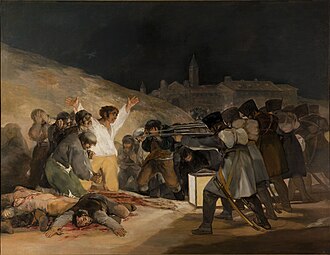 El tres de mayo de 1808 - Francisco Goya (1814)
.jpg) La Maja desnuda - Francisco Goya (1800)
La Maja desnuda - Francisco Goya (1800).jpg) Saturno devorando a su hijo - Francisco Goya (1819)
Saturno devorando a su hijo - Francisco Goya (1819)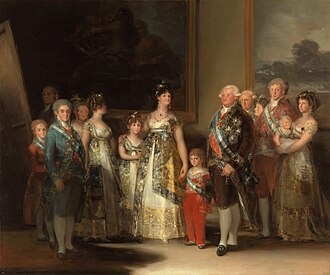 La familia de Carlos IV - Francisco Goya (1800)
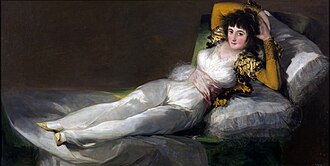 La maja vestida - Francisco Goya (1800)
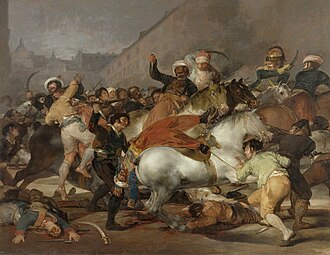 El dos de mayo de 1808 en Madrid - Francisco Goya (1814)
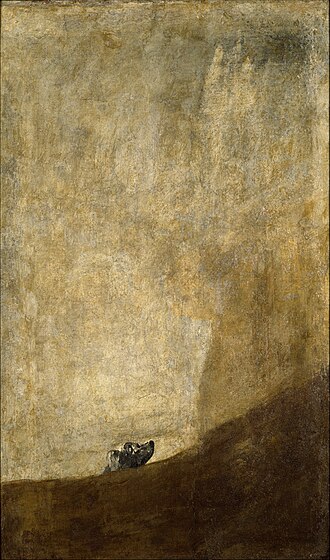 Perro semihundido - Francisco Goya (1819)
 El aquelarre - Francisco Goya (1820s)
Obras de artistas relacionados
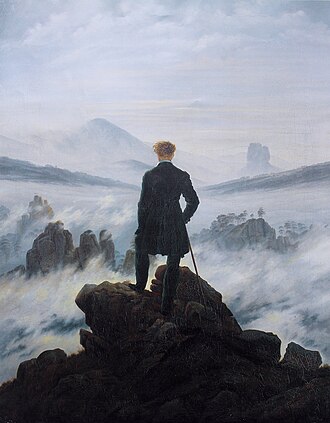 El caminante sobre el mar de nubes - Caspar David Friedrich (c. 1818)
 Abadía en el robledal - Caspar David Friedrich (1800s)
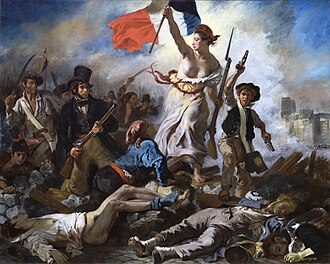 La Libertad guiando al pueblo - Eugène Delacroix (1830)
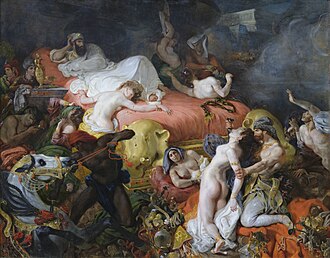 La muerte de Sardanápalo - Eugène Delacroix (1827)
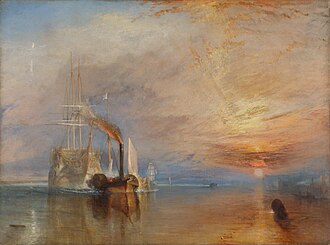 El Temerario remolcado - J. M. W. Turner (1839)
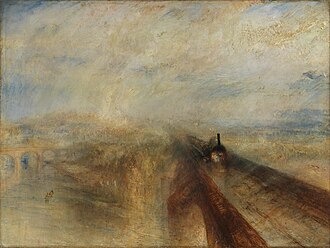 Lluvia, vapor y velocidad. El gran ferrocarril del Oeste - J. M. W. Turner (1844)
.jpg) El joven azul - Thomas Gainsborough (1770)
El joven azul - Thomas Gainsborough (1770).jpg) El Señor y la Señora Andrews - Thomas Gainsborough (1748)
El Señor y la Señora Andrews - Thomas Gainsborough (1748)