La maja vestida
Francisco Goya · 1800
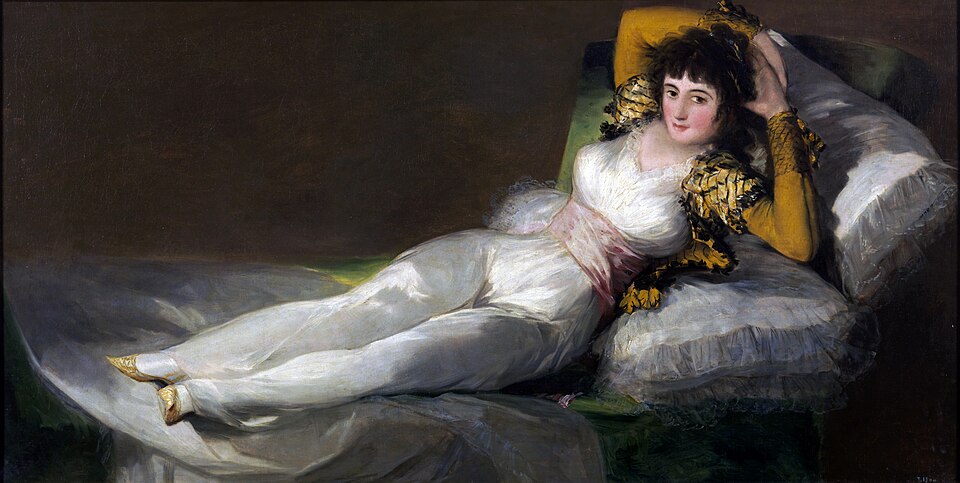
She reclines on green cushions, arms folded behind her head, meeting your gaze with a half-smile. Somewhere nearby, in the same pose, hangs her famous twin without the dress.
The story behind the painting
La maja vestida, The Clothed Maja, is an oil on canvas by the Spanish Romantic painter and printmaker Francisco Goya, created between 1800 and 1807. It is a clothed version of an earlier picture, La maja desnuda, painted between 1795 and 1800. Much about its making is uncertain. Neither the model nor the person who commissioned the work has been confirmed. Some sources say both paintings were commissioned by the Prime Minister Manuel de Godoy for his private collection, which would suggest the sitter was his mistress Pepita Tudó. The novelist Lion Feuchtwanger instead wrote that Godoy bought the pair from the heirs of María Cayetana de Silva, the 13th Duchess of Alba, after her death in 1802. Goya and the Duchess were rumoured to have had a passionate affair, which has fed that theory for generations.
What to look for
The picture is wide and low, almost twice as long as it is tall, built around a single horizontal figure. A young woman with brown hair lies on a fainting couch, propped on cushions, her arms raised and folded behind her head. Notice how directly she looks out at us, with a faint smile rather than a modest downward glance. Her clothing clings to the shape of her body, so that the dress conceals and reveals at the same time. The pose is the same as in La maja desnuda, which invites the viewer to compare the two and to notice how much the presence of clothing changes the mood of an otherwise identical arrangement. Beyond these elements, the sources say little about Goya's specific handling of paint, so it is best simply to stand before her and look.
Meaning and intent
A maja was a figure of Spanish popular culture, and Goya's title names a type rather than a person, which keeps her identity open. The suggested candidates, the Duchess of Alba and Pepita Tudó, have never been confirmed. Because the paintings were never shown publicly in Goya's lifetime, it is not even known whether they were meant as pendants, to be hung as a pair. What is clear is how they were seen once discovered. When Godoy's collection was inventoried in 1808 during the French occupation of Spain, the two pictures were listed as the Naked and Clothed Gypsy or Venus, and the French ruling class considered them obscene. The clothed version's frank, confident gaze is part of what made the pair so charged: she is not a goddess from myth, but a real woman looking back.
Legacy
The painting's history is a story of confiscation and concealment. Both majas were first recorded in an 1808 inventory, when Godoy's assets were seized by King Ferdinand VII. The clothed maja was twice in the collection of the Royal Academy of Fine Arts of San Fernando in Madrid, and between 1814 and 1836 it was sequestered by the Spanish Inquisition. Since 1901 the two paintings have been exhibited side by side at the Museo Nacional del Prado in Madrid, where visitors can finally see them as a pair. Few works ask so directly what it means to look at a body, and the mystery of who she was has only deepened her hold on the imagination.
¿Sabías que…?
- The painting was never publicly exhibited during Goya's lifetime.
- It was sequestered by the Spanish Inquisition between 1814 and 1836.
- Since 1901 it has hung beside La maja desnuda at the Prado in Madrid.
- An 1808 French inventory listed the pair as the Naked and Clothed Gypsy or Venus.
Sobre el artista
Francisco Goya (1746-1828)
mujer · retrato · Museo del Prado · castaño · decúbito · sonrisa
Más obras de Francisco Goya
 El tres de mayo de 1808 - Francisco Goya (1814)
.jpg) La Maja desnuda - Francisco Goya (1800)
La Maja desnuda - Francisco Goya (1800).jpg) Saturno devorando a su hijo - Francisco Goya (1819)
Saturno devorando a su hijo - Francisco Goya (1819) La familia de Carlos IV - Francisco Goya (1800)
 El dos de mayo de 1808 en Madrid - Francisco Goya (1814)
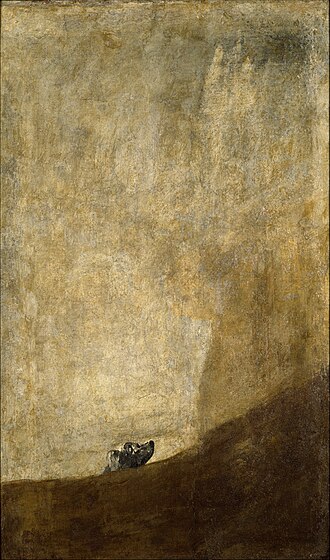 Perro semihundido - Francisco Goya (1819)
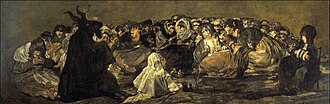 El aquelarre - Francisco Goya (1820s)
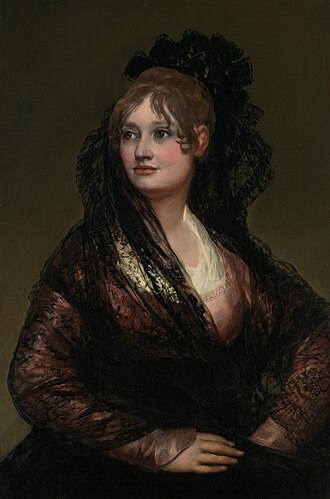 Retrato de Isabel Porcelana - Francisco Goya (1800s)