El joven azul
Thomas Gainsborough · 1770
.jpg)
A boy in shimmering blue satin stands life-size in seventeenth-century dress. Nobody is quite sure who he is, and the most famous story about him is not true.
The story behind the painting
Gainsborough painted The Blue Boy around 1770, over a canvas on which he had already drawn something else. For a long time the boy was thought to be Jonathan Buttall, son of a wealthy hardware merchant, because Buttall owned the picture early. That was never proven. In 2013 Susan Sloman argued that the likely sitter was Gainsborough's nephew, Gainsborough Dupont. The portrait is also a costume study: the youth wears seventeenth-century clothing in homage to Anthony van Dyck, and the picture is close to van Dyck's portraits of boys, especially his double portrait of George Villiers, 2nd Duke of Buckingham, and Lord Francis Villiers.
What to look for
The painting is about life-size, some 180 by 124 cm. Its dominant blue, a cool colour, later gave rise to a famous tale. In 1821 the printmaker John Young published the first reproduction and claimed Gainsborough painted it to contradict Sir Joshua Reynolds, who in his Eighth Discourse of 1778 said the masses of light in a picture should always be warm, with blue, grey or green kept almost entirely out of them.
Meaning and intent
The story pleased the public because it set two very different men against each other: Reynolds, knighted president of the Royal Academy and champion of history painting, and Gainsborough, portraitist and landscapist who kept away from academic duties and never received royal honours. In fact the painting was finished about eight years before Reynolds' discourse. But the tale of a challenge over warm and cool colours was too good to give up, and its repetition helped carry the picture to international fame.
Legacy
Buttall owned it until his bankruptcy in 1796; it passed to John Nesbitt, to the painter John Hoppner in 1802, and around 1809 to Earl Grosvenor, whose family lent it to many exhibitions, from Manchester in 1857 to the Royal Academy in 1896. In 1921 the second Duke of Westminster sold it to the railway magnate Henry Edward Huntington. Before it left for California in 1922, 90,000 people saw it at the National Gallery in London, and a London revue staged its farewell with a song by Cole Porter. It became prints, ceramic figures and costumes, and today hangs at The Huntington in San Marino, California.
¿Sabías que…?
- Painted around 1770 in homage to van Dyck.
- The sitter is disputed: Jonathan Buttall or Gainsborough Dupont.
- The tale of a challenge to Reynolds is not true.
- The Huntington, San Marino, California, since 1922.
Sobre el artista
Thomas Gainsborough (1727-1788)
retrato · niño · árbol · Romanticismo · sombrero · calzón · cuello · jubón · pluma
Más obras de Thomas Gainsborough
.jpg) El Señor y la Señora Andrews - Thomas Gainsborough (1748)
El Señor y la Señora Andrews - Thomas Gainsborough (1748)%20-%20WGA8418.jpg) El señor y la señora Hallett - Thomas Gainsborough (1785)
El señor y la señora Hallett - Thomas Gainsborough (1785)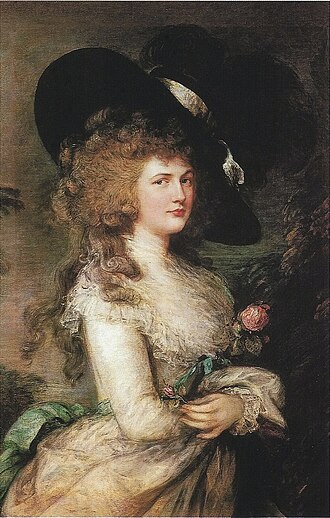 Retrato de Georgiana, duquesa de Devonshire - Thomas Gainsborough (1780s)
%20-%20Google%20Art%20Project.jpg) Retrato de la señora Mary Graham - Thomas Gainsborough (1775)
Retrato de la señora Mary Graham - Thomas Gainsborough (1775)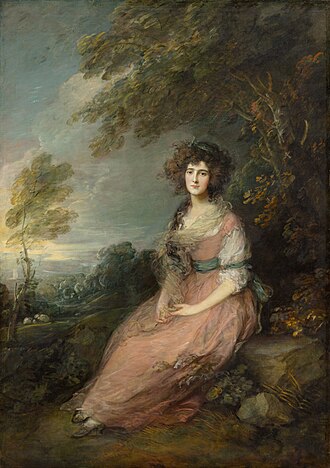 Mrs. Richard Brinsley Sheridan - Thomas Gainsborough (1785)
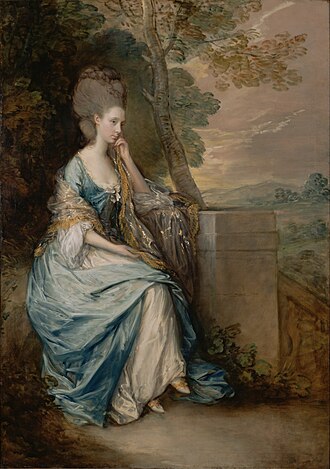 Portrait of Anne, Countess of Chesterfield - Thomas Gainsborough (1770s)
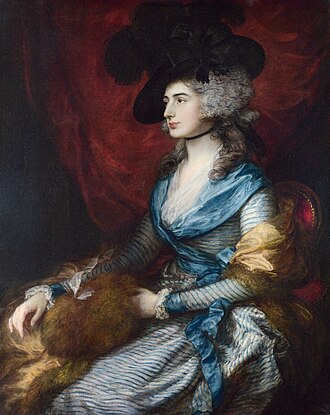 Mrs Siddons - Thomas Gainsborough (1785)
 La esposa de William St Quintín - Thomas Gainsborough (1767)
Obras de artistas relacionados
 El tres de mayo de 1808 - Francisco Goya (1814)
.jpg) La Maja desnuda - Francisco Goya (1800)
La Maja desnuda - Francisco Goya (1800) El caminante sobre el mar de nubes - Caspar David Friedrich (c. 1818)
 Abadía en el robledal - Caspar David Friedrich (1800s)
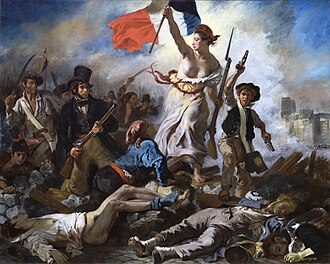 La Libertad guiando al pueblo - Eugène Delacroix (1830)
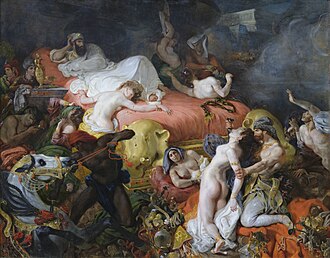 La muerte de Sardanápalo - Eugène Delacroix (1827)
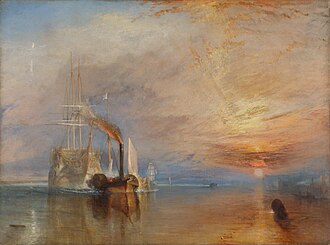 El Temerario remolcado - J. M. W. Turner (1839)
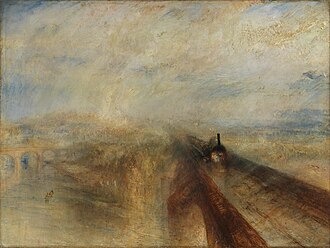 Lluvia, vapor y velocidad. El gran ferrocarril del Oeste - J. M. W. Turner (1844)