La Maja desnuda
Francisco Goya · 1800
.jpg)
She does not hide, and she does not pretend to be a goddess. She looks straight back at you, and that steady gaze once brought her painter before the Spanish Inquisition.
The story behind the painting
Francisco Goya painted The Nude Maja, La maja desnuda, in oil on canvas around 1797 to 1800. It was probably commissioned by Manuel Godoy, Spain's prime minister, to hang in a separate private cabinet reserved for nude paintings. Goya also made a pendant showing the same woman in the identical pose but clothed, La maja vestida. The woman is identified as a maja, a fashionable lower-class woman of Madrid, because of the costume she wears in the clothed version. Beyond that, the identity of the model and the reason the pictures were made remain unknown. Both are first recorded in 1800 in Godoy's collection, hanging in that private room alongside works such as Velázquez's Rokeby Venus.
What to look for
The canvas is wide, 98 by 191 centimetres, and the woman stretches across it, reclining on a bed of pillows. Notice how plain her setting is: bare white cloths beneath her, rather than the richly coloured satin on which Velázquez placed his Venus. Goya's figure is short and angular, where Velázquez's is long and curving. Most striking of all is the frontal view and her bold gaze, turned directly toward the viewer. Compare her, if you can, with her clothed twin. The two canvases are the same size, but in the clothed version the sitter fills a slightly larger share of the space; the historian Janis Tomlinson observed that she seems almost to 'press boldly against the confines of her frame', which makes the nude seem, by contrast, more timid.
Meaning and intent
The Nude Maja draws on the Spanish tradition of the nude while breaking with it in important ways. Its companion in contemporary dress makes clear that this is not a mythological goddess, as in the Rokeby Venus, but a real Spanish woman of Goya's own day. And where Velázquez showed his Venus only from behind, Goya shows his maja fully from the front, meeting our eyes. That shift turns the viewer from a hidden admirer into someone who is seen in return. The paired pictures also invite a game of looking and imagining, clothed and unclothed, that was surely part of their appeal within a private collection. What Goya personally intended, however, is not recorded.
Legacy
In 1808 investigators for the Spanish Inquisition found the painting among Godoy's 'questionable pictures'. Godoy and his curator were made to name the artists, and Goya was summoned on a charge of moral depravity, asked why he made the works and at whose request. His answers do not survive, but the authorities accepted that he had followed Titian's Danaë series and Velázquez's Rokeby Venus, painters admired by court and church, and Goya escaped prosecution. The controversy was driven partly by politics, amid a mob demanding Godoy's removal. Since 1901 the painting has hung in the Museo del Prado in Madrid, usually beside La maja vestida, where visitors can still compare the two women who once caused such alarm.
¿Sabías que…?
- Goya painted a clothed twin, La maja vestida, usually hung beside it at the Prado.
- Both pictures were first recorded in 1800 in a room reserved for nudes.
- Goya was summoned by the Inquisition but escaped prosecution.
- The canvas measures 98 by 191 centimetres.
Sobre el artista
Francisco Goya (1746-1828)
retrato · Museo del Prado · desnudo · cama · mujer desnuda
Más obras de Francisco Goya
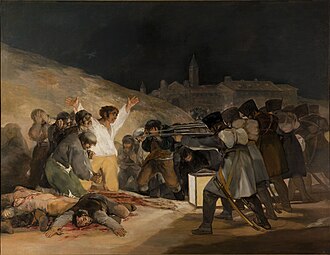 El tres de mayo de 1808 - Francisco Goya (1814)
.jpg) Saturno devorando a su hijo - Francisco Goya (1819)
Saturno devorando a su hijo - Francisco Goya (1819)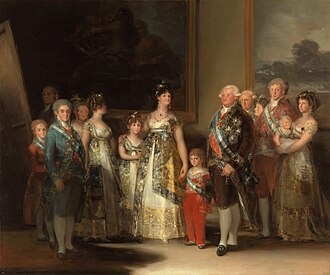 La familia de Carlos IV - Francisco Goya (1800)
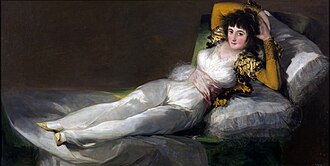 La maja vestida - Francisco Goya (1800)
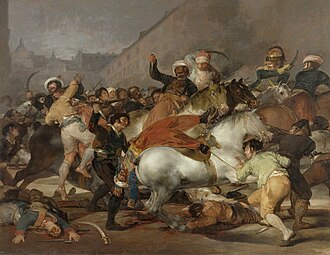 El dos de mayo de 1808 en Madrid - Francisco Goya (1814)
 Perro semihundido - Francisco Goya (1819)
 El aquelarre - Francisco Goya (1820s)
 Retrato de Isabel Porcelana - Francisco Goya (1800s)