La familia de Carlos IV
Francisco Goya · 1800
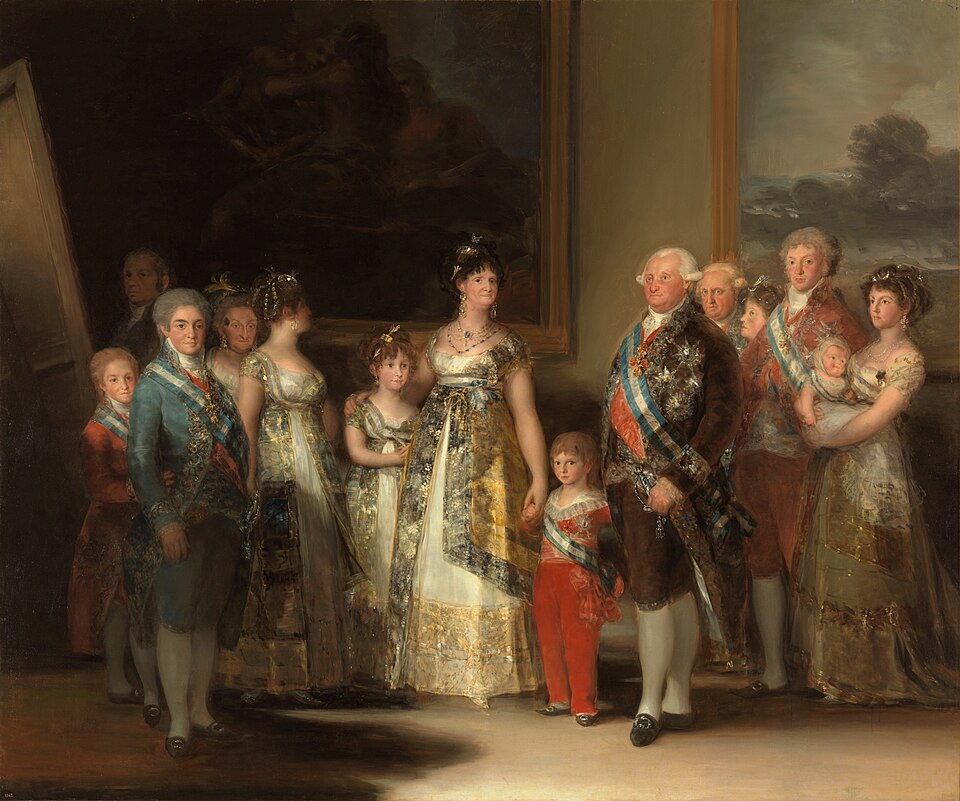
Thirteen royals glitter in silk, sashes and jewels, life-sized and staring straight at you, while in the shadows at the left the painter himself looks out, as if inviting you to judge them.
The story behind the painting
Francisco Goya began this enormous group portrait in 1800, shortly after becoming First Chamber Painter to the Spanish royal family, the highest position open to a Spanish artist and one once held by Diego Velázquez. He completed it in the summer of 1801. These were troubled years: Spain was still living with the aftermath of the French Revolution, and within a few years Napoleon would invade and place his brother Joseph Bonaparte on the Spanish throne in 1808. Goya never explained why he modelled the work on older examples, Louis-Michel van Loo's 1743 portrait of Philip V and his family and Velázquez's Las Meninas, but both echoes are unmistakable.
What to look for
The family seems to be visiting the artist's studio. Look to the far left: in the dim background stands Goya at his easel, glancing out at us, the back of his canvas turned our way just as in Las Meninas. At the centre stands Queen Maria Luisa of Parma, holding the hand of her youngest son, Francisco de Paula, while King Charles IV stands forward at the right. The future Ferdinand VII, in blue, leads the group on the left. Notice the woman whose face is turned away: probably the prince's intended bride, not yet married to him. Silks, jewels and the sashes of the Order of Charles III shimmer everywhere, and the paintings on the wall behind have never been identified.
Meaning and intent
Unlike Velázquez, Goya shows no servants and tells no story: these are simply people posing for a painting, set out on what one scholar described as a stage facing the public. Some viewers have read satire into it; the French writer Théophile Gautier famously likened the family to a grocer who has just won the lottery. The critic Robert Hughes rejected that idea outright, arguing that a court painter who mocked his sitters would not keep his post, and that the portrait is closer to flattery, even making Ferdinand look regal. Others stress its domestic warmth and the queen's central role as matriarch, surrounded by her children.
Legacy
The painting hangs today in the Museo del Prado in Madrid, measuring roughly 280 by 336 centimetres, so its figures meet visitors at life size. It remains one of the most debated royal portraits ever made, precisely because it can be read two ways at once: as dutiful homage or as an unflinching record of a dynasty on the eve of upheaval. Writers have also seen it as a sign of the Romantic age, arguing that where Velázquez bridged art and the visible world, Goya bridged art and the reality of his own mind. Standing before it, each viewer is still asked to decide.
¿Sabías que…?
- Goya completed it in the summer of 1801, a year after becoming First Chamber Painter.
- Goya painted himself into the scene, half-hidden in shadow at the left.
- One woman's face is turned away, possibly because her marriage to the future Ferdinand VII had not yet taken place.
- It hangs in the Museo del Prado, Madrid.
Sobre el artista
Francisco Goya (1746-1828)
mujer · varón · Museo del Prado · niño · niña · retrato grupal · familia
Más obras de Francisco Goya
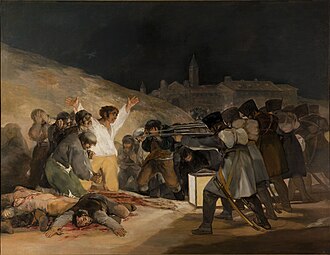 El tres de mayo de 1808 - Francisco Goya (1814)
.jpg) La Maja desnuda - Francisco Goya (1800)
La Maja desnuda - Francisco Goya (1800).jpg) Saturno devorando a su hijo - Francisco Goya (1819)
Saturno devorando a su hijo - Francisco Goya (1819)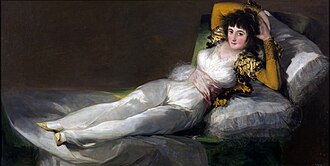 La maja vestida - Francisco Goya (1800)
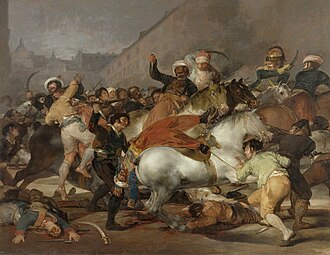 El dos de mayo de 1808 en Madrid - Francisco Goya (1814)
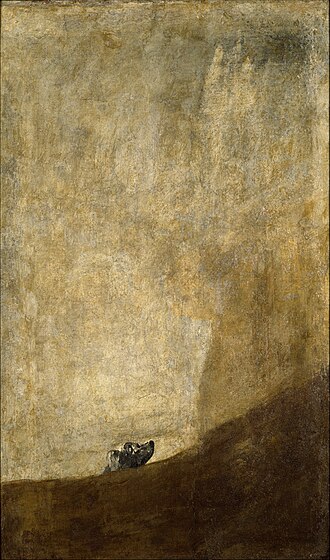 Perro semihundido - Francisco Goya (1819)
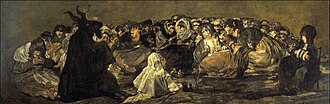 El aquelarre - Francisco Goya (1820s)
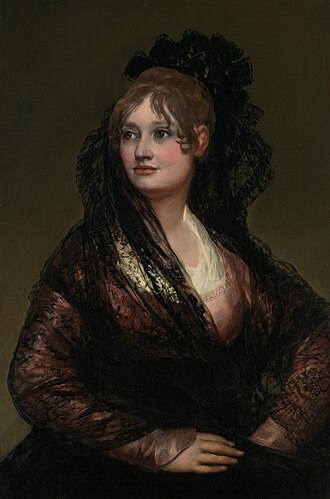 Retrato de Isabel Porcelana - Francisco Goya (1800s)