La Procesión al Calvario
Pieter Bruegel the Elder · 1564
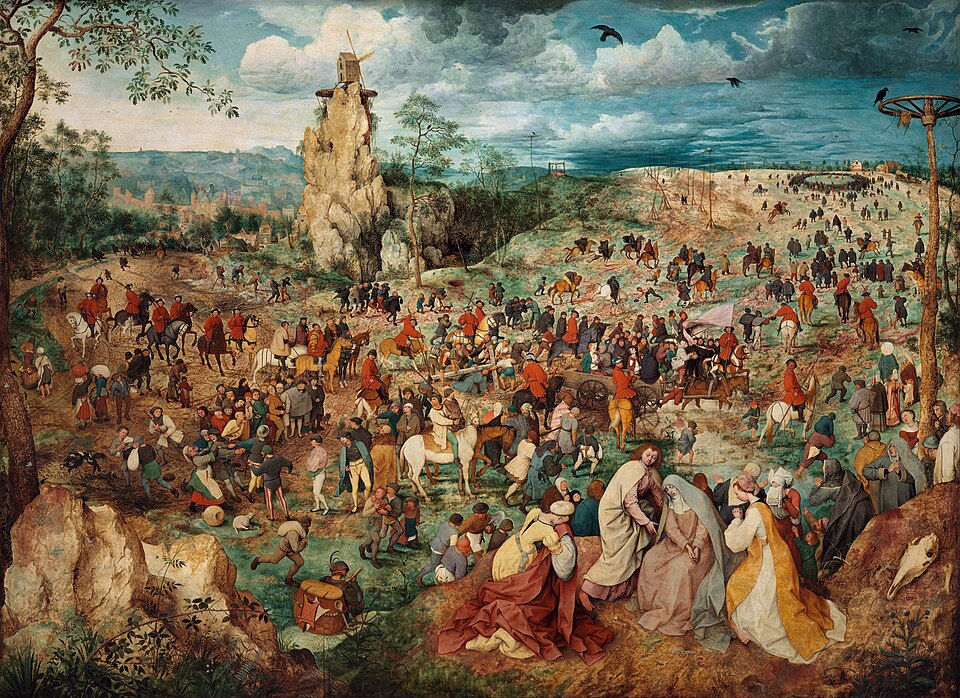
Somewhere in this crowded landscape Christ has fallen under the cross, and almost nobody is looking. Bruegel hid the most solemn moment of the Gospels inside an ordinary day in Flanders, full of gawkers, pedlars and pickpockets.
The story behind the painting
Bruegel painted this oil on panel in 1564, and it is the second-largest painting by him that we know, about 124 by 170 cm. It appears among sixteen Bruegels listed in the 1566 inventory of Nicolaes Jonghelinck, a wealthy Antwerp collector who commissioned Bruegel's series of the months and may have ordered this picture too. That same year Jonghelinck's Bruegels passed to the city of Antwerp. By 1604 the panel was in Prague, in the collection of Emperor Rudolf II, and later moved to Vienna, where it hangs today in the Kunsthistorisches Museum.
What to look for
Start at the bottom right, where the fainting Virgin is held up by Saint John and the other Marys on a small rocky ledge. They are larger than everyone else and play out their own grief, cut off from the action behind them. Then search the crowd for Christ, small and easy to miss. Find the cart carrying the two thieves, both clutching crucifixes as cowled priests hear their last confessions. On the hill of Golgotha two crosses already stand and a hole is being dug for the third. Gallows and wheels dot the landscape, and to the left rises a sheer, almost impossible outcrop of rock.
Meaning and intent
For Bruegel the composition is unusually traditional, perhaps because the subject was so solemn: he followed a scheme used before by the Brunswick Monogrammist and by Pieter Aertsen. Hiding Christ among the crowd was a familiar Mannerist device. Except for Christ, everyone wears sixteenth-century dress, so the scene clearly speaks about Bruegel's own day, when public executions in troubled Flanders drew crowds like a festival. The onlookers show complete indifference to the fear of the condemned men, and Bruegel makes no difference between the two thieves, even though Christ would bless one of them.
Legacy
The painting has travelled with the fortunes of empires. After Prague and Vienna, it was taken to Paris in 1809 as part of Napoleon's war booty and stayed there until 1815, before returning to Vienna. In modern times it inspired an art-historical book by Michael Francis Gibson, The Mill and the Cross, which became a 2011 film of the same name directed by Lech Majewski. The film places the people of the painting in their sixteenth-century Flemish world, with Rutger Hauer as Bruegel, Michael York as the patron Jonghelinck and Charlotte Rampling as the Virgin Mary.
¿Sabías que…?
- Oil on panel, 1564, about 124 x 170 cm.
- Listed in the 1566 inventory of Antwerp collector Nicolaes Jonghelinck.
- Taken to Paris by Napoleon from 1809 to 1815.
- Inspired the 2011 film The Mill and the Cross.
Sobre el artista
Pieter Bruegel the Elder (1525-1569)
arte religioso · varón · Jesús de Nazaret · Museo de Historia del Arte de Viena · Cristo llevando la cruz
Más obras de Pieter Bruegel the Elder
 Cazadores en la nieve - Pieter Bruegel the Elder (1565)
 Los proverbios flamencos - Pieter Bruegel the Elder (1551)
 El triunfo de la muerte - Pieter Bruegel the Elder (1560s)
 La parábola de los ciegos - Pieter Bruegel the Elder (1568)
 La boda campesina - Pieter Bruegel the Elder (1560s)
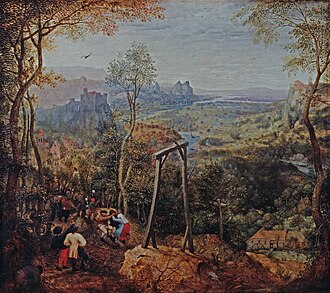 La urraca sobre el cadalso - Pieter Bruegel the Elder (1568)
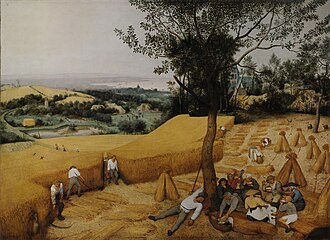 La cosecha - Pieter Bruegel the Elder (1565)
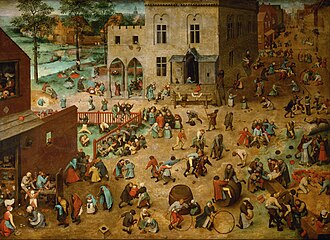 Juego de niños - Pieter Bruegel the Elder (1560)
Obras de artistas relacionados
 Los embajadores - Hans Holbein the Younger (1533)
 El cuerpo de Cristo en la tumba - Hans Holbein the Younger (1520s)
 El jardín de las delicias - Hieronymus Bosch
 La nave de los locos - Hieronymus Bosch (1500s)
 Retrato de Arnolfini y su esposa - Jan van Eyck (1434)
 Políptico de Gante - Jan van Eyck (1432)