El afilador
Francisco Goya · 1808
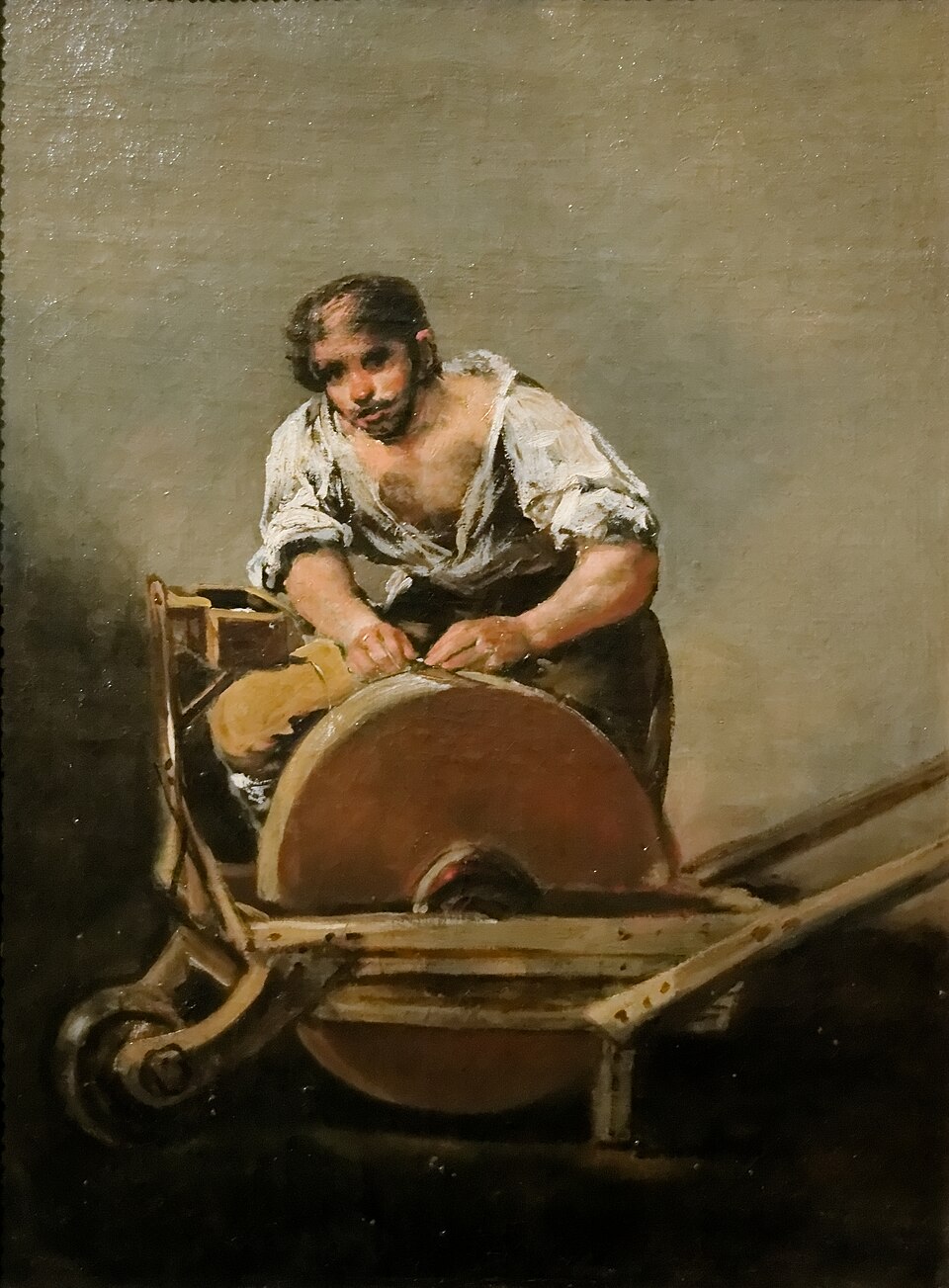
A man in an open white shirt leans into his grinding wheel, a knife held in both hands, and looks up as if caught at work. Goya painted him in the years of the war against Napoleon, and he may be more than a tradesman.
The story behind the painting
Wikipedia dates The Knifegrinder to about 1808 to 1812, while Wikidata gives 1808. The art historian Juliet Wilson-Bareau suggests that Goya painted it, together with The Water Bearer, for his own house in Madrid. It was still with the artist in 1812: when his wife Josefa Bayeu died, an inventory of his paintings was made, and The Knifegrinder was listed under number 13, the same number given to The Water Bearer and The Servant with a Pitcher. It stayed close to him through the hardest years of the Peninsular War.
What to look for
The man works with a knife on the wheel, gripped in both hands, his body leaning slightly forward and his right leg resting on the wooden post. Behind him is a neutral, completely smooth background, so nothing competes with the figure. His white shirt hangs open and rolled up, showing his chest and his arms bare to the elbows. The rest of the picture is ochre, with light touches of red on the sharpening wheel that suggest it is turning. Then notice his eyes: he seems to be looking straight at you, as if you had walked in on him mid-task.
Meaning and intent
During the Spanish War of Independence Goya paid particular attention to ordinary people, at work or not. The Knifegrinder and The Water Carrier can both be read in the context of that war. Here the grinder can be seen as a symbol of resistance, the man who sharpens the knives the guerrillas used against the troops of Napoleon I. Goya treats him the way he treated figures in his religious pictures, with idealization, a monumental presence and lighting that makes him stand out. A humble craft becomes something close to heroic.
Legacy
In this work Goya is seen as a forerunner of a kind of realism that developed a little later in France, in painting that took working people as its subject. According to the art historian Manuela Mena, Goya sold the picture after the Peninsular War directly to Prince Alois Wenzel Kaunitz, the Austrian ambassador to Spain. Soon afterwards it passed to Nicolas Esterhazy. The Hungarian state acquired the Esterhazy collection in 1870, and that collection became the nucleus of the Museum of Fine Arts in Budapest, where the painting hangs today.
¿Sabías que…?
- Painted about 1808 to 1812, during the Spanish War of Independence.
- Still in Goya's possession in 1812, listed as number 13 in his inventory.
- Sold to Prince Kaunitz, then to Nicolas Esterhazy.
- Now in the Museum of Fine Arts, Budapest.
Sobre el artista
Francisco Goya (1746-1828)
Munich Central Collecting Point · Museo de Bellas Artes de Budapest
Más obras de Francisco Goya
 El tres de mayo de 1808 - Francisco Goya (1814)
.jpg) La Maja desnuda - Francisco Goya (1800)
La Maja desnuda - Francisco Goya (1800).jpg) Saturno devorando a su hijo - Francisco Goya (1819)
Saturno devorando a su hijo - Francisco Goya (1819) La familia de Carlos IV - Francisco Goya (1800)
 La maja vestida - Francisco Goya (1800)
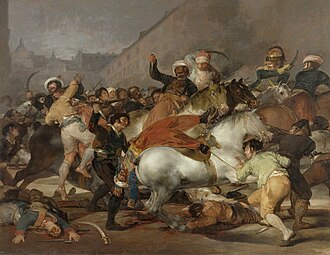 El dos de mayo de 1808 en Madrid - Francisco Goya (1814)
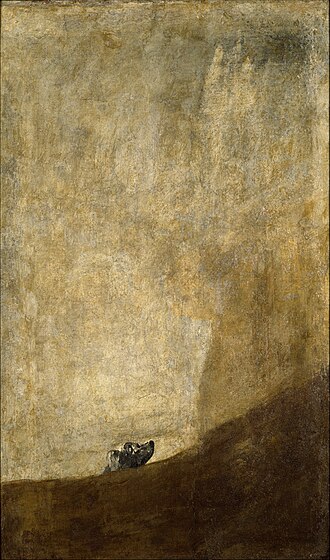 Perro semihundido - Francisco Goya (1819)
 El aquelarre - Francisco Goya (1820s)
Obras de artistas relacionados
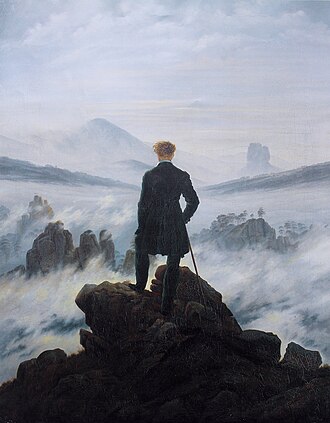 El caminante sobre el mar de nubes - Caspar David Friedrich (c. 1818)
 Abadía en el robledal - Caspar David Friedrich (1800s)
 La Libertad guiando al pueblo - Eugène Delacroix (1830)
 La muerte de Sardanápalo - Eugène Delacroix (1827)
 El Temerario remolcado - J. M. W. Turner (1839)
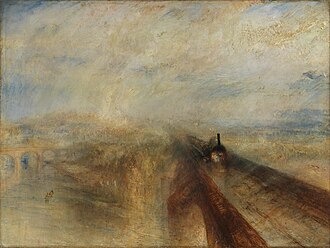 Lluvia, vapor y velocidad. El gran ferrocarril del Oeste - J. M. W. Turner (1844)
.jpg) El joven azul - Thomas Gainsborough (1770)
El joven azul - Thomas Gainsborough (1770).jpg) El Señor y la Señora Andrews - Thomas Gainsborough (1748)
El Señor y la Señora Andrews - Thomas Gainsborough (1748)