La duquesa de Alba
Francisco Goya · 1795
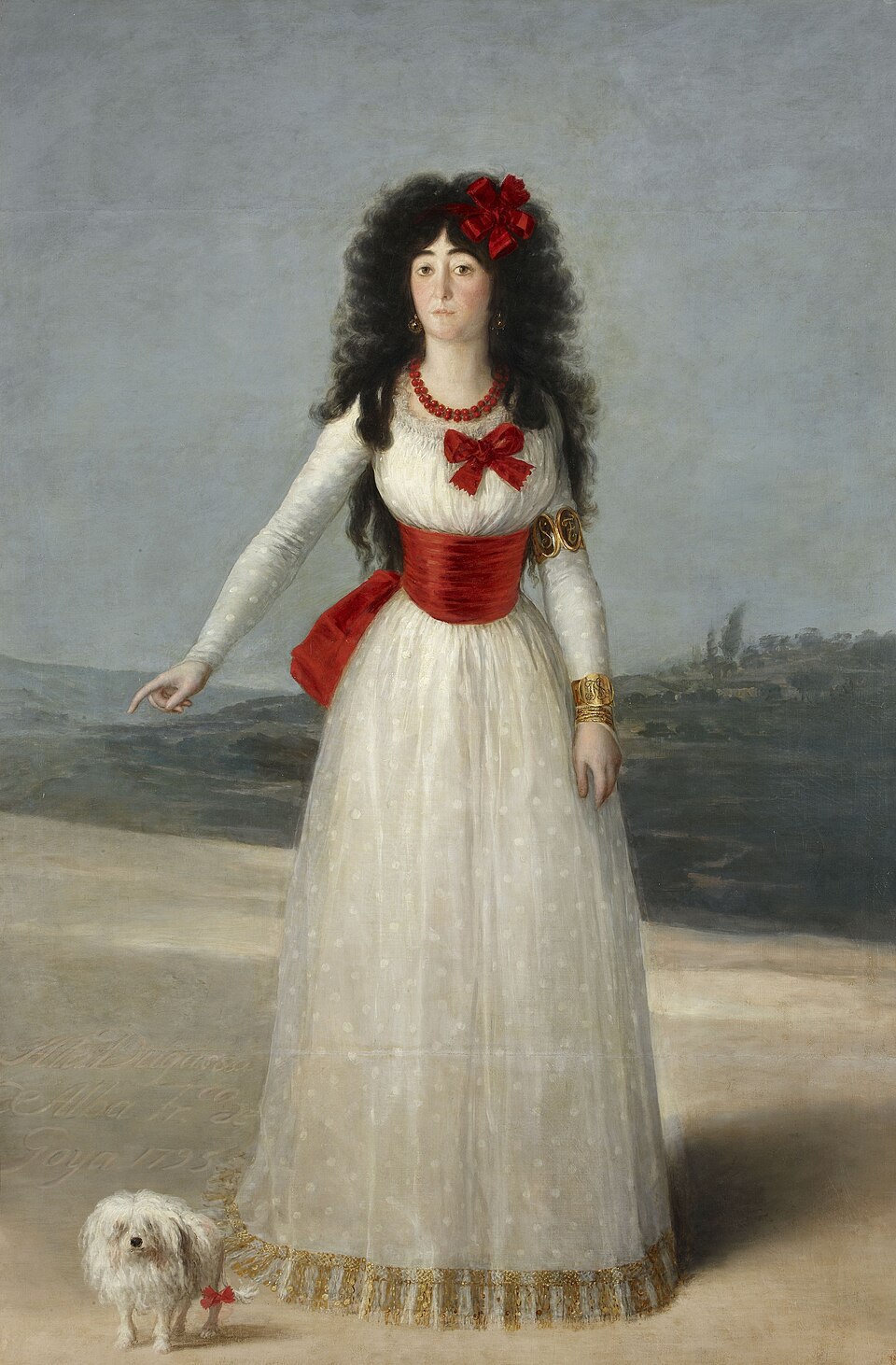
A woman in white muslin stands in an open landscape, a small white dog at her feet, and points at the ground where Goya has written her name and his. This is the White Duchess, painted life-size in 1795.
The story behind the painting
The commission first appears in a letter Goya wrote to his friend Martín Zapater on 2 August 1794, saying he had been asked to paint life-sized portraits of the Duke and Duchess of Alba. The sitter is María Cayetana de Silva, 13th Duchess of Alba. She and her husband, José Álvarez de Toledo, were highly placed, cultivated and well regarded members of the Spanish court of the 1790s. She was 33 at the time, middle aged by the standards of the day, and had recently recovered from a long illness. Goya painted several portraits of her in these years.
What to look for
The picture, about 192 by 128 cm, is built, in Robert Hughes's words, around two themes, red and white, with black in her dark curly hair. Her flowing white dress is French in style, made of muslin hemmed with gold embroidery. Look for the red sash, the red bows on her breast and in her hair, the red necklace and beads, and the white pearl earrings. Gold jewellery circles her left wrist and arm above the elbow. The little bolognese dog beside her wears a red ribbon on a hind leg. With her right index finger she points to an inscription on the ground: A la duquesa de Alba Fr. de Goya 1795.
Meaning and intent
She stands in a dignified pose and looks straight out with a penetrating gaze, shown with affection as a beauty and a woman of wit and education. Placing her outdoors displays her land and her wealth. Because she was so respected and known for a forceful personality, she is thought to have shaped the final image. Her almost Neoclassical dress may reflect English portraits by Gainsborough, Hogarth, Romney and Reynolds, which Goya probably knew from black and white prints. Hughes called the work a portrait fit for semi-public consumption, while Janis Tomlinson doubted the duchess would have accepted an image that so mercilessly emphasised her pride.
Legacy
The painting belongs to the House of Alba and hangs in the Liria Palace in Madrid. It is usually compared with the Black Duchess, painted two years later, just after her husband died aged 39, similar in size but very different in tone. Goya kept that second portrait for at least 15 years. Art historians have wondered about a love affair between painter and sitter, but no evidence survives, and sceptics point out that she was famous, wealthy and independent while Goya was much older and unwell. What is certain is that both full-length portraits mattered deeply to him.
¿Sabías que…?
- Painted in 1795 after a commission mentioned in August 1794.
- Life-size, about 192 by 128 cm.
- The duchess points to the inscription A la duquesa de Alba Fr. de Goya 1795.
- Owned by the House of Alba, Liria Palace, Madrid.
Sobre el artista
Francisco Goya (1746-1828)
retrato · vestido · de pie · 1795-1820 in Western fashion · cabello negro · pulsera · María del Pilar Teresa Cayetana de Silva y Álvarez de Toledo y Silva-Bazán
Más obras de Francisco Goya
 El tres de mayo de 1808 - Francisco Goya (1814)
 La Maja desnuda - Francisco Goya (1800)
 Saturno devorando a su hijo - Francisco Goya (1819)
 La familia de Carlos IV - Francisco Goya (1800)
 La maja vestida - Francisco Goya (1800)
 El dos de mayo de 1808 en Madrid - Francisco Goya (1814)
 Perro semihundido - Francisco Goya (1819)
 El aquelarre - Francisco Goya (1820s)
Obras de artistas relacionados
 El caminante sobre el mar de nubes - Caspar David Friedrich (c. 1818)
 Abadía en el robledal - Caspar David Friedrich (1800s)
 La Libertad guiando al pueblo - Eugène Delacroix (1830)
 La muerte de Sardanápalo - Eugène Delacroix (1827)
 El Temerario remolcado - J. M. W. Turner (1839)
 Lluvia, vapor y velocidad. El gran ferrocarril del Oeste - J. M. W. Turner (1844)
 El joven azul - Thomas Gainsborough (1770)
 El Señor y la Señora Andrews - Thomas Gainsborough (1748)