retrato de Juan Bautista de Muguiro
Francisco Goya · 1827
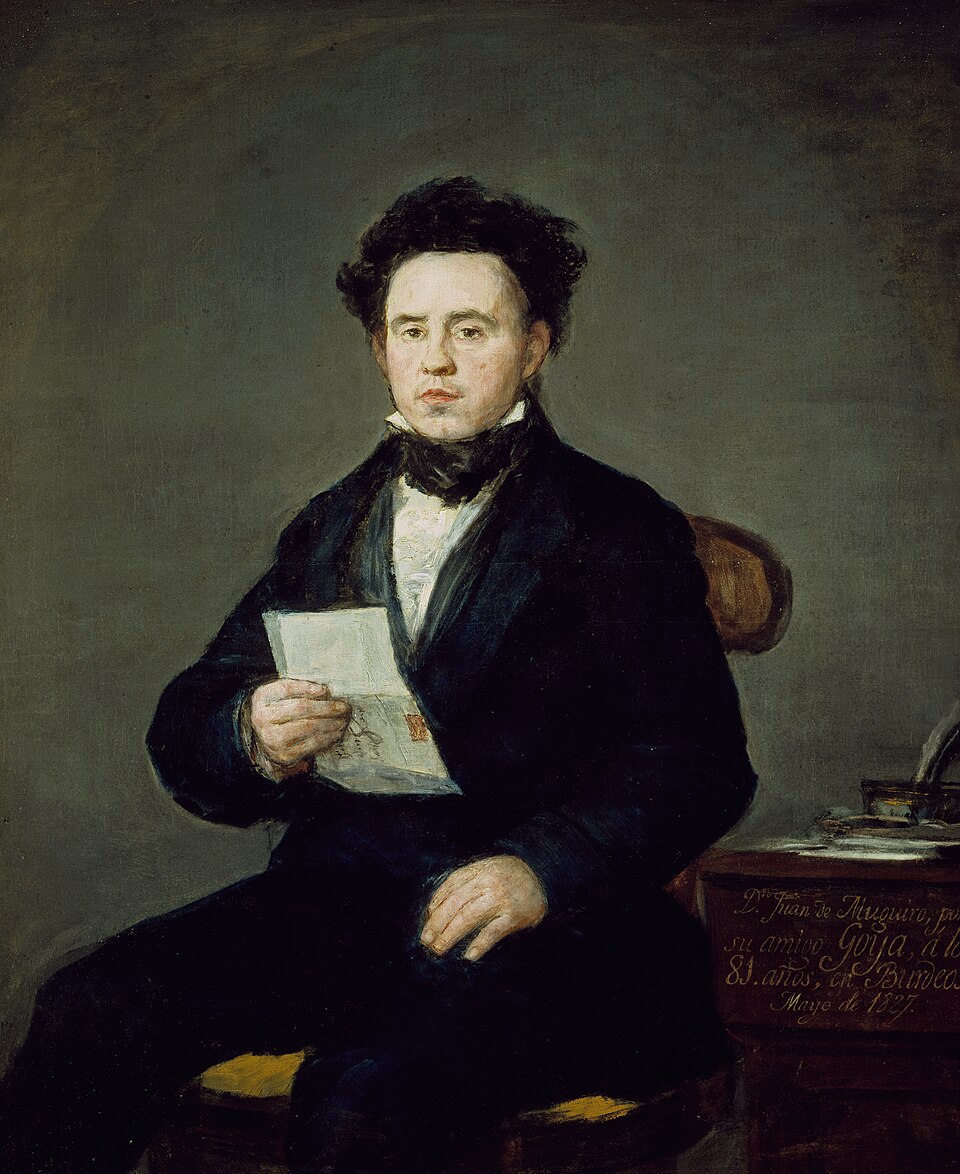
In May 1827, in exile in Bordeaux, an 81-year-old Goya painted a merchant and banker reading a letter. He signed it as a friend. A year later the painter was dead, and this late, spare portrait shows how far his hand had travelled.
The story behind the painting
After Ferdinand VII came to power in Spain and turned against the afrancesados, the liberals and those who had worked with the government of Joseph Bonaparte, Goya chose exile in Bordeaux. He went with his companion Leocadia Zorrilla and her daughter Rosario Weiss, and found his friends Leandro Fernández de Moratín, Manuel Silvela and Antonio de Brugada there. Later Juan Bautista Muguiro, a merchant and banker distantly related to the painter, also went into exile in Bordeaux. He met Goya and commissioned this portrait, painted in May 1827, one year before the painter's death.
What to look for
Muguiro sits on a gilded silk chair in a dark blue suit, reading a letter beside a desk covered with papers and an inkwell. His hair falls loosely, in the Romantic fashion. The bright face seems sculpted by the brush: a square jaw, a firm mouth, a stubborn look, set against a broad, open forehead, and it stands out powerfully from a neutral background. Goya kept to a very small range of colours, black, white and brown, with a few touches of yellow and carmine. The papers and the inkwell are reduced to almost abstract strokes, a few energetic marks from an old man whose eyesight had greatly declined.
Meaning and intent
An inscription on the canvas reads, in translation, Don Juan Muguiro, by his friend Goya, at 81 years, in Bordeaux, May 1827, which is how the work is dated. At the time the Spanish word for friend was a general way to express gratitude, here probably for financial help Muguiro gave the painter and, in any case, his son Javier. Goya leaves out superfluous detail and concentrates on character, so the banker appears hardworking, respectable and austere, full of energy and will. The article sees in this late work an independent, pure and concentrated way of painting, in which the paint itself becomes important.
Legacy
Muguiro also bought Goya's The Milkmaid of Bordeaux from Leocadia Zorrilla in 1830, and both paintings stayed in his family. Juan Bautista Muguiro Beruete, second count of Muguiro and great-nephew of the sitter, left them to the Museo del Prado in his will. The bequest only took effect in 1945, when his brother Fermín, third count of Muguiro, who had the use of both paintings for life, died. The portrait, 103 by 85 cm according to Wikidata, is still in the Prado in Madrid.
¿Sabías que…?
- Painted by Goya in Bordeaux in May 1827, at the age of 81.
- The sitter was a merchant and banker in exile, distantly related to Goya.
- Inscribed as a gift from his friend Goya.
- Bequeathed to the Prado, where it arrived in 1945.
Sobre el artista
Francisco Goya (1746-1828)
Más obras de Francisco Goya
 El tres de mayo de 1808 - Francisco Goya (1814)
 La Maja desnuda - Francisco Goya (1800)
 Saturno devorando a su hijo - Francisco Goya (1819)
 La familia de Carlos IV - Francisco Goya (1800)
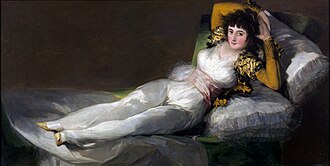 La maja vestida - Francisco Goya (1800)
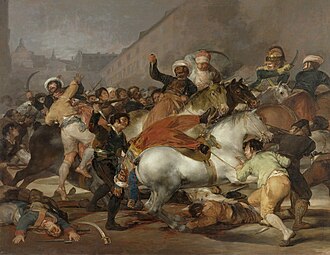 El dos de mayo de 1808 en Madrid - Francisco Goya (1814)
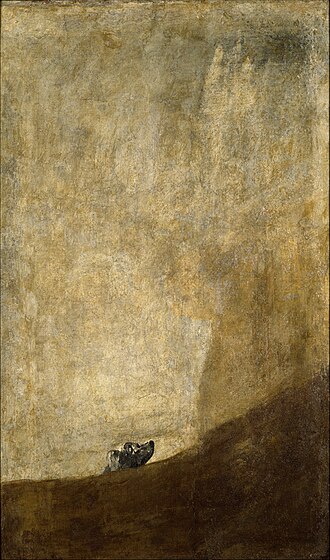 Perro semihundido - Francisco Goya (1819)
 El aquelarre - Francisco Goya (1820s)
Obras de artistas relacionados
 El caminante sobre el mar de nubes - Caspar David Friedrich (c. 1818)
 Abadía en el robledal - Caspar David Friedrich (1800s)
 La Libertad guiando al pueblo - Eugène Delacroix (1830)
 La muerte de Sardanápalo - Eugène Delacroix (1827)
 El Temerario remolcado - J. M. W. Turner (1839)
 Lluvia, vapor y velocidad. El gran ferrocarril del Oeste - J. M. W. Turner (1844)
 El joven azul - Thomas Gainsborough (1770)
 El Señor y la Señora Andrews - Thomas Gainsborough (1748)