Retrato de Asensio Julià
Francisco Goya · 1798
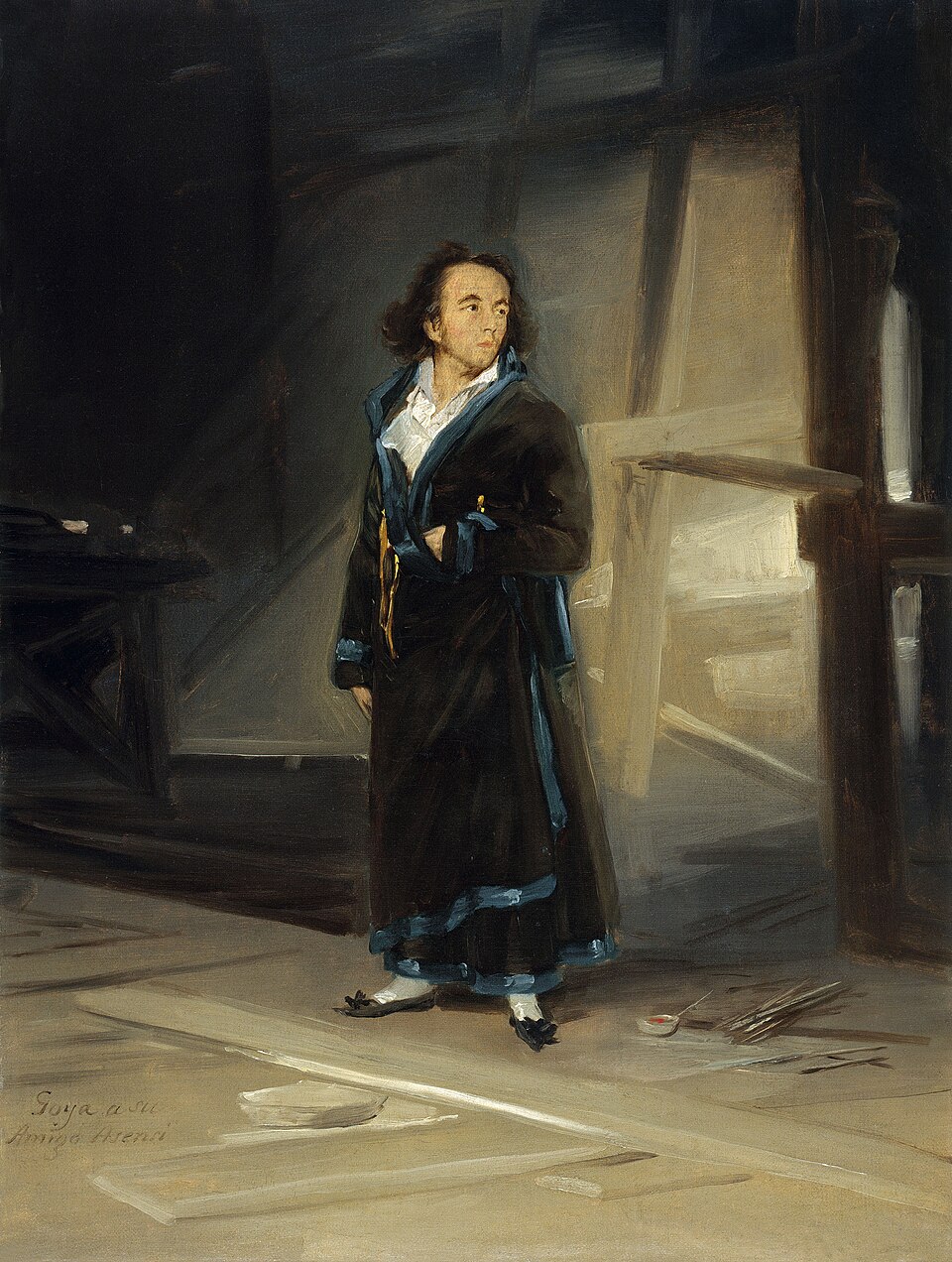
A painter in a work smock stands among scaffolding and beams, brushes scattered at his feet. Goya dashed him off almost like a sketch and wrote across it a dedication to his friend.
The story behind the painting
The picture was probably painted around 1798. Goya inscribed it Goya a su amigo Asensi, Goya to his friend Asensi. That dedication, together with the background, points to the sitter: the Valencian painter Asensio Julià, who lived from 1760 to 1832 and was assisting Goya on the frescoes of the Ermita de San Antonio de la Florida in Madrid when the portrait was made. In the first half of 1798 Goya also painted portraits of Andrés Peral and Gaspar Melchor de Jovellanos. In 1814 he painted his friend again.
What to look for
The canvas is small and upright, 54.5 by 41 cm, in oil. Behind the figure you can see wooden scaffolding and beams, and on the floor lie brushes and other tools of the painter's trade, as if we had walked into the chapel while the work was under way. Julià wears a work smock and stands without any pose of importance. The brushwork is quick and sketchy, and light rather than line shapes the scene.
Meaning and intent
In 1989 the art historian Elsbeth Wiemann stressed the unpretentious bearing of the painter in his smock, which gives the picture a decidedly private character in which Goya openly shows his sympathy for the sitter. Though barely more than a rapid sketch, she wrote, it captivates through a masterly use of means, and its fleeting handling and effects of light give it an almost impressionist note. It is a portrait of a colleague and a friend, painted among the shared work.
Legacy
The painting has travelled far. It was recorded in 1846 at the royal palace of Vista Alegre near Madrid, though the source also says Queen Maria Christina acquired it in 1832. It passed to her daughter the Infanta Luisa Fernanda and the Duke of Montpensier, moved to the San Telmo Palace in Seville, and was later with Paul Durand-Ruel in Paris and New York and with the collector Arthur Sachs. It entered the Thyssen-Bornemisza collection, and since 1992 it has been in the Museo Thyssen-Bornemisza in Madrid.
¿Sabías que…?
- Painted around 1798 and dedicated by Goya to his friend.
- The sitter, Asensio Julià, assisted Goya on the San Antonio de la Florida frescoes.
- Goya painted him again in 1814.
- Held in the Museo Thyssen-Bornemisza, Madrid.
Sobre el artista
Francisco Goya (1746-1828)
retrato · Museo Nacional Thyssen-Bornemisza
Más obras de Francisco Goya
 El tres de mayo de 1808 - Francisco Goya (1814)
 La Maja desnuda - Francisco Goya (1800)
 Saturno devorando a su hijo - Francisco Goya (1819)
 La familia de Carlos IV - Francisco Goya (1800)
 La maja vestida - Francisco Goya (1800)
 El dos de mayo de 1808 en Madrid - Francisco Goya (1814)
 Perro semihundido - Francisco Goya (1819)
 El aquelarre - Francisco Goya (1820s)
Obras de artistas relacionados
 El caminante sobre el mar de nubes - Caspar David Friedrich (c. 1818)
 Abadía en el robledal - Caspar David Friedrich (1800s)
 La Libertad guiando al pueblo - Eugène Delacroix (1830)
 La muerte de Sardanápalo - Eugène Delacroix (1827)
 El Temerario remolcado - J. M. W. Turner (1839)
 Lluvia, vapor y velocidad. El gran ferrocarril del Oeste - J. M. W. Turner (1844)
 El joven azul - Thomas Gainsborough (1770)
 El Señor y la Señora Andrews - Thomas Gainsborough (1748)