Mujeres riendo
Francisco Goya · 1819
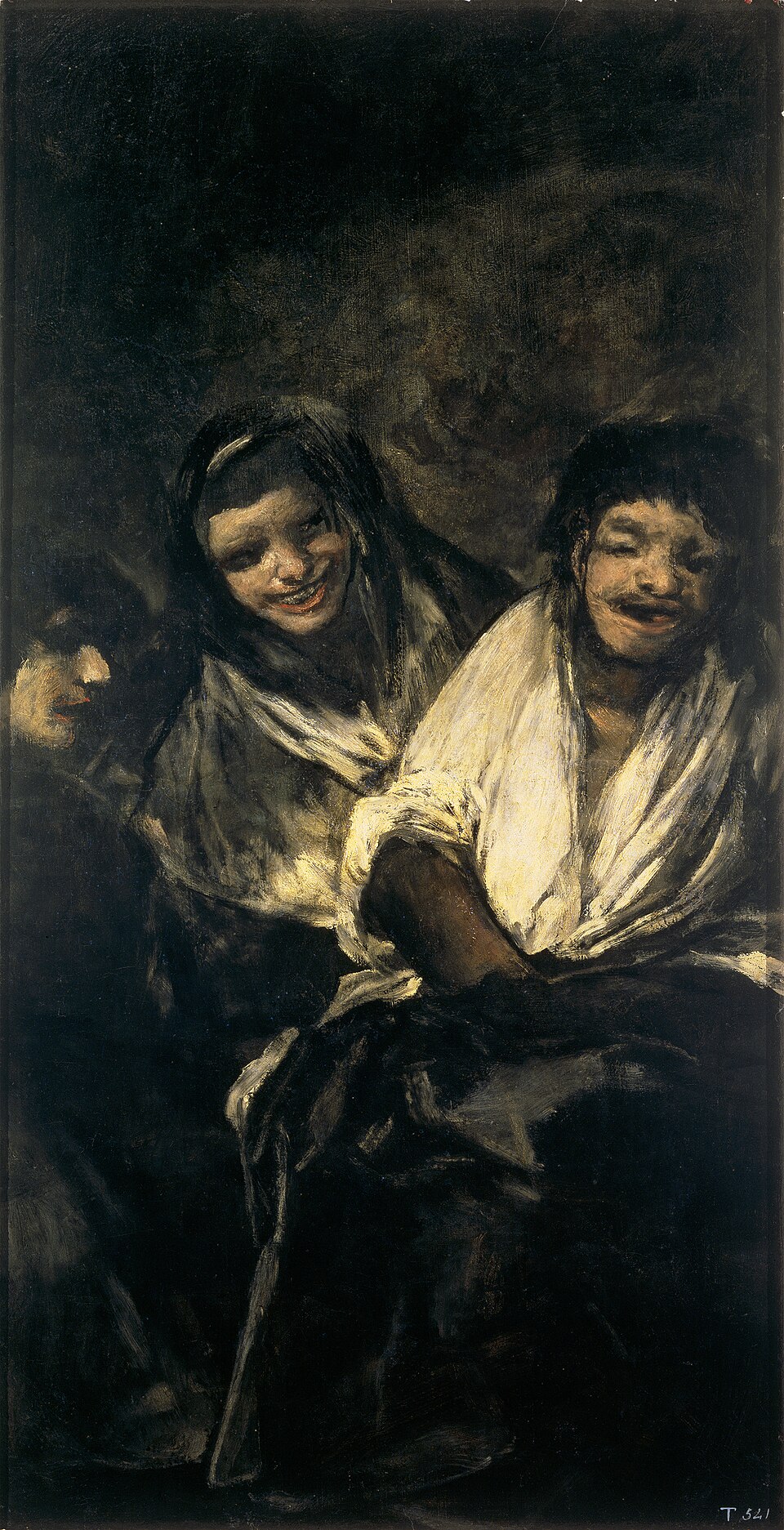
Two women with wide, sinister grins leer at a man with a sickly smile, all three huddled against pure black. Goya painted this on the wall of his own house and never said a word about it.
The story behind the painting
The work is one of Goya's fourteen Black Paintings, painted in oil directly onto the plaster walls of his house, the Quinta del Sordo outside Madrid. Goya was then about 75, living alone in mental and physical despair, and he never meant these works to be seen or spoke or wrote about them. Wikipedia dates the painting probably between 1820 and 1823, while Wikidata gives 1819. It is known by several names: Man Mocked by Two Women, Women Laughing, or Two Women and a Man.
What to look for
Three figures crowd together against a black background, lit from the front left, with no setting or detail around them. The man on the right faces us, his hands at his crotch, and the critic Fred Licht saw sexual compulsion in his grin. The two women, likely prostitutes, mock him with broad smiles. As in the whole series, Goya began with thick black and drew the figures in whites, greys, blues and greens with broad slashing strokes. X-rays show the hand was moved, and an earlier version may have shown the women reading a book on a man's knees. It measures about 125 by 66 cm.
Meaning and intent
Its meaning is very obscure. Some critics think the hidden lower part conceals that the woman on the left is also masturbating, which would make the scene futile and sterile. Licht saw possible self-mockery, comparing the lonely exhibitionist with the artist who also bares himself and is condemned as an aberration. He also noted that Goya, unflinching about humanity, was often reserved in depicting sex. Goya himself left no comment on it.
Legacy
According to the inventory of Goya's friend Antonio Brugada, around 1828 to 1830, the painting faced Men Reading on the smaller walls of the upper floor; both are vertical and smaller than the others. Around 1874, some fifty years after Goya's death, the Black Paintings were taken off the walls and transferred to canvas. They are now in the Museo del Prado in Madrid and count among his most important works.
¿Sabías que…?
- One of the fourteen Black Paintings.
- Painted directly on the walls of the Quinta del Sordo.
- Probably 1820-1823; Wikidata gives 1819.
- Transferred to canvas around 1874, now in the Prado.
Sobre el artista
Francisco Goya (1746-1828)
escena de género · Museo del Prado
Más obras de Francisco Goya
 El tres de mayo de 1808 - Francisco Goya (1814)
 La Maja desnuda - Francisco Goya (1800)
 Saturno devorando a su hijo - Francisco Goya (1819)
 La familia de Carlos IV - Francisco Goya (1800)
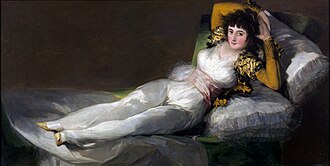 La maja vestida - Francisco Goya (1800)
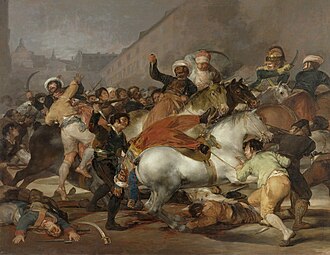 El dos de mayo de 1808 en Madrid - Francisco Goya (1814)
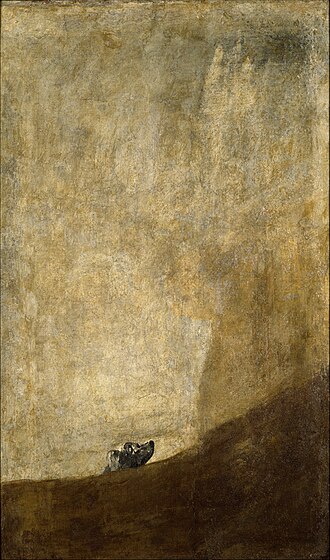 Perro semihundido - Francisco Goya (1819)
 El aquelarre - Francisco Goya (1820s)
Obras de artistas relacionados
 El caminante sobre el mar de nubes - Caspar David Friedrich (c. 1818)
 Abadía en el robledal - Caspar David Friedrich (1800s)
 La Libertad guiando al pueblo - Eugène Delacroix (1830)
 La muerte de Sardanápalo - Eugène Delacroix (1827)
 El Temerario remolcado - J. M. W. Turner (1839)
 Lluvia, vapor y velocidad. El gran ferrocarril del Oeste - J. M. W. Turner (1844)
 El joven azul - Thomas Gainsborough (1770)
 El Señor y la Señora Andrews - Thomas Gainsborough (1748)