Virgen en la Fuente
Jan van Eyck · 1439
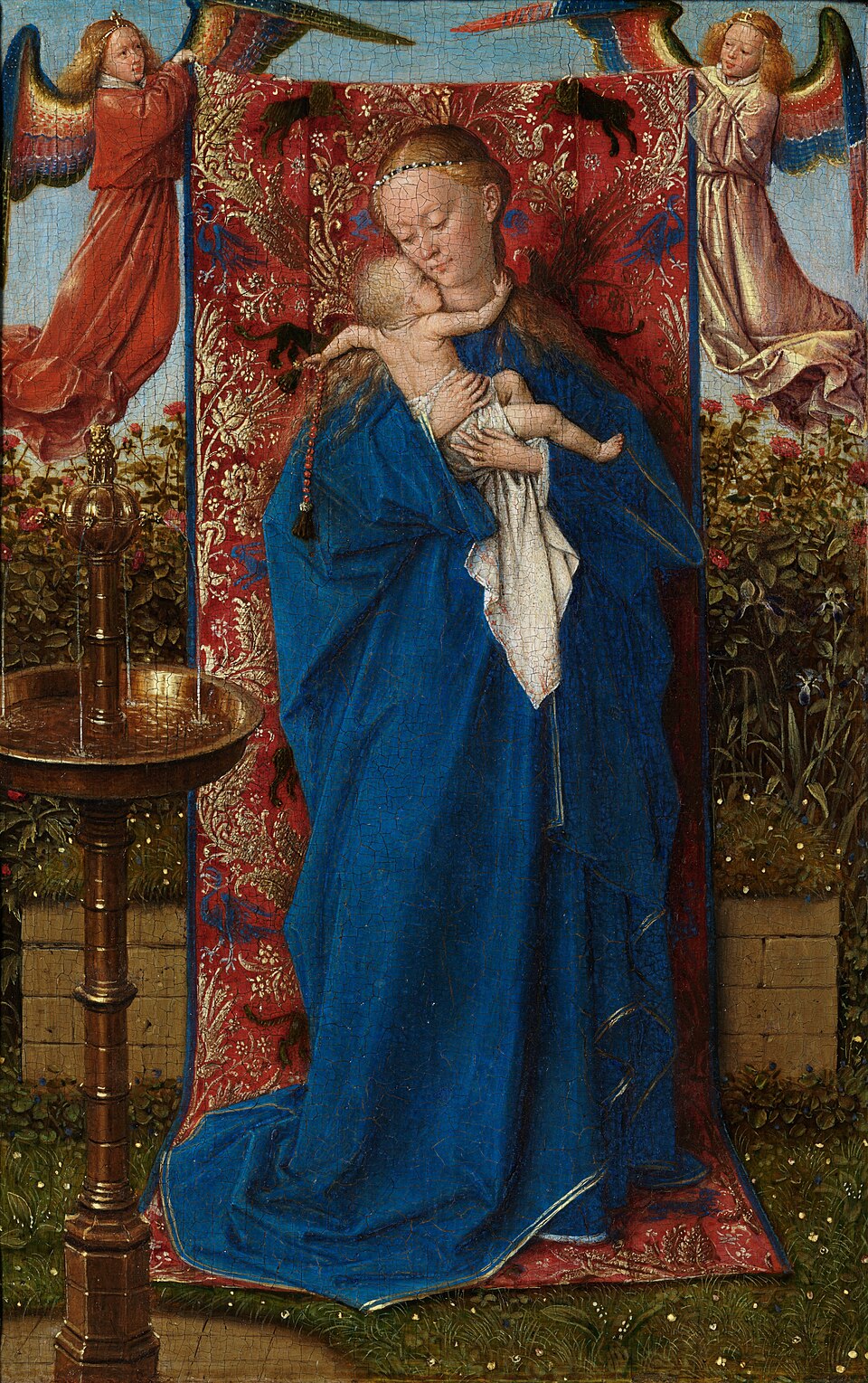
Barely larger than a postcard, this is Jan van Eyck's last signed and dated painting. The Virgin stands in a walled garden, dressed not in his usual red but in blue.
The story behind the painting
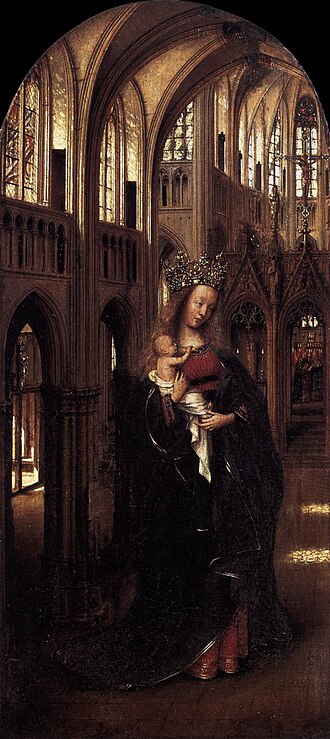
Jan van Eyck painted this oil on panel in 1439, and it is his last signed and dated work. It still has its original frame, inscribed with his motto ALS IXH CAN and the words that John of Eyck made and completed it in 1439. With the Madonna in the Church in Berlin, it is generally thought to be one of his two paintings of the Madonna and Child from the final years before his death in about 1441. Both show a standing Virgin, unlike his earlier treatments of the subject and most other painted Virgins.
What to look for
At 19 by 12 cm, the painting is only a little larger than a postcard. The scene is a hortus conclusus, an enclosed garden, with a fountain representing the fountain of life. The Madonna, dressed in blue, is framed by a richly embroidered cloth of honour held up by two angels. The Christ Child holds prayer beads in his left hand, and a rose bush grows behind the figures. Mother and child touch cheeks while he reaches out a hand, a version of the eleusa type, the Virgin of Tenderness. Her blue is unusual: in other works van Eyck dressed her in red.
Meaning and intent
The beads and the roses together suggest the rosary, which was growing more popular in northern Europe in the 15th century. Netherlandish painters often used red for sacred figures, as cochineal was among the costliest textile dyes, while Italian painters used ultramarine for the Madonna's robes, so van Eyck's blue may show Italian influence. Standing Virgins and the eleusa came from Byzantine icons, which van Eyck absorbed, perhaps on his visit to Italy in 1426 or 1428. The Byzantine flavour may also relate to efforts to reconcile with the Greek Orthodox Church, a cause his patron Philip the Good followed closely.
Legacy
The image was copied many times. A very high-quality copy, given to van Eyck's workshop, was made just after the original and is in a private collection in Maastricht. A workshop drawing by Gerard David from about 1500 to 1510, now in the Kupferstichkabinett in Berlin, served for his own version with four angels and a view of Bruges, now in the Metropolitan Museum of Art. Analysis of its underdrawing shows it was planned as a precise copy, with new elements added during work. The original is in the Royal Museum of Fine Arts in Antwerp.
¿Sabías que…?
- Painted in 1439, van Eyck's last signed and dated work.
- Only 19 x 12 cm, with its original inscribed frame.
- The Virgin wears blue, unusual for van Eyck.
- Kept at the Royal Museum of Fine Arts, Antwerp.
Sobre el artista
Jan van Eyck (1390-1441)
arte religioso · mujer · Virgen María · Niño Jesús · niño · Primitivo flamenco · madre · Museo Real de Bellas Artes de Amberes · Colección de arte flamenco
Más obras de Jan van Eyck
 Retrato de Arnolfini y su esposa - Jan van Eyck (1434)
 Políptico de Gante - Jan van Eyck (1432)
 Virgen del canciller Rolin - Jan van Eyck
 La Virgen en una iglesia - Jan van Eyck (1440)
 Virgen del canónigo Van der Paele - Jan van Eyck (1436)
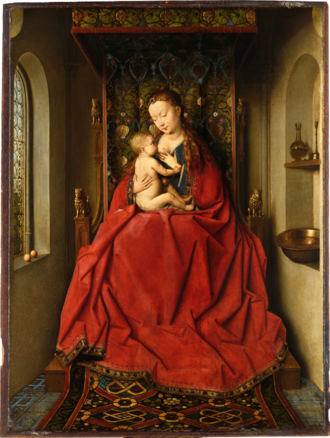 Virgen de Lucca - Jan van Eyck (1437)
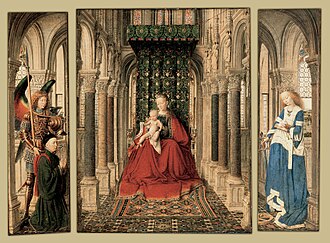 Tríptico de Dresden - Jan van Eyck (1437)
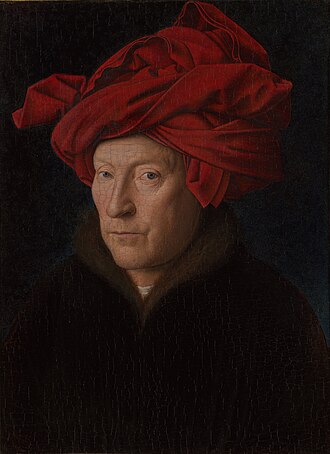 Retrato de hombre con turbante - Jan van Eyck (1433)
Obras de artistas relacionados
 Descendimiento de la cruz - Rogier van der Weyden (1440s)
 Retrato de una dama - Rogier van der Weyden (1460)
 Anunciación - Hans Memling (1480s)
 Escenas de la Pasión de Cristo - Hans Memling (1470)
 El jardín de las delicias - Hieronymus Bosch
 La nave de los locos - Hieronymus Bosch (1500s)
 Cazadores en la nieve - Pieter Bruegel the Elder (1565)
 Los proverbios flamencos - Pieter Bruegel the Elder (1551)