Virgen de Lucca
Jan van Eyck · 1437
.png)
In a narrow room glowing with blue tiles and a red carpet, Mary nurses her child on a throne guarded by four tiny brass lions. Some think she wears the face of van Eyck's own wife.
The story behind the painting
The Lucca Madonna is an oil painting by Jan van Eyck from about 1437, one of his last works. It takes its name from Charles II, Duke of Parma and Lucca, who owned it in the early nineteenth century. Its carpentry suggests it was once the inner panel of a triptych, and its small size, about 65.7 by 49.6 cm, points to private devotion. It is one of six surviving Madonna paintings van Eyck made between completing the Ghent Altarpiece and his death in June 1441. It now belongs to the Städel Museum in Frankfurt.
What to look for
Mary sits on a wooden throne under a canopy, breastfeeding the infant Christ. Look for the four small brass lions on the throne. On the windowsill lie two fruits, either apples or oranges. The window is made of round bullseye glass set in lead, and on the right a shelf holds an empty candlestick and a half-filled glass carafe, with a basin below. Blue and white geometric tiles cover the floor, mostly hidden by a carpet around the throne. The room is unusually narrow for so large a chair, which suggests a small chapel.
Meaning and intent
Every detail carries meaning. The lions recall the throne of Solomon, so the image combines the Nursing Madonna with the Throne of Wisdom: Mary is the throne on which Christ, true wisdom, sits. She is also shown like an altar, supporting the oversized, flattened child on her lap as the altar supports the host at Mass. The white cloth beneath him and the niche resembling a piscina, where a priest washed his hands, strengthen the comparison. The fruits allude to paradise.
Legacy
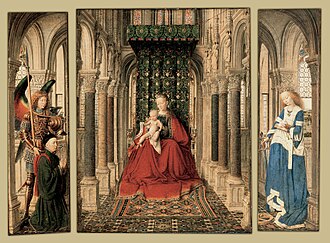
The Virgin has been identified as a portrait of van Eyck's wife Margaretha, whom he also painted in a secular portrait. The source also links it to the Dresden Triptych of 1437, where Mary likewise wears two rings on her left ring finger. Small enough to hold close in prayer, yet dense with symbols, the Lucca Madonna shows the late van Eyck turning a domestic room into a sacred one, and a mother feeding her child into a meditation on wisdom and the Mass.
¿Sabías que…?
- Painted about 1437, one of van Eyck's last works.
- Named after Charles II, Duke of Parma and Lucca.
- Städel Museum, Frankfurt.
- Size: 65.7 x 49.6 cm (Wikidata).
Sobre el artista
Jan van Eyck (1390-1441)
arte religioso · mujer · Virgen María · Niño Jesús · niño · Primitivo flamenco · madre · Virgen con Niño · niño · Museo Städel
Más obras de Jan van Eyck
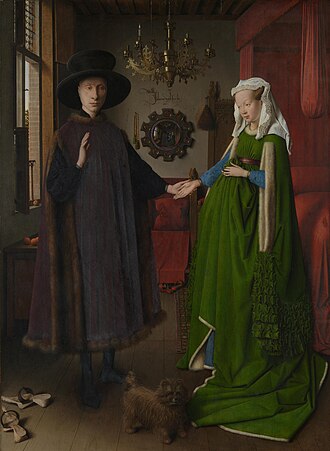 Retrato de Arnolfini y su esposa - Jan van Eyck (1434)
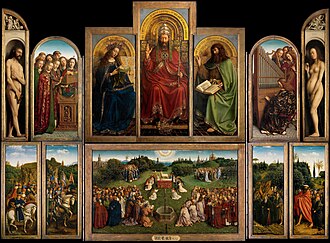 Políptico de Gante - Jan van Eyck (1432)
.webp) Virgen del canciller Rolin - Jan van Eyck
Virgen del canciller Rolin - Jan van Eyck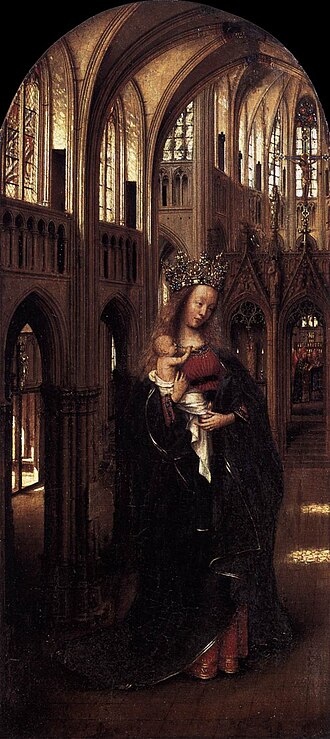 La Virgen en una iglesia - Jan van Eyck (1440)
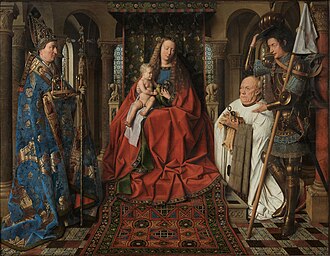 Virgen del canónigo Van der Paele - Jan van Eyck (1436)
 Tríptico de Dresden - Jan van Eyck (1437)
%201433.jpg) Retrato de hombre con turbante - Jan van Eyck (1433)
Retrato de hombre con turbante - Jan van Eyck (1433) Anunciación - Jan van Eyck (1430s)
Obras de artistas relacionados
 El jardín de las delicias - Hieronymus Bosch
 La nave de los locos - Hieronymus Bosch (1500s)
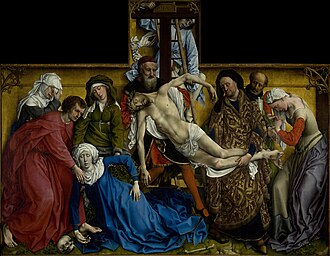 Descendimiento de la cruz - Rogier van der Weyden (1440s)
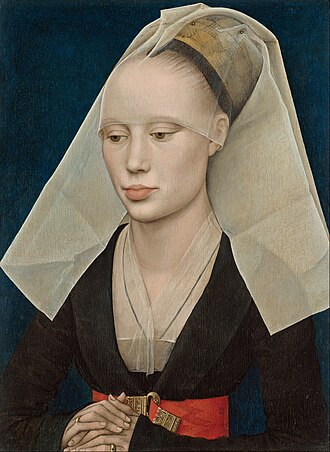 Retrato de una dama - Rogier van der Weyden (1460)
%20-%20Google%20Art%20Project.jpg) Cazadores en la nieve - Pieter Bruegel the Elder (1565)
Cazadores en la nieve - Pieter Bruegel the Elder (1565)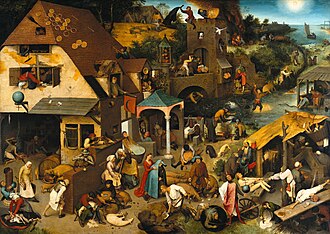 Los proverbios flamencos - Pieter Bruegel the Elder (1551)