Jan van Eyck
1390-1441
Jan van Eyck signed his paintings with a quiet boast, ALS ICH KAN, "as I can". A court painter and secret envoy for the Duke of Burgundy, he pushed oil paint to a new level of truth and changed the course of Northern painting.
Origins
Little is known of Jan van Eyck's early life, and neither the date nor the place of his birth is documented. Surviving records place his birth around 1380 or 1390, and some scholars argue for a date closer to 1380. In the late 16th century he was identified as having been born in Maaseik, in present-day Belgium, and the notes on one of his preparatory drawings are written in the Maasland dialect. He had two brothers who were also painters, Hubert, with whom he probably trained, and Lambert. A sister named Margaret may have existed, though her existence is uncertain. Where Jan was educated is not known, but he knew Latin and used the Greek and Hebrew alphabets in his inscriptions, a level of learning rare among painters of his time.
Life and turning points
The first record of his life comes from The Hague, where between 1422 and 1424 payments were made to "Master Jan the painter", court painter and valet de chambre to John of Bavaria, already with assistants. After John's death in 1425 he entered the service of Philip the Good, Duke of Burgundy, worked in Lille and moved to Bruges in 1429, where he stayed for the rest of his life. A court salary freed him from ordinary commissions. Between 1426 and 1429 he made journeys for the duke described as "secret", and in 1428 he travelled to Portugal to paint Isabella of Portugal so that Philip could see his future bride. Around 1432 he married Margaret, fifteen years younger, and the first of their two children was born in 1434. He died in Bruges on 9 July 1441.
Style and technique
About 20 surviving paintings are confidently attributed to him, all dated between 1432 and 1439, and ten are signed with a variation of his motto ALS ICH KAN, a pun on his name, usually painted in Greek letters. His early work shows the influence of the International Gothic style, which he soon left behind through a greater emphasis on naturalism and realism. He achieved a new level of virtuosity in the use of oil paint, so much that Giorgio Vasari spread the myth that he had invented oil painting, a claim now considered an oversimplification. He painted altarpieces, diptychs, triptychs and commissioned portraits. In his religious works the Virgin Mary is usually the central figure, often seated, crowned and dressed in red, with a playful Christ child gripping the hem of her dress. He showed his sitters as dignified, yet did not hide their imperfections.
Stories and anecdotes
In Portugal the plague kept the royal court on the move, so the Burgundian party met the princess at the out-of-the-way castle of Avis. Van Eyck spent nine months there and returned with Isabella as the duke's bride; the couple married on Christmas Day of 1429. It was a delicate task, since he had to be honest about her appearance while also pleasing the sitter herself. In 1427, on the Feast of St. Luke, he travelled to Tournai for a banquet in his honour, also attended by Robert Campin and Rogier van der Weyden. His motto first appeared in 1433 on Portrait of a Man in a Turban, which can be read as a sign of growing self-confidence. Very little is known about his wife Margaret; even her maiden name is lost.
Legacy
The Ghent Altarpiece, probably begun by his brother Hubert around 1420 and completed by Jan in 1432, was consecrated on 6 May 1432 at Saint Bavo Cathedral. It has been described as "the final conquest of reality in the North". The years 1434 to 1436, which brought the Madonna of Chancellor Rolin and Virgin and Child with Canon van der Paele, are generally seen as his high point. After his death Philip made a payment to his widow equal to the painter's annual salary, and Lambert ran the workshop and had Jan's body placed inside St. Donatian's in Bruges. Unlike many of his peers, his reputation never faded. His style and techniques profoundly altered the development of the Early Netherlandish school, and his small, luminous panels still reward anyone who looks closely.
¿Sabías que…?
- Since 1901 he has often been identified as Hand G, an anonymous illuminator of the Turin-Milan Hours.
- Most of the Turin-Milan Hours were destroyed by fire in 1904.
- His widow Margaret received a modest pension from the city of Bruges.
- In 1449 the Italian humanist Ciriaco de' Pizzicolli named him as a painter of note.
Primitivo flamenco · Renacimiento nórdico
Artistas relacionados
Jerónimo Bosch · Rogier van der Weyden · Pieter Bruegel the Elder
Obras de Jan van Eyck
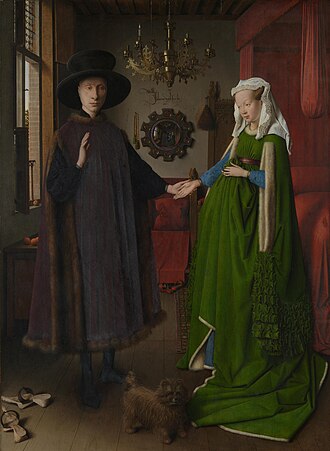 Retrato de Arnolfini y su esposa - Jan van Eyck (1434)
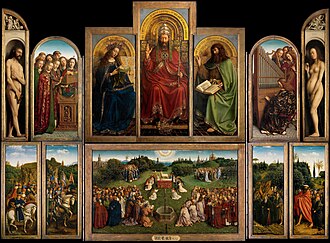 Políptico de Gante - Jan van Eyck (1432)
.webp) Virgen del canciller Rolin - Jan van Eyck
Virgen del canciller Rolin - Jan van Eyck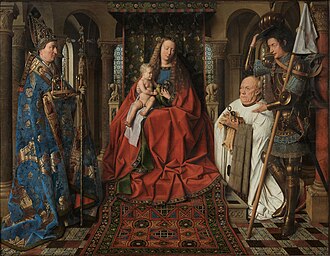 Virgen del canónigo Van der Paele - Jan van Eyck (1436)
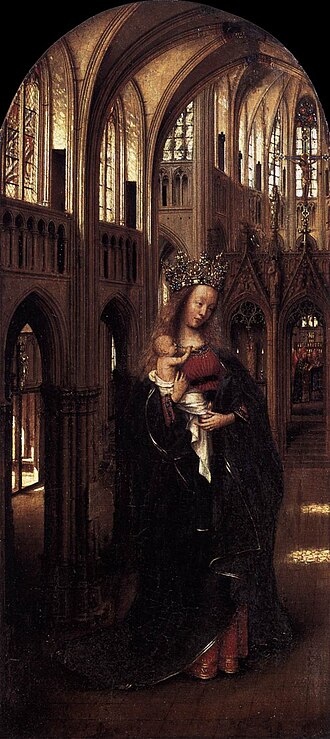 La Virgen en una iglesia - Jan van Eyck (1440)
.png) Virgen de Lucca - Jan van Eyck (1437)
Virgen de Lucca - Jan van Eyck (1437)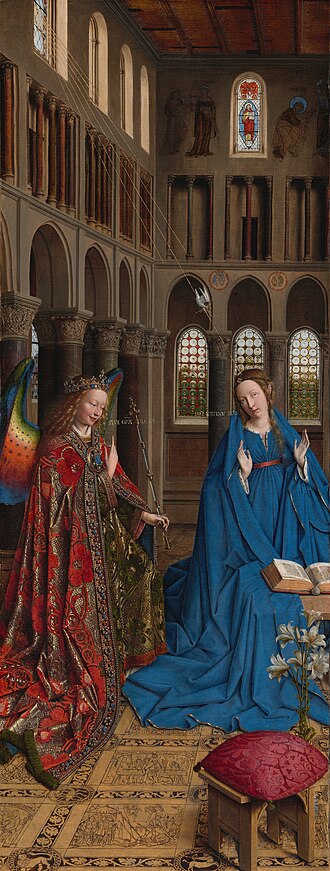 Anunciación - Jan van Eyck (1430s)
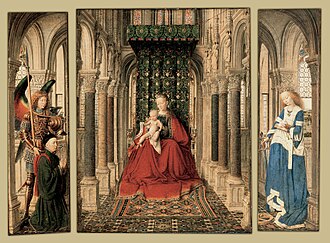 Tríptico de Dresden - Jan van Eyck (1437)
%201433.jpg) Retrato de hombre con turbante - Jan van Eyck (1433)
Retrato de hombre con turbante - Jan van Eyck (1433)%20-%20National%20Gallery%2C%20London.jpg) Léal Souvenir - Jan van Eyck (1432)
Léal Souvenir - Jan van Eyck (1432)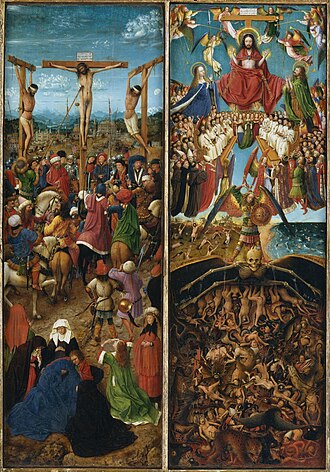 Díptico: La Crucifixión y el Juicio Final - Jan van Eyck (1430s)
.jpg) Retrato de un orfebre - Jan van Eyck (1430s)
Retrato de un orfebre - Jan van Eyck (1430s)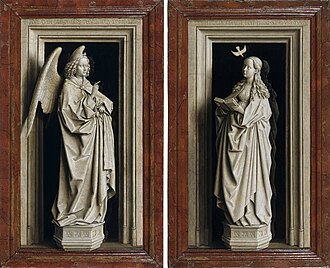 Anunciación - Jan van Eyck (1440)