Dulle Griet
Pieter Bruegel the Elder · 1563
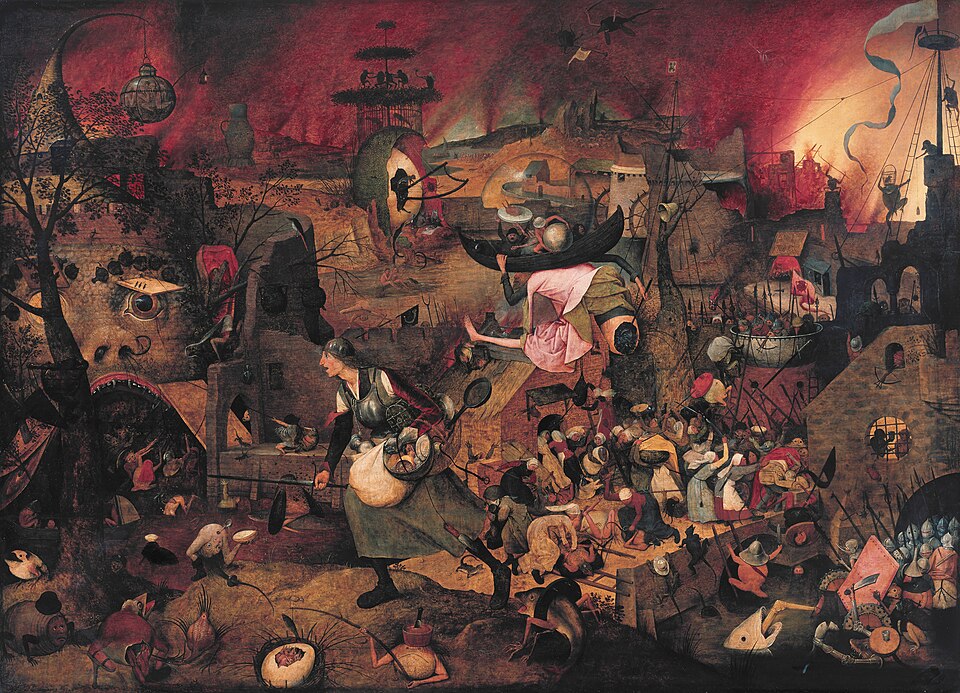
A woman in a breastplate, sword in hand, laden with possessions, strides toward the gaping mouth of Hell. Behind her, an army of women plunders as monsters swarm. Bruegel's Mad Meg is fearless, greedy and unforgettable.
The story behind the painting
Dulle Griet, or Mad Meg, is a figure of Flemish folklore who leads an army of women to pillage Hell. Bruegel painted her in oil on panel. For a long time the signature and date were illegible, and the work was dated to 1561 or 1562 because of its likeness to The Fall of the Rebel Angels and The Triumph of Death. A restoration in 2018 revealed the date 1563, shortly after Bruegel moved to Brussels. Like those pictures it owes much to Hieronymus Bosch, and it may have been meant for a series.
What to look for
Griet advances through a landscape of Boschian monsters that stand for the sins punished in Hell, while her followers loot a house. She wears male armour: a breastplate, a mailed glove and a metal cap, mocked by a helmeted monster beside her pulling up a drawbridge. A knife hangs at her side and she carries a sword. Pigment analysis at Ghent University found that Bruegel painted her robe with cheap smalt rather than costly ultramarine, along with vermilion and copper resinate.
Meaning and intent
Her mission echoes a Flemish proverb: she could plunder in front of Hell and return unscathed. Scholars read it differently. Seidel and Marijnissen see Bruegel mocking noisy, aggressive women and condemning covetousness, since Griet, already laden with possessions, storms Hell for more. Margaret Sullivan notes that in the 16th century dulle meant both mad and foolish, and that Griet was a name for a fool, so the picture allegorises the madness and folly of its age. Others see courage in her, a person entering her own hell and coming back stronger.
Legacy
Bruegel's first biographer, Karel van Mander, described it in 1604 as Dulle Griet looking at the mouth of Hell. The panel, about 117 by 162 cm, entered the collection of Emperor Rudolf II, was looted by Swedish troops in 1648, and reappeared in Stockholm in 1800. In 1897 the collector Fritz Mayer van den Bergh bought it cheaply at an auction in Cologne and only days later realised who had painted it. It is now in the Museum Mayer van den Bergh in Antwerp, and Mad Meg lives on in Caryl Churchill's play Top Girls and in comics.
¿Sabías que…?
- A 2018 restoration revealed the date 1563.
- Looted by Swedish troops in 1648.
- Rediscovered at a Cologne auction in 1897.
- Held by the Museum Mayer van den Bergh, Antwerp.
Sobre el artista
Pieter Bruegel the Elder (1525-1569)
Más obras de Pieter Bruegel the Elder
 Cazadores en la nieve - Pieter Bruegel the Elder (1565)
 Los proverbios flamencos - Pieter Bruegel the Elder (1551)
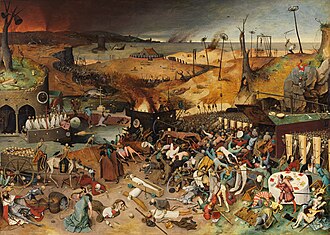 El triunfo de la muerte - Pieter Bruegel the Elder (1560s)
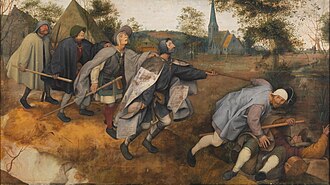 La parábola de los ciegos - Pieter Bruegel the Elder (1568)
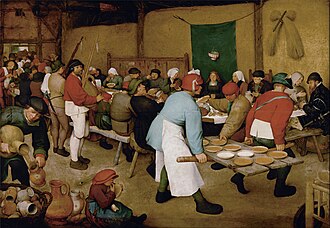 La boda campesina - Pieter Bruegel the Elder (1560s)
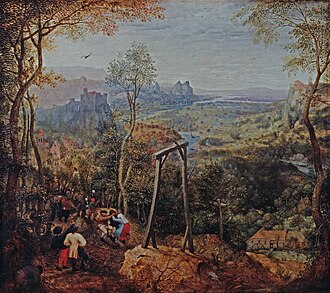 La urraca sobre el cadalso - Pieter Bruegel the Elder (1568)
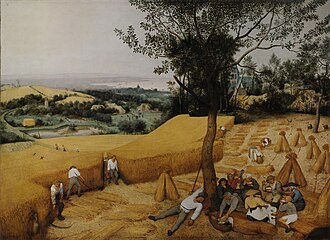 La cosecha - Pieter Bruegel the Elder (1565)
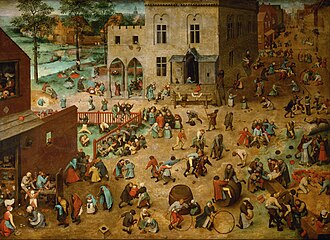 Juego de niños - Pieter Bruegel the Elder (1560)
Obras de artistas relacionados
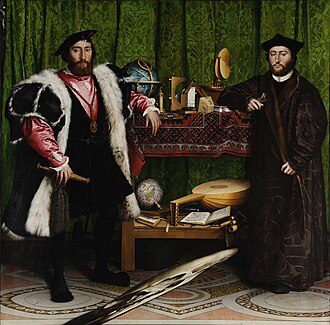 Los embajadores - Hans Holbein the Younger (1533)
 El cuerpo de Cristo en la tumba - Hans Holbein the Younger (1520s)
 El jardín de las delicias - Hieronymus Bosch
 La nave de los locos - Hieronymus Bosch (1500s)
 Retrato de Arnolfini y su esposa - Jan van Eyck (1434)
 Políptico de Gante - Jan van Eyck (1432)