Carlos IV vestido de cazador
Francisco Goya · 1799
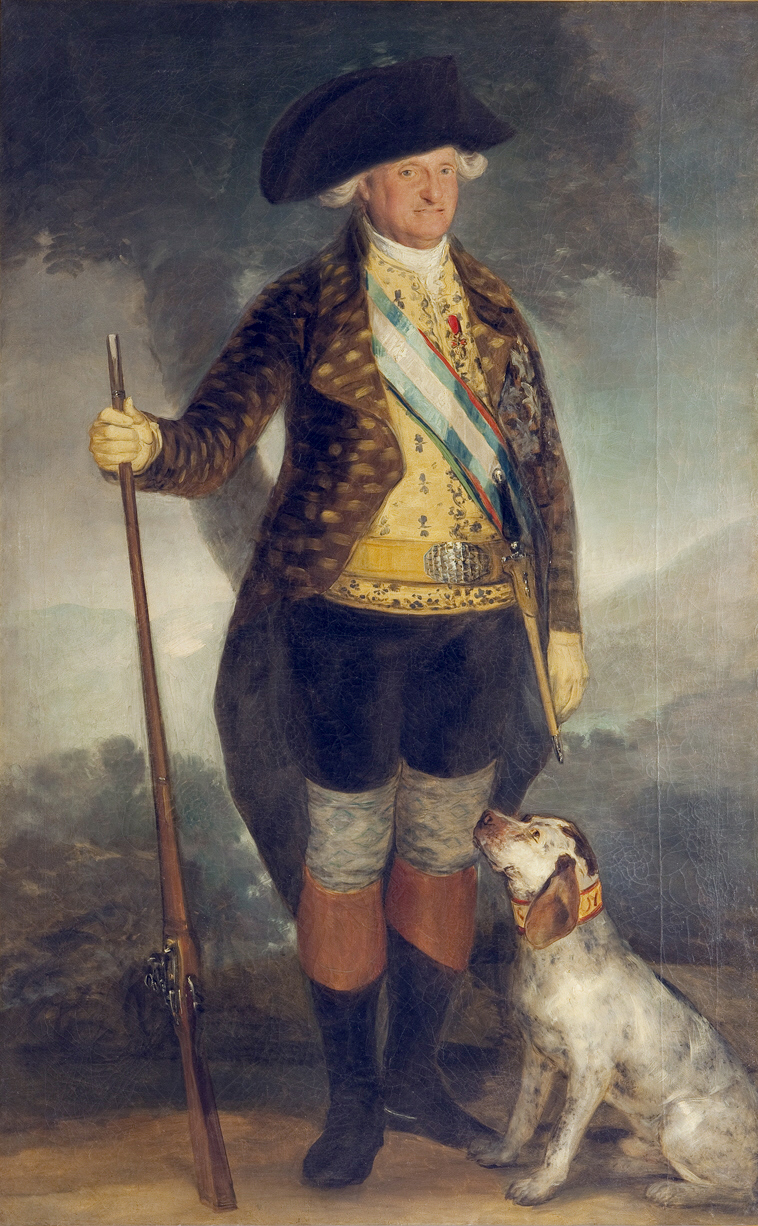
A king in hunting dress, gun in hand, a dog sniffing at him, his gaze unsure. Goya painted Charles IV with care for every sash and fold, and with a quiet honesty about the man inside them.
The story behind the painting
In 1799 Francisco Goya painted this oil on canvas, the second of his two portraits of King Charles IV of Spain. Goya had earlier been court painter to Charles III, the king's father, whom he had painted in 1780 as a young artist. Charles III was widely seen as the more astute political operator. His son, while not lacking intelligence, is broadly seen as an idler, more interested in sport and hunting than in affairs of state, and he was ultimately outmanoeuvred by Napoleon. Goya painted both father and son in hunting dress.
What to look for
The canvas is large, about 210 by 130 cm. Goya gives a great deal of attention to the king's sash and the cloth of his clothes. Then look at the man: a near-portly belly and an indecisive stare. The critic Robert Hughes described a big-nosed face framed in the tricorn hat like the head of an affable turtle poking from its shell. At the king's side a dog sniffs loyally at the royal crotch, a detail Wikipedia reads as a tribute to Titian's Portrait of Charles V with a dog.
Meaning and intent
The outfit was probably inspired by Velázquez's portrait of Philip IV in hunting dress, which Goya, as court painter, had the chance to see; the dog nods to Titian. So the picture places Charles IV in a long line of royal hunting portraits. Yet it also seems to undercut him. Few of Goya's own thoughts survive, but historians generally believe that works such as Charles IV of Spain and His Family show he held his weak king in little regard, painting him portly, slightly confused, more country gentleman than absolute monarch.
Legacy
The painting is part of the Spanish national collection and is now displayed in the Royal Palace of Madrid. It stands alongside Goya's other images of the king as a record of a reign that ended badly, painted by an artist who served the crown while seeing it clearly. The polished surface of sash and cloth, and the uncertain face above them, still invite viewers to decide for themselves how much Goya meant to say.
¿Sabías que…?
- Painted in 1799, Goya's second portrait of Charles IV.
- The dog is a tribute to Titian's Portrait of Charles V.
- The outfit likely echoes Velázquez's Philip IV in hunting dress.
- Displayed in the Royal Palace of Madrid.
Sobre el artista
Francisco Goya (1746-1828)
retrato · varón · 1795-1820 in Western fashion · Palacio Real de Madrid
Más obras de Francisco Goya
 El tres de mayo de 1808 - Francisco Goya (1814)
 La Maja desnuda - Francisco Goya (1800)
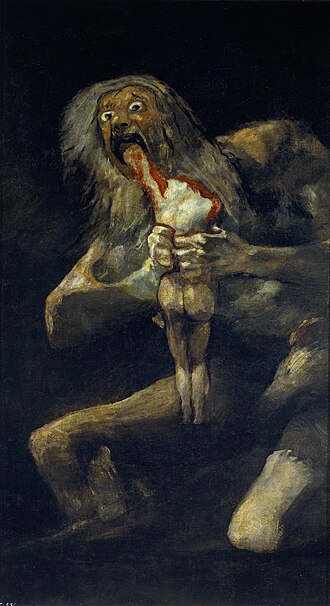 Saturno devorando a su hijo - Francisco Goya (1819)
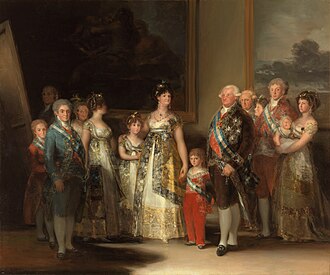 La familia de Carlos IV - Francisco Goya (1800)
 La maja vestida - Francisco Goya (1800)
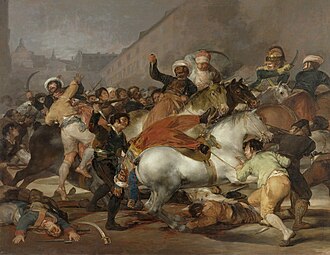 El dos de mayo de 1808 en Madrid - Francisco Goya (1814)
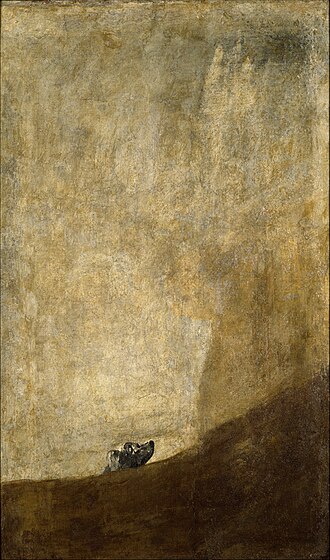 Perro semihundido - Francisco Goya (1819)
 El aquelarre - Francisco Goya (1820s)
Obras de artistas relacionados
 El caminante sobre el mar de nubes - Caspar David Friedrich (c. 1818)
 Abadía en el robledal - Caspar David Friedrich (1800s)
 La Libertad guiando al pueblo - Eugène Delacroix (1830)
 La muerte de Sardanápalo - Eugène Delacroix (1827)
 El Temerario remolcado - J. M. W. Turner (1839)
 Lluvia, vapor y velocidad. El gran ferrocarril del Oeste - J. M. W. Turner (1844)
 El joven azul - Thomas Gainsborough (1770)
 El Señor y la Señora Andrews - Thomas Gainsborough (1748)