Asalto de ladrones
Francisco Goya · 1793
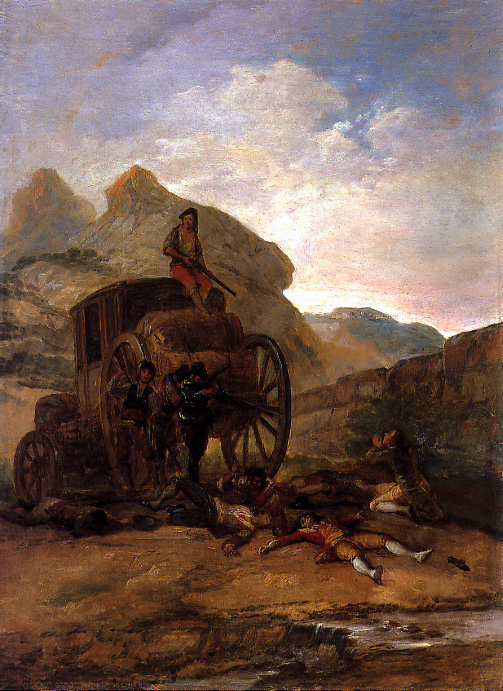
Armed robbers have stopped a coach, bodies lie in the dust, and every rifle points at one survivor begging for his life. Goya painted this small scene on tin plate just after losing his hearing.
The story behind the painting
Assault of Thieves is one of fourteen small oil paintings on tin plate that Goya made in 1793 and 1794. Eight of them deal with bullfighting, six of those set in the ring, and the other six treat varied themes that he himself grouped as national diversions. He painted them shortly after he became deaf in 1792 following an unknown illness, a turning point in his life and work, which from then on took a sharper, more acid tone. Goya sent the series to the Royal Academy of Fine Arts of San Fernando to receive its critique.
What to look for
The picture shows thieves holding up a coach at gunpoint, with several dead lying on the ground in the foreground. Ochre and earth tones dominate. Violent death sits at the very centre, and nothing splits the viewer's attention into separate groups. The point of view is pulled to the foreground, and every gesture concerns the killings: the converging lines of the rifles lead the eye straight to a survivor pleading to be spared. The French Wikipedia gives the size as 42 by 31 cm, while Wikidata gives 50 by 32 cm.
Meaning and intent
The scene is easiest to understand next to Goya's Attack on a Coach of 1787, which treats the same theme. There, the pastel blues and greens of a Rococo landscape dominate and almost hide the violence: the corpse is pushed into the lower left corner, and the main group of robbers is busy inspecting the loot. Here the brutality is no longer softened or set aside. It fills the middle of the picture and confronts the viewer directly, with the begging man as the point where all the lines meet.
Legacy
The Academy's response to the tin plate series was very positive. These small works mark a renewal in Goya's art, above all through a looser, more thickly loaded brushstroke that comes very close to the Caprichos. The French Wikipedia dates the painting to 1793 to 1794 and places it in the Castro Serna Collection in Madrid. Seen this way, a minor genre scene of highway robbery becomes one of the first places where the darker, more direct Goya of later years can already be felt.
¿Sabías que…?
- One of 14 small oils on tin plate painted in 1793-1794.
- Made soon after Goya became deaf in 1792.
- Revisits the theme of his Attack on a Coach of 1787.
- Held in the Castro Serna Collection, Madrid.
Sobre el artista
Francisco Goya (1746-1828)
varón · escena de género · Romanticismo · cadáver · roca · mendigo · arroyo
Más obras de Francisco Goya
 El tres de mayo de 1808 - Francisco Goya (1814)
 La Maja desnuda - Francisco Goya (1800)
 Saturno devorando a su hijo - Francisco Goya (1819)
 La familia de Carlos IV - Francisco Goya (1800)
 La maja vestida - Francisco Goya (1800)
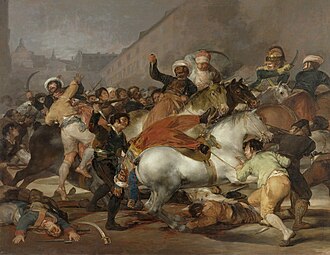 El dos de mayo de 1808 en Madrid - Francisco Goya (1814)
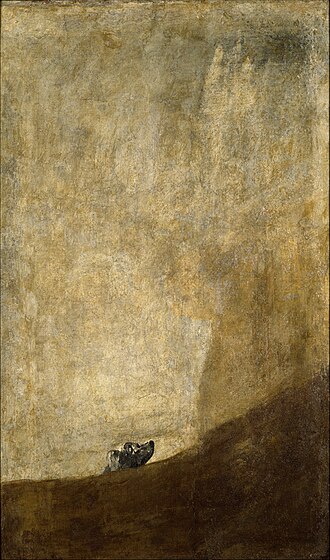 Perro semihundido - Francisco Goya (1819)
 El aquelarre - Francisco Goya (1820s)
Obras de artistas relacionados
 El caminante sobre el mar de nubes - Caspar David Friedrich (c. 1818)
 Abadía en el robledal - Caspar David Friedrich (1800s)
 La Libertad guiando al pueblo - Eugène Delacroix (1830)
 La muerte de Sardanápalo - Eugène Delacroix (1827)
 El Temerario remolcado - J. M. W. Turner (1839)
 Lluvia, vapor y velocidad. El gran ferrocarril del Oeste - J. M. W. Turner (1844)
 El joven azul - Thomas Gainsborough (1770)
 El Señor y la Señora Andrews - Thomas Gainsborough (1748)