La romería de San Isidro
Francisco Goya · 1820s
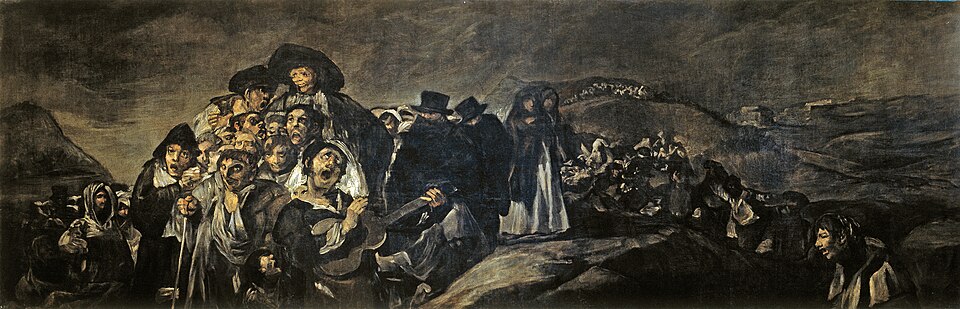
A crowd stumbles through the night, mouths open, faces twisted, singing or moaning. Goya painted this pilgrimage on a wall of his own house, thirty years after he had shown the same festival as a sunny holiday.
The story behind the painting
A Pilgrimage to San Isidro is one of the Black Paintings that Francisco de Goya painted between 1819 and 1823 directly on the walls of the Quinta del Sordo, the House of the Deaf Man, which he bought in 1819. Wikidata dates it to the 1820s. It probably occupied a wall on the first floor, opposite The Great He-Goat. Goya had treated the same subject some thirty years earlier in The Meadow of San Isidro, a picture of Madrid's traditional holiday and a fairly accurate view of the city.
What to look for
This long, low picture, about 138.5 by 436 cm, shows a group of figures in the night, apparently drunk, singing with distorted faces. In the foreground are people of humble origin, while further back top hats and nuns' habits appear. The crowd fades little by little into the distance, and at the edge of the picture the line of the rocks and of the marching multitude coincide. Only one figure on the right shows his face in profile, seeming to moan or sing. The palette is reduced to blacks, ochres, greys and earth tones, laid on with free, energetic strokes.
Meaning and intent
Goya used the procession to bring out theatrical and satirical aspects, as in The Burial of the Sardine. The open space presses the crowd into one compact mass, turning individuals into a formless group. Goya's house stood at roughly the same vantage point from which he had viewed the pilgrims in his earlier tapestry cartoon, so this dark procession may be heading toward the very house, and into his haunted imagination. One writer imagined them coming to serenade the deaf painter, for whom a guitar without strings would make no difference.
Legacy
Like the other Black Paintings, the work was transferred to canvas in 1873 and 1874 under the supervision of Salvador Martinez Cubells, a curator at the Museo del Prado. The owner, Baron Emile d'Erlanger, donated the canvases to the Spanish state in 1881, and they are now displayed at the Prado. The theme of losing one's identity in a crowd has been seen as a forerunner of expressionist painting, particularly the work of James Ensor. The motif of a crowd fading into the distance also returns in Goya's Disasters of War.
¿Sabías que…?
- One of Goya's Black Paintings, painted on the walls of his house in 1819-1823.
- About 138.5 by 436 cm.
- Transferred to canvas in 1873-1874 and donated to Spain in 1881.
- Now in the Museo del Prado, Madrid.
Sobre el artista
Francisco Goya (1746-1828)
escena de género · Museo del Prado · Romanticismo · guitarra
Más obras de Francisco Goya
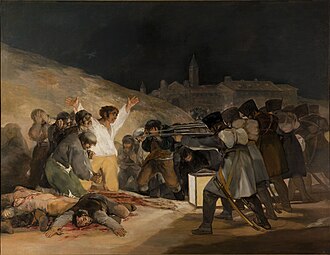 El tres de mayo de 1808 - Francisco Goya (1814)
.jpg) La Maja desnuda - Francisco Goya (1800)
La Maja desnuda - Francisco Goya (1800).jpg) Saturno devorando a su hijo - Francisco Goya (1819)
Saturno devorando a su hijo - Francisco Goya (1819)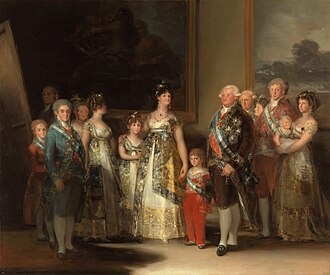 La familia de Carlos IV - Francisco Goya (1800)
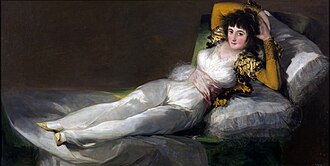 La maja vestida - Francisco Goya (1800)
 El dos de mayo de 1808 en Madrid - Francisco Goya (1814)
 Perro semihundido - Francisco Goya (1819)
 El aquelarre - Francisco Goya (1820s)
Obras de artistas relacionados
 El caminante sobre el mar de nubes - Caspar David Friedrich (c. 1818)
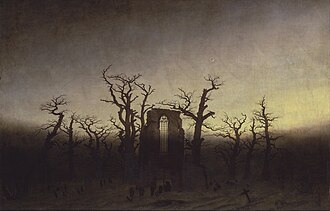 Abadía en el robledal - Caspar David Friedrich (1800s)
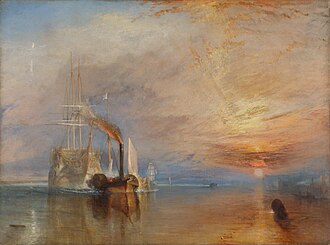 El Temerario remolcado - J. M. W. Turner (1839)
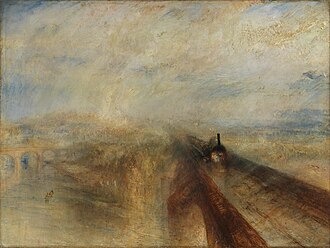 Lluvia, vapor y velocidad. El gran ferrocarril del Oeste - J. M. W. Turner (1844)