Madonna of the Rosary
Caravaggio · 1607
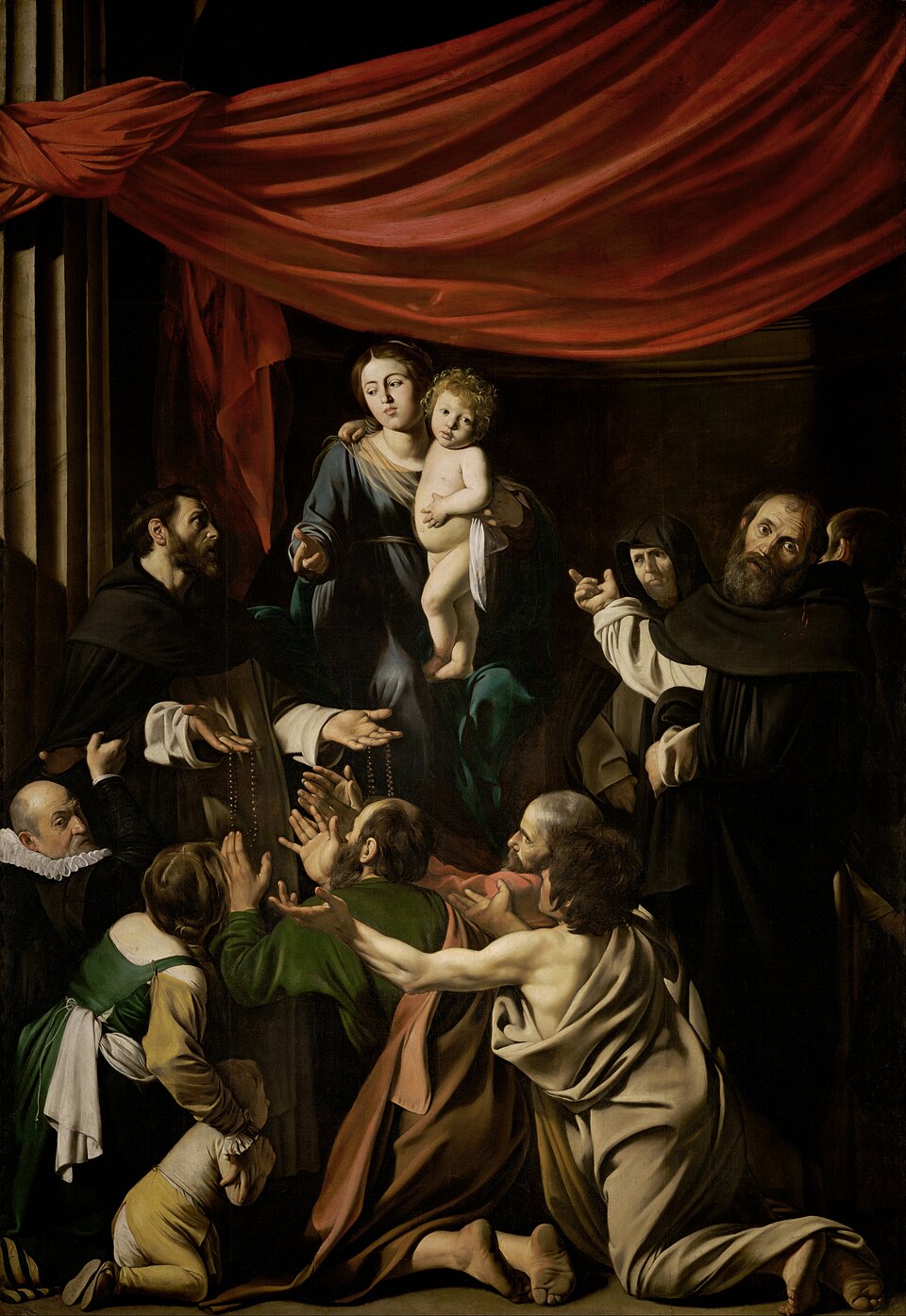
A huge red drape billows like a sail above a crowd of kneeling hands. Caravaggio's only standard Baroque altarpiece left Naples almost as soon as it was finished.
The story behind the painting
Caravaggio finished the Madonna of the Rosary in 1607, probably between 8 January and mid-July, between completing the Seven Works of Mercy and leaving for Malta. Who commissioned it is uncertain. Some say Nicholas Radulovic, a merchant of Ragusa, now Dubrovnik, with an early plan showing Saints Nicholas and Vito. Others, perhaps more likely, link it to Luigi Carafa-Colonna and a family chapel in San Domenico Maggiore in Naples, where the painter had taken refuge after escaping Rome. Cesare d'Este, Duke of Modena, is another possibility. Something may have gone wrong, because by 15 September 1607 the painter Frans Pourbus the Younger reported it on the market in Naples. A Flemish consortium including Rubens bought it, and after being offered to the Duke of Mantua it went to Antwerp.
What to look for
The Madonna sits enthroned with the Christ Child, and with a wave of her hand she seems to give assent to Saint Dominic, who stands in his habit holding a rosary. Below, the faithful reach toward him, kneeling. At far left a man in black with a ruff, the donor, shelters under Dominic's cloak and peers straight out at us. On the right Saint Peter Martyr bears a large scar on his forehead and points toward the Virgin; behind him stand other Dominicans. A great column rises at left, tied to a big red drape that dominates the scene almost like a sail.
Meaning and intent
Saint Dominic and Saint Peter Martyr of Verona signal that the altarpiece was meant for a Dominican church, and the rosary is its heart: grace passes from the Virgin through Dominic to the hands of ordinary believers. The column may refer to the Colonna family. The Feast of the Rosary was established in 1571 after the Battle of Lepanto, and Luigi Carafa-Colonna was related to Marcantonio Colonna, a leading admiral there. Peter Martyr's scar echoes Caravaggio's own, received months earlier in the fight with Ranuccio Tommasoni, as if the painter had slipped a trace of himself into the crowd.
Legacy
Wikipedia calls this the only painting by Caravaggio that could be called a standard Baroque altarpiece. Its journey is part of its legend: painted in Naples, sold almost at once, carried north by a group of Flemish buyers that included Rubens, and offered to the Dominican church in Antwerp. Today, at 364.5 by 249.5 cm, it fills a wall of the Kunsthistorisches Museum in Vienna. Standing before it, you become one more figure in the crowd, and the donor in black still looks back at you from the shadows, as if to ask whether you, too, are waiting for grace.
Did you know?
- Finished in 1607, likely between 8 January and mid-July (Wikipedia)
- Commissioner uncertain: Radulovic, Carafa-Colonna or Cesare d'Este are proposed (Wikipedia)
- Size 364.5 x 249.5 cm, Kunsthistorisches Museum, Vienna (Wikidata)
About the artist
Caravaggio (1571-1610)
woman · religious art · Mary · boy · Christ Child · Kunsthistorisches Museum · mother
More by Caravaggio
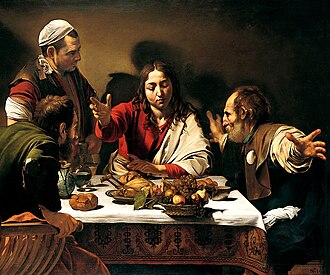 Supper at Emmaus - Caravaggio (1601)
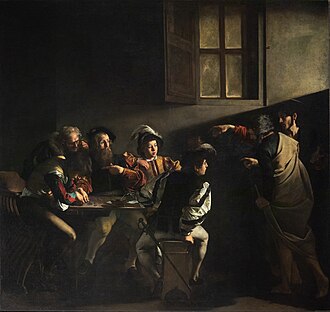 The Calling of Saint Matthew - Caravaggio (1609)
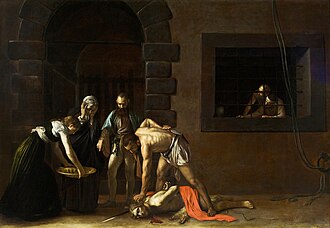 The Beheading of Saint John the Baptist - Caravaggio (1608)
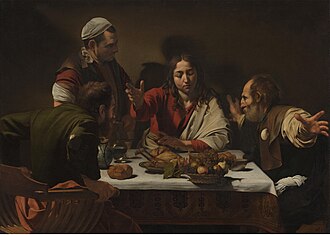 Supper at Emmaus - Caravaggio (1601)
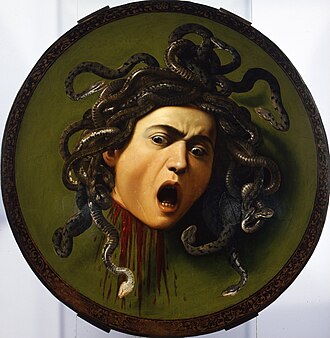 Medusa - Caravaggio (1597)
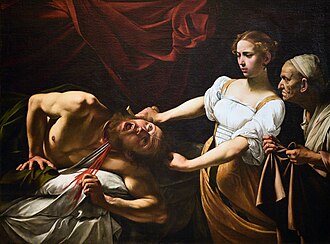 Judith Beheading Holofernes - Caravaggio (1598)
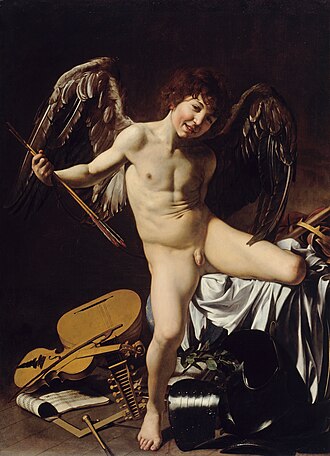 Amor Vincit Omnia - Caravaggio (1600s)
%2C%201595%20circa%2C%20534.jpg) Self-Portrait as Bacchus - Caravaggio (1595)
Self-Portrait as Bacchus - Caravaggio (1595)
Paintings by related artists
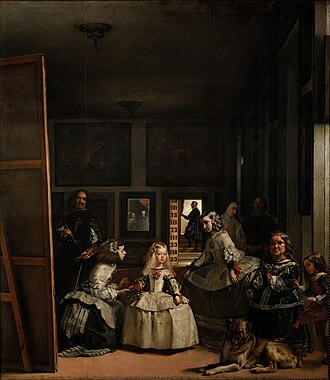 Las Meninas - Diego Velázquez (1656)
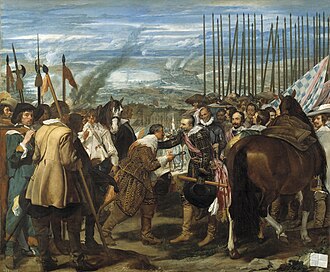 The Surrender of Brea - Diego Velázquez (1635)
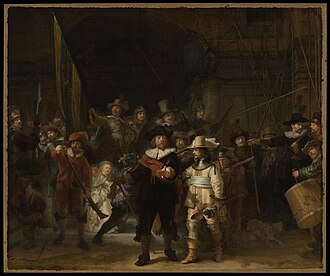 The Night Watch - Rembrandt van Rijn (1642)
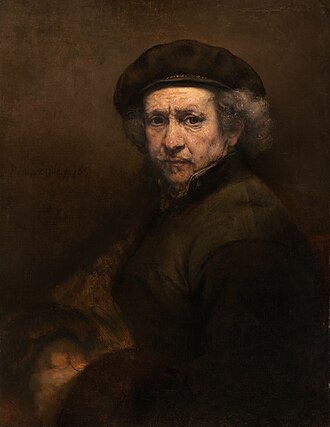 Self-Portrait - Rembrandt van Rijn (1659)
 Girl with a Pearl Earring - Johannes Vermeer (1665)
 The Milkmaid - Johannes Vermeer (c. 1658)