Ecce Homo
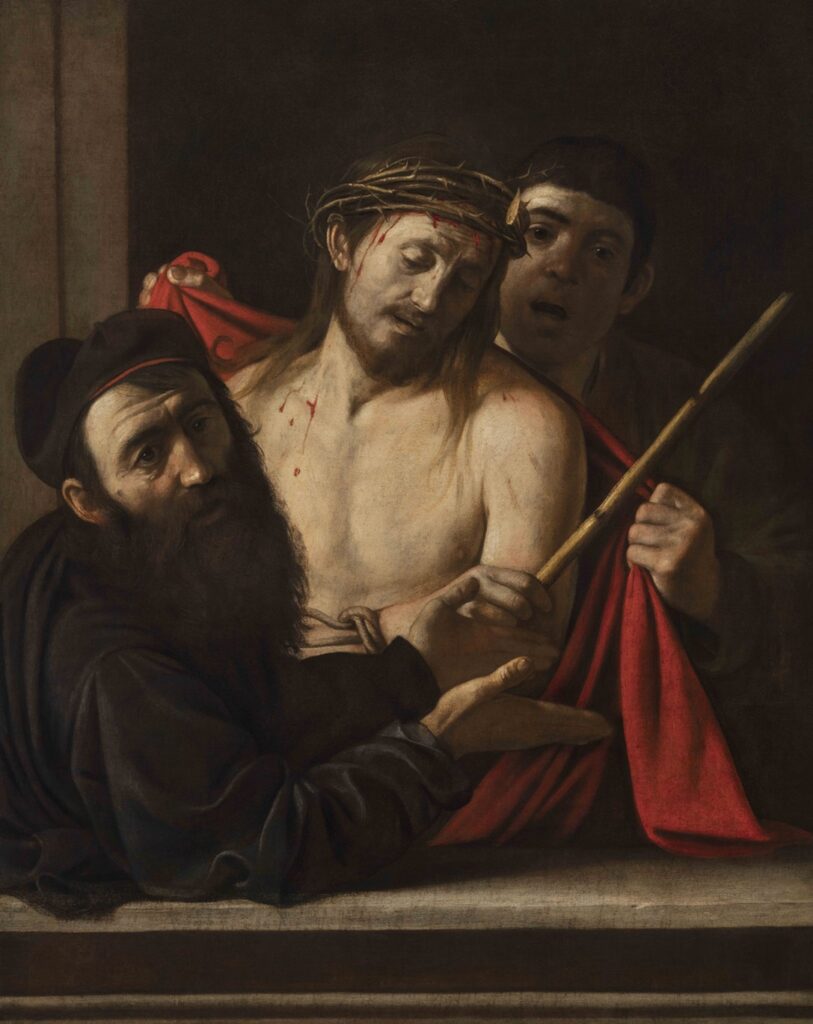
In April 2021 a bleeding Christ in a crown of thorns appeared in a Madrid auction as the work of a minor follower. Experts suspected Caravaggio, the government stopped the sale, and the painting now hangs in the Prado.
The story behind the painting
The painting is believed to date from 1605 to 1609, late in Caravaggio's life; he died in 1610. It was brought from Italy to Spain in the same century and is thought to appear first in 1631 as the property of Juan de Lezcano, secretary to a Spanish viceroy. By 1657 it belonged to the Count of Castrillo. It entered the Spanish royal collection after being given to Philip IV, later belonged to Manuel Godoy, prime minister under Charles IV, and during the Peninsular War passed to the politician Evaristo Pérez de Castro, whose family kept it in Madrid for generations.
What to look for
The scene is the Ecce Homo, the biblical moment when Christ is shown to the crowd before his crucifixion. Christ bleeds and wears a crown of thorns. Pontius Pilate stands in front of him, and behind, another man holds a red robe. The canvas measures about 111 by 86 cm. Maria Cristina Terzaghi pointed to Christ's head and torso and the three-dimensional presence of all three figures, and found the robe's colour close to Caravaggio's Salome with the Head of John the Baptist. Massimo Pulini noted the tilt of Christ's face, the light and the soldier's face, which reminded him of the Young Sick Bacchus.
Meaning and intent
The painting places the viewer almost face to face with suffering: three half-figures pressed close, the wounded Christ between the official who presents him and the man with the robe. Supporters of the attribution read in its brushwork, scale and modelling the hand of Caravaggio. Not everyone agrees. Nicola Spinosa believes it was painted in Caravaggio's style but is not his work, and Camillo Mazitti wrote in Finestre sull'Arte that it lacks Caravaggio's dramatic vigour. That disagreement is part of the picture's story today.
Legacy
In April 2021 the Pérez de Castro family put the painting up for auction as the work of an associate of Jusepe de Ribera, a Spanish painter who imitated Caravaggio. The Spanish government halted the sale after experts warned it might be by Caravaggio himself. On 27 May 2024 the painting went on display at the Museo del Prado in Madrid. Wikidata records no date for it. Its journey from a family collection into a national museum shows how a single attribution can change how a picture is seen.
Did you know?
- Attributed to Caravaggio, about 1605 to 1609.
- Its 2021 auction in Madrid was halted by the Spanish government.
- Some scholars, including Nicola Spinosa, reject the attribution.
- On display at the Museo del Prado since 27 May 2024.
About the artist
Caravaggio (1571-1610)
religious art · Museo del Prado · Jesus Christ
More by Caravaggio
 Supper at Emmaus - Caravaggio (1601)
 The Calling of Saint Matthew - Caravaggio (1609)
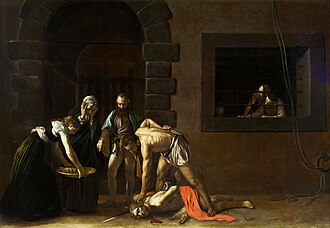 The Beheading of Saint John the Baptist - Caravaggio (1608)
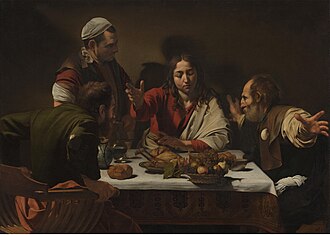 Supper at Emmaus - Caravaggio (1601)
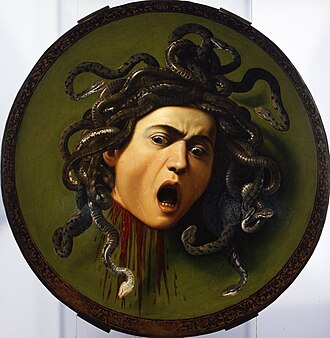 Medusa - Caravaggio (1597)
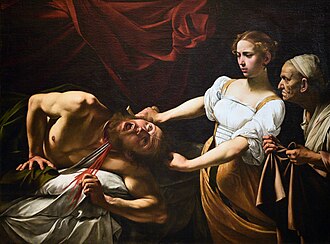 Judith Beheading Holofernes - Caravaggio (1598)
 Amor Vincit Omnia - Caravaggio (1600s)
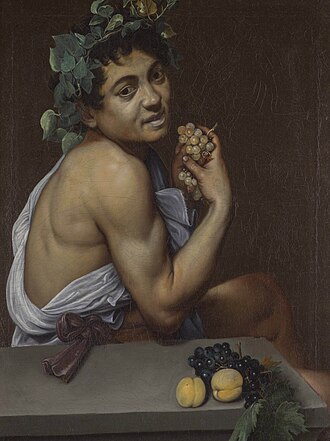 Self-Portrait as Bacchus - Caravaggio (1595)
Paintings by related artists
 Las Meninas - Diego Velázquez (1656)
 The Surrender of Brea - Diego Velázquez (1635)
 Saint Francis in Meditation - Francisco de Zurbarán (1639)
 The Immaculate Conception - Francisco de Zurbarán (1661)
 Charles I in Three Positions - Anthony van Dyck (1635)
 Charles I (1600-1649) with M. de St Antoine - Anthony van Dyck (1636)
 The Elevation of the Cross - Peter Paul Rubens (1609)
 The Rape of the Daughters of Leucippus - Peter Paul Rubens (1618)
 The Night Watch - Rembrandt van Rijn (1642)
 Self-Portrait - Rembrandt van Rijn (1659)
 A Militiaman Holding a Berkemeyer, Known as the ‘Merry Drinker’ - Frans Hals (1620s)
 Laughing Cavalier - Frans Hals (1624)