David with the Head of Goliath
Caravaggio · 1605
.jpg)
A young victor holds up a severed head, yet he does not triumph; he looks almost sorrowful. And the face of the slain giant is Caravaggio's own.
The story behind the painting
This is the version of David with the Head of Goliath in the Galleria Borghese in Rome, recorded in the collection of Cardinal Scipione Borghese by 1650. Its date is debated: scholars have placed it anywhere from 1605 to as late as 1609-1610, with more recent opinion leaning towards the earlier date. According to the biographer Bellori, the cardinal commissioned it from Caravaggio in 1606. A Borghese inventory of 1693 records a 'twin' painting of the same subject in another room, and it has been suggested that the two were worked on a double easel. Caravaggio treated the theme more than once: a panel of about 1607 is in Vienna, and an earlier canvas of about 1600 is in Madrid.
What to look for
The canvas measures about 125 by 101 centimetres. Caravaggio's starting point was a work of around 1510 by a follower of Giorgione, but he sharpens the drama. Instead of resting on a ledge, Goliath's head dangles from David's hand, and blood drips from it. Look at the sword in David's other hand: it carries an abbreviated inscription, H-AS OS. Then look at David's face. He is perturbed, his expression described as mingling sadness and compassion, pensive and resigned rather than jubilant. The sword's angle echoes the diagonal that links his gaze to his victim, binding the two figures together.
Meaning and intent
The inscription has been read as humilitas occidit superbiam, 'humility kills pride'. In the orthodox imagery of the time, David and Goliath could stand for Christ and Satan, the triumph of good over evil. But the painting is also personal. Caravaggio depicted himself as Goliath. David may be modelled on his studio assistant, possibly Cecco del Caravaggio, though no portrait of Cecco survives to confirm it; some scholars see a sexual intimacy implied between the two. Others read it as a double self-portrait, the young Caravaggio holding the head of the older. If it was a gift to Cardinal Borghese, who had the power to pardon Caravaggio for murder, it may also be a plea for mercy.
Legacy
The painting belongs to a contemporary genre in which an artist cast himself as the slain lover of a cold-hearted beloved; Cristofano Allori, in his Judith and Holofernes in the Pitti Palace, painted himself as Holofernes. Caravaggio departed from that convention by showing David not cruel and indifferent but deeply moved by Goliath's death. One commentator has called the work a searing statement of the human condition, distilled from the painter's own experience into sacred imagery. Having passed through the Borghese collection since at least 1650, it remains in Rome today, at the Galleria Borghese.
Did you know?
- Dated between 1605 and 1609-1610; recent scholars favour 1605 (Wikipedia)
- In Cardinal Scipione Borghese's collection by 1650; now Galleria Borghese, Rome (Wikipedia)
- About 125 × 101 cm (Wikidata)
- The sword's inscription H-AS OS is read as 'humility kills pride' (Wikipedia)
About the artist
Caravaggio (1571-1610)
religious art · Italian Baroque painting · self-portrait · Galleria Borghese · Borghese Collection · sword · Caravaggio
More by Caravaggio
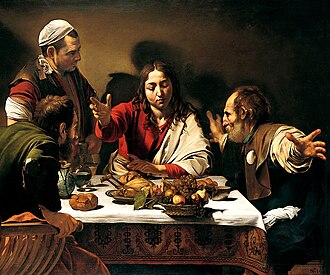 Supper at Emmaus - Caravaggio (1601)
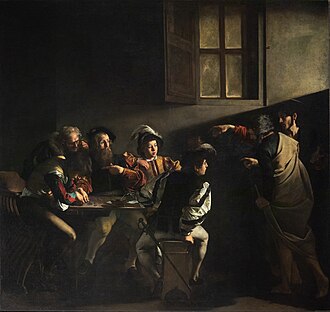 The Calling of Saint Matthew - Caravaggio (1609)
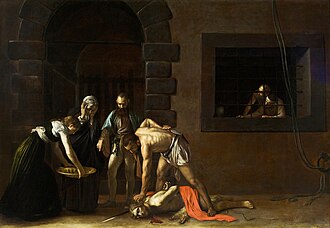 The Beheading of Saint John the Baptist - Caravaggio (1608)
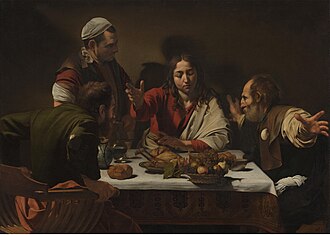 Supper at Emmaus - Caravaggio (1601)
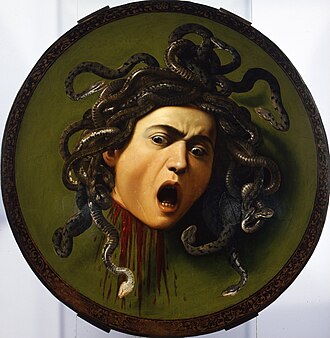 Medusa - Caravaggio (1597)
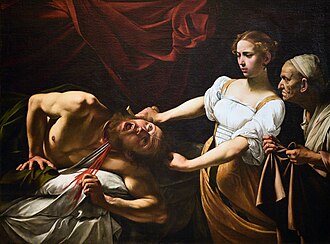 Judith Beheading Holofernes - Caravaggio (1598)
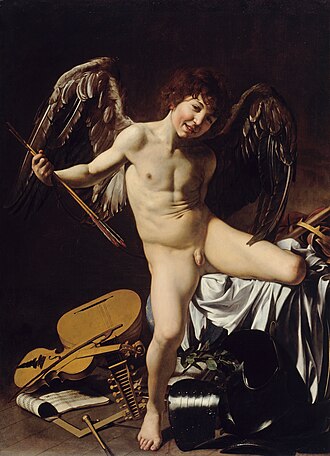 Amor Vincit Omnia - Caravaggio (1600s)
%2C%201595%20circa%2C%20534.jpg) Self-Portrait as Bacchus - Caravaggio (1595)
Self-Portrait as Bacchus - Caravaggio (1595)
Paintings by related artists
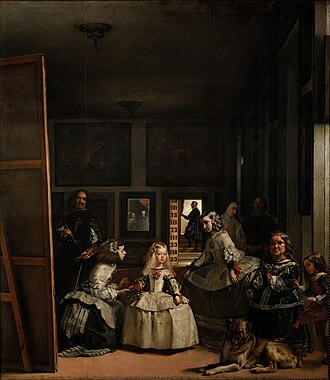 Las Meninas - Diego Velázquez (1656)
 The Surrender of Brea - Diego Velázquez (1635)
 The Night Watch - Rembrandt van Rijn (1642)
 Self-Portrait - Rembrandt van Rijn (1659)
 Girl with a Pearl Earring - Johannes Vermeer (1665)
 The Milkmaid - Johannes Vermeer (c. 1658)