Gustave Caillebotte
1848-1894
Gustave Caillebotte painted Paris from bold, plunging viewpoints and used his fortune to keep his Impressionist friends afloat. Best known for Paris Street; Rainy Day, he waited almost a century to be recognised as a painter in his own right.
Origins
Gustave Caillebotte was born on 19 August 1848 into an upper-class Parisian family living on the rue du Faubourg-Saint-Denis. His father, Martial Caillebotte, had inherited the family's military textile business and was also a judge at the commercial court of the Seine; he had been widowed twice before marrying Céleste Daufresne, Gustave's mother, who had two more sons, René and Martial. Gustave earned a law degree in 1868 and a licence to practise in 1870, and he was also an engineer. Soon after, he was drafted into the Franco-Prussian War and served in the Garde Nationale Mobile de la Seine from July 1870 to March 1871. It was during this service that he began to paint.
Life and turning points
After the war Caillebotte studied seriously in the studio of Léon Bonnat and quickly developed an accomplished style. He entered the École des Beaux-Arts in 1873 but apparently spent little time there. Around 1874 he befriended artists working outside the academy, including Edgar Degas, and he made his debut at the second Impressionist exhibition in 1876 with eight paintings. His father died in 1874 and his mother in 1878, leaving him a fortune. By 1877 he had taken the lead in organising the exhibitions, and he showed in five of the eight. In 1881 he bought a property at Petit-Gennevilliers on the Seine and moved there in 1888. He died there of pulmonary congestion while working in his garden in 1894, aged 45.
Style and technique
Like Millet, Courbet and Degas, Caillebotte aimed to paint reality as he saw it, and he painted in a more realistic manner than many Impressionists. His style varies greatly, sometimes close to Degas's rich-coloured realism, sometimes softer and looser like Renoir and Pissarro. Tilted ground, cropping and a very high vantage point mark much of his work, as in Boulevard Seen from Above; these may owe something to Japanese prints and photography, though evidence that he used photographs is lacking. He painted family interiors, boating at Yerres, still lifes of food and the new streets of Paris. Paris Street; Rainy Day stands out for its flat colours and near photographic effect.
Stories and anecdotes
His earliest masterpiece, The Floor Scrapers of 1875, shows workers preparing a wooden floor, thought to be his own studio. Some critics found it vulgar, and it was probably rejected by the Salon of 1875 because only rustic peasants were thought acceptable working-class subjects. Caillebotte bought his first Monet in 1875, paid at least some of Monet's studio rent, and in 1890 helped Monet persuade the State to buy Manet's Olympia. He also loved stamp collecting, orchid growing and building and racing yachts; his boat Roastbeef won several races. He even appears in Renoir's Luncheon of the Boating Party of 1881.
Legacy
On his death Caillebotte left his collection of his friends' works to the State, and despite fierce controversy it became the central Impressionist collection of the French Republic. Because he never had to sell his own work, his reputation as a patron long overshadowed his painting. His art was largely forgotten until the 1950s, when relatives began selling the family collection. In 1964 the Art Institute of Chicago acquired Paris Street; Rainy Day, and in 1994 his first comprehensive international retrospective opened in Paris. In 2022 France declared Boating Party a national treasure, and in 2024 the Musée d'Orsay celebrated it with a national tour and a major exhibition.
Did you know?
- He submitted 35 paintings and pastels to the fourth Impressionist exhibition in 1879.
- He left a sizeable annuity to Charlotte Berthier, with whom he appears to have had a serious relationship.
- He is buried at Père Lachaise Cemetery in Paris.
- Of his paintings, 100 show only men and 32 only women, an emphasis unique among his French contemporaries.
Related artists
Claude Monet · Édouard Manet · Pierre-Auguste Renoir · Edgar Degas · Camille Pissarro · Joaquín Sorolla · Vincent van Gogh · J. M. W. Turner
Paintings by Gustave Caillebotte
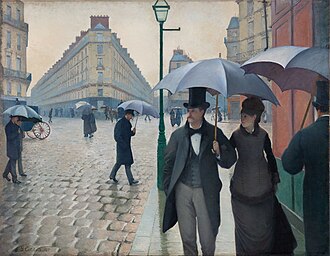 Paris Street; Rainy Day - Gustave Caillebotte (1877)
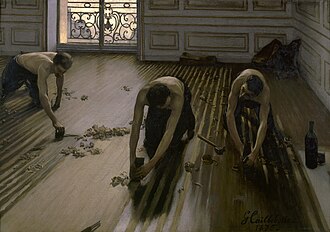 Les raboteurs de parquet - Gustave Caillebotte (1875)
%20-%20Google%20Art%20Project.jpg) Vue de toits - Gustave Caillebotte (1878)
Vue de toits - Gustave Caillebotte (1878)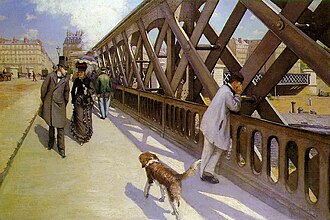 Le Pont de l'Europe - Gustave Caillebotte (1876)
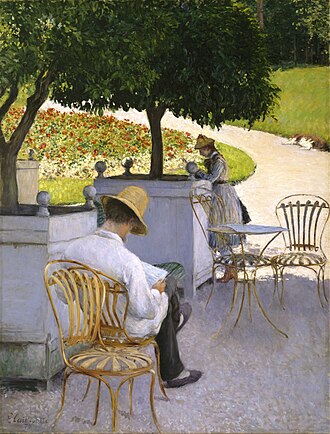 Les orangers - Gustave Caillebotte (1878)
.jpg) Young Man at His Window - Gustave Caillebotte (1876)
Young Man at His Window - Gustave Caillebotte (1876)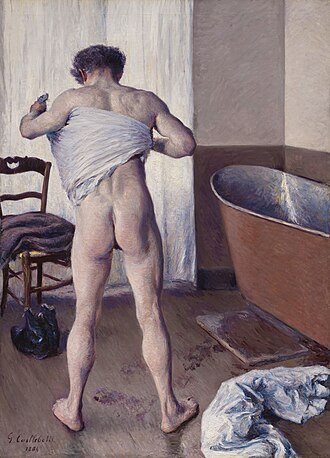 Man at His Bath - Gustave Caillebotte (1884)
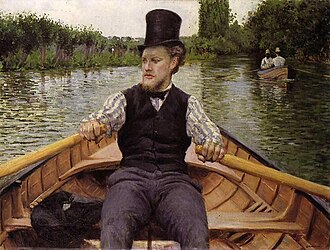 Boating Party - Gustave Caillebotte (1878)
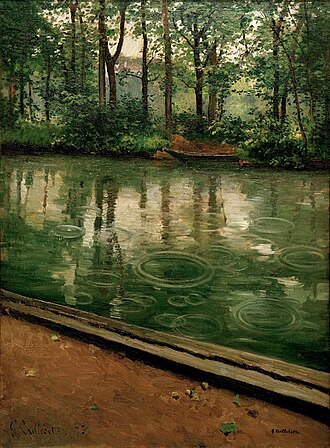 The Yerres, Effect of Rain - Gustave Caillebotte (1875)
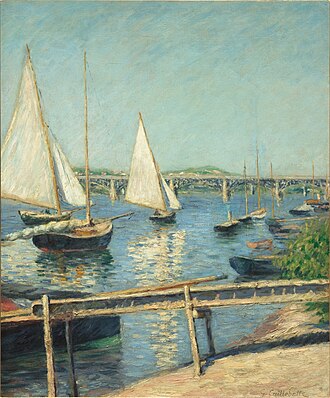 Voiliers à Argenteuil - Gustave Caillebotte (1888)