Maria und Kind mit der hl. Barbara, Elisabeth von Ungarn und Jan Vos.
Jan van Eyck · 1440s
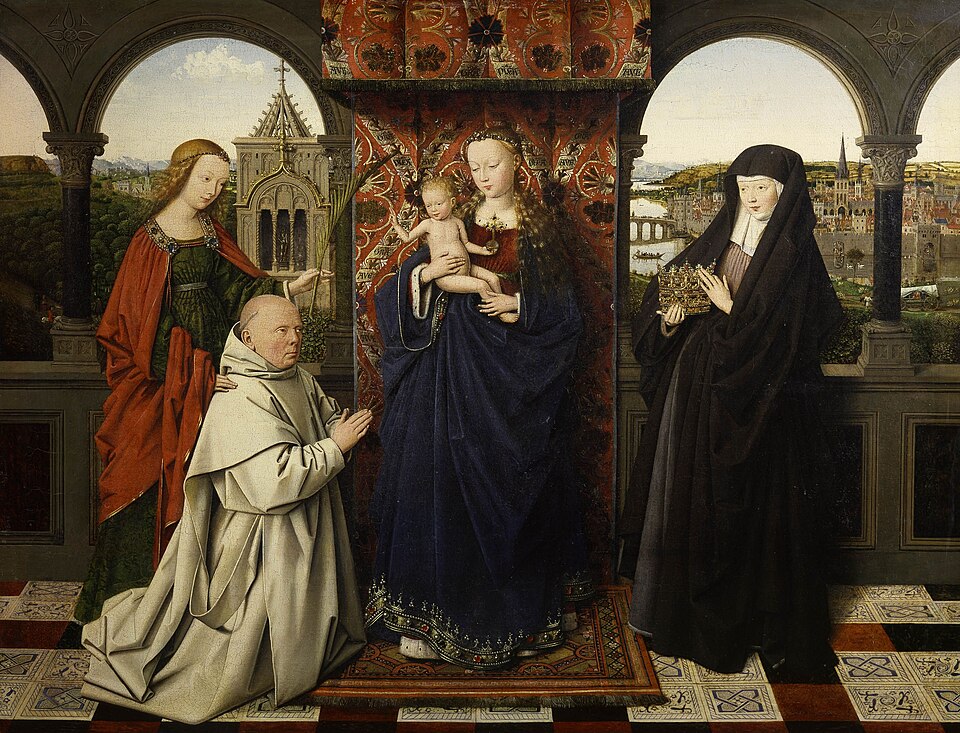
A Carthusian monk kneels before the Virgin, two saints at his side, a city glittering beyond the arches. Jan van Eyck began this panel and died before it was done, so it is counted as his last work.
The story behind the painting
The Madonna of Jan Vos, also called Virgin and Child, with Saints and Donor, was commissioned by Jan Vos, who in March 1441 became prior of a Carthusian monastery near Bruges, the earliest date he could have asked van Eyck for it. Van Eyck began it about 1441 and died in 1442, during the work. Art historians generally agree he painted the central Virgin and Child and conceived the overall design, while a member of his workshop completed the side figures and the background about 1443. Wikidata places it in the 1440s.
What to look for
The panel is small, 47.3 by 61.3 cm. Mary stands in majesty on an oriental carpet, holding the Christ Child. To one side is Saint Barbara before the tower in which she was imprisoned; look through its window and you will find a statue of the god Mars. Saint Elizabeth of Hungary wears a nun's habit. The donor Jan Vos, who died in 1462, kneels in prayer in Carthusian dress. Woven into the canopy are the words AVE GRA[TIA] PLE[N]A, Hail Mary full of grace. Beyond the arcades of the loggia opens a wide landscape with a city.
Meaning and intent
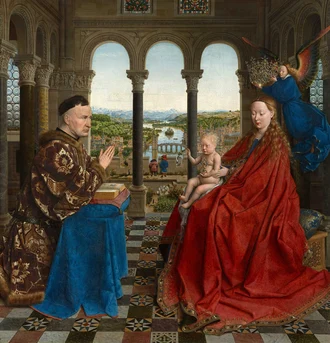
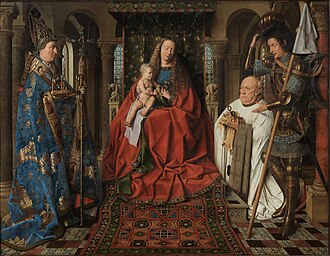
Because van Eyck died mid-work, the painting is partly a pastiche of his earlier ideas. The kneeling Vos closely echoes the donors Nicolas Rolin in the Madonna of Chancellor Rolin and Joris van der Paele in the Virgin and Child with Canon van der Paele, which also includes Saint Barbara. The landscape resembles those in several earlier works. Historians have tried to name the city and cathedral, but like most of van Eyck's backgrounds they are probably imaginary. What remains surely his is the quiet centre: the mother and child, around whom his assistant arranged the rest.
Legacy
After 1450, when van Eyck's workshop had closed, Petrus Christus painted the Exeter Madonna, read as an interpretation rather than a close copy of this panel, borrowing also from van Eyck's lost Madonna of Nicolas van Maelbeke. The painting also found a place in fiction: in Margaret Campbell Barnes's 1946 novel My Lady of Cleves, Hans Holbein and Anne of Cleves discuss its merits about a century after it was made. The Frick Collection in New York acquired it in 1954.
Schon gewusst?
- Begun by Jan van Eyck about 1441, finished by his workshop after his death.
- Generally considered van Eyck's last work.
- The donor is Jan Vos, a Carthusian prior near Bruges.
- In the Frick Collection, New York, since 1954.
Über den Künstler
Jan van Eyck (1390-1441)
religiöse Kunst · Maria · Jesus Christus · Flämische Primitive · The Frick Collection · Krone · Barbara von Nikomedien · Reichsapfel · Stifter
Mehr von Jan van Eyck
 Arnolfini-Porträt - Jan van Eyck (1434)
 Genter Altar - Jan van Eyck (1432)
 Rolin-Madonna - Jan van Eyck
 Die Madonna in der Kirche - Jan van Eyck (1440)
 Madonna des Kanonikus Georg van der Paele mit hll. Donatian, Georg und Stifter Paele - Jan van Eyck (1436)
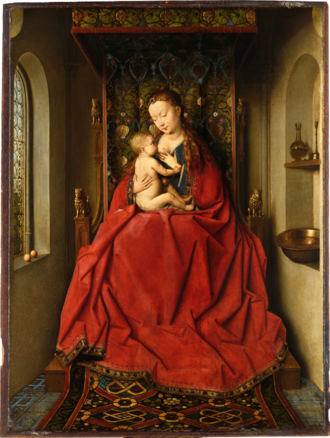 Lucca-Madonna - Jan van Eyck (1437)
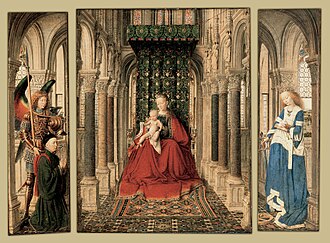 Dresdner Marienaltar - Jan van Eyck (1437)
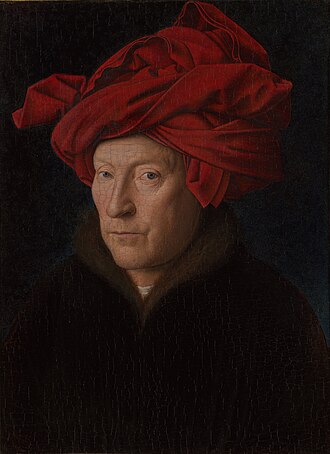 Porträt eines Mannes - Jan van Eyck (1433)
Werke verwandter Künstler
 Kreuzabnahme - Rogier van der Weyden (1440s)
 Porträt einer Dame - Rogier van der Weyden (1460)
 Die Verkündigung - Hans Memling (1480s)
 Szenen der Passion Christi - Hans Memling (1470)
 Der Garten der Lüste - Hieronymus Bosch
 Das Narrenschiff - Hieronymus Bosch (1500s)
 Die Jäger im Schnee - Pieter Bruegel the Elder (1565)
 Die niederländischen Sprichwörter - Pieter Bruegel the Elder (1551)