Madonna des Kanonikus Georg van der Paele mit hll. Donatian, Georg und Stifter Paele
Jan van Eyck · 1436
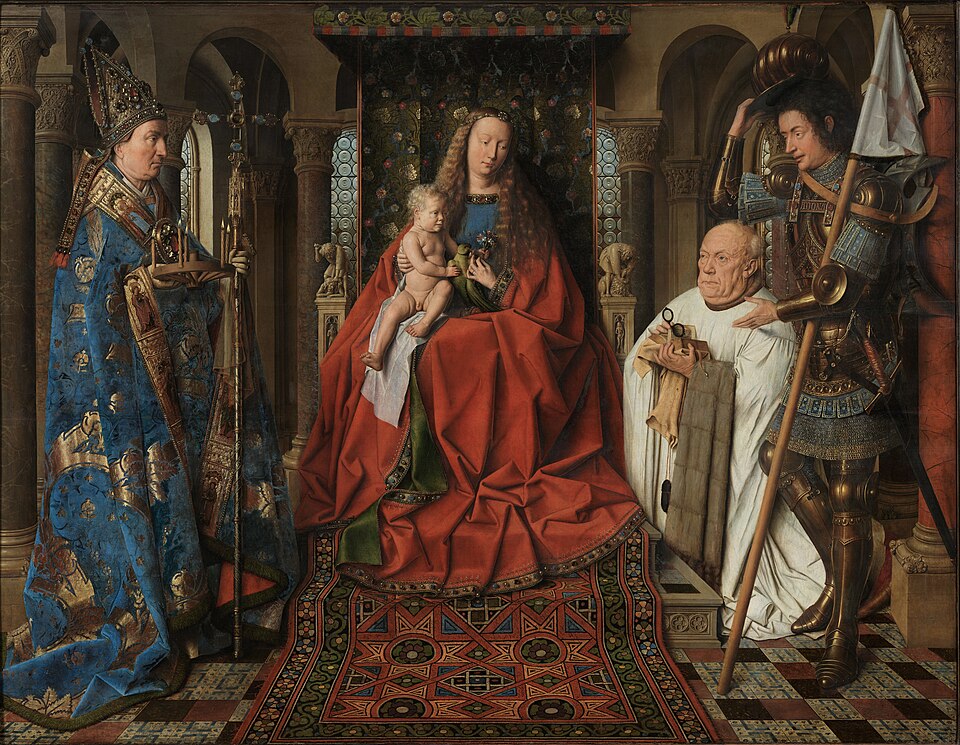
An old, ill canon looks up from his prayer book, and Saint George, lifting his helmet, introduces him to the Virgin. Van Eyck painted every vein and whisker of his ageing face.
The story behind the painting
Joris van der Paele, born in Bruges around 1370, worked as a papal scribe in Rome before returning home wealthy in 1425 as a canon of St Donatian's church. Around 1431 an illness left him unable to perform his duties and led him to reflect on his mortality. He endowed a chaplaincy and commissioned this altarpiece from Jan van Eyck as his memorial. The original frame records the story: the canon had the work made in 1434, but it was completed only in 1436. It is now in the Groeningemuseum in Bruges, about 124.5 by 160 cm.
What to look for
The Virgin sits enthroned in a rounded, Romanesque church, the Child on her lap reaching for what seems to be a parrot. On the left stands Saint Donatian in a blue and gold cope, holding a jewelled cross and a wheel of five lit candles. On the right Saint George, in decorated armour, raises his helmet to present the kneeling canon, who reads from a book of hours in a white surplice. Look at the precision: the threads of the cope, the weave of the oriental carpet, and the stubble and veins on van der Paele's face. George even casts a shadow on him and seems to step on his surplice.
Meaning and intent
The painting is one of the earliest known northern sacra conversazione, the Virgin and Child with saints in an informal group. Bringing the donor so close to the Virgin breaks, in one historian's words, the barriers between heaven and earth. The Child represents the host, since the panel was meant for the Mass. The throne is carved with Adam and Eve, Cain and Abel and Old Testament scenes, and the frame's inscriptions compare Mary to an "unspotted mirror" from the Book of Wisdom. The Child's nudity was once overpainted; restoration removed this in the late twentieth century.
Legacy
After the Adoration of the Mystic Lamb in the Ghent Altarpiece, this is van Eyck's second largest surviving painting and his only one in horizontal format. It still has its original oak frame with his signature. It stayed in St Donatian's until the church was demolished in 1779, and after the iconoclasm of 1566 it was placed on the main altar. Widely considered one of his most ambitious works, it has been called a "masterpiece of masterpieces".
Schon gewusst?
- Frame inscriptions give 1434 and completion in 1436.
- Van Eyck's second largest surviving painting and only horizontal one.
- Original oak frame with van Eyck's signature survives.
- Groeningemuseum, Bruges; 124.5 x 160 cm (Wikidata).
Über den Künstler
Jan van Eyck (1390-1441)
religiöse Kunst · Frau · Mann · Maria · Jesuskind · Junge · Flämische Primitive · Mutter · Vlaamse Kunstcollectie · Georg
Mehr von Jan van Eyck
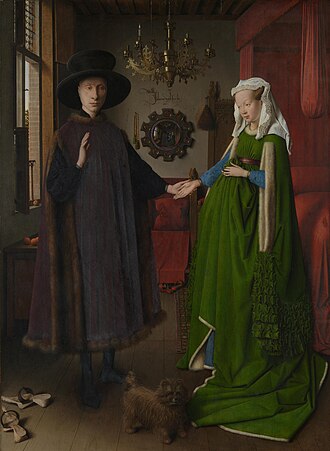 Arnolfini-Porträt - Jan van Eyck (1434)
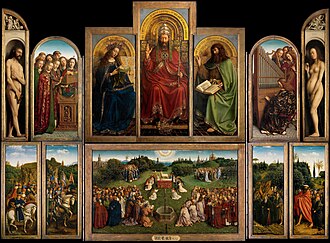 Genter Altar - Jan van Eyck (1432)
.webp) Rolin-Madonna - Jan van Eyck
Rolin-Madonna - Jan van Eyck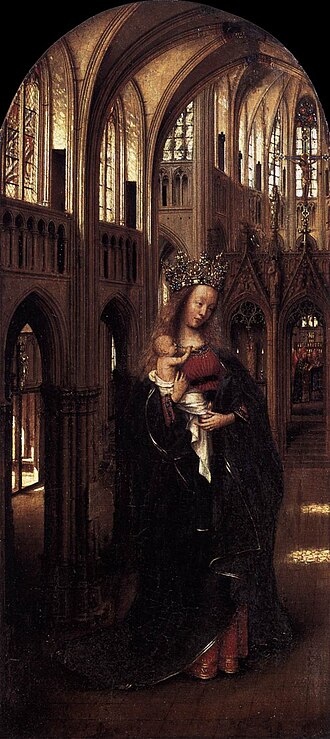 Die Madonna in der Kirche - Jan van Eyck (1440)
.png) Lucca-Madonna - Jan van Eyck (1437)
Lucca-Madonna - Jan van Eyck (1437)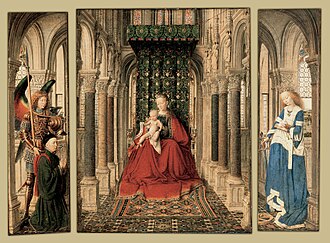 Dresdner Marienaltar - Jan van Eyck (1437)
%201433.jpg) Porträt eines Mannes - Jan van Eyck (1433)
Porträt eines Mannes - Jan van Eyck (1433)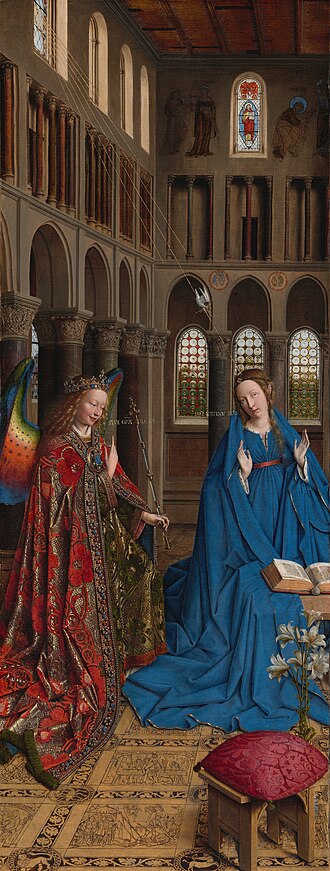 Verkündigung - Jan van Eyck (1430s)
Werke verwandter Künstler
 Der Garten der Lüste - Hieronymus Bosch
 Das Narrenschiff - Hieronymus Bosch (1500s)
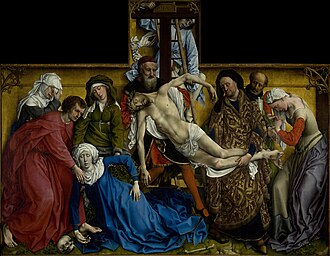 Kreuzabnahme - Rogier van der Weyden (1440s)
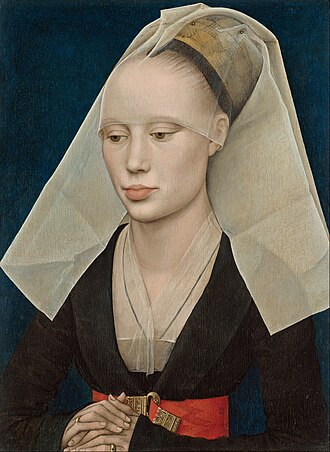 Porträt einer Dame - Rogier van der Weyden (1460)
%20-%20Google%20Art%20Project.jpg) Die Jäger im Schnee - Pieter Bruegel the Elder (1565)
Die Jäger im Schnee - Pieter Bruegel the Elder (1565)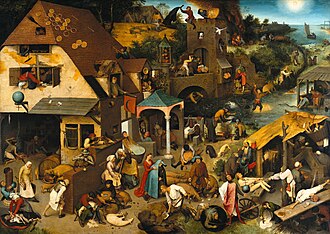 Die niederländischen Sprichwörter - Pieter Bruegel the Elder (1551)