Portrait of Isabella of Portugal
Jan van Eyck · 1420s
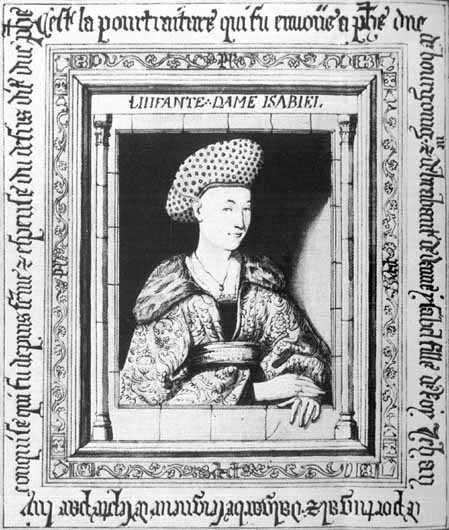
Jan van Eyck travelled to Portugal to paint a princess so that a duke could decide whether to marry her. The original is lost, known only from copies, but in them Isabella still lays her hand on a painted stone ledge as if reaching into our world.
The story behind the painting
In 1428 and 1429 Philip the Good, Duke of Burgundy, sent an embassy to Portugal to judge whether the thirty-year-old Isabella would make a suitable bride. Van Eyck went with it, tasked with bringing back faithful likenesses, most likely two, so that at least one would survive the journey. Plague had made the Portuguese court itinerant, and the party met it at the remote castle of Aviz. Van Eyck stayed nine months. The mission succeeded, and Isabella and Philip married on Christmas Day 1429.
What to look for
Since the original is lost, we look through copies. They show that, besides the real oak frame, there were two painted frames, one carrying an inscription along the top, and a fake stone parapet on which Isabella rests her hands. Watch that hand placed forward over the ledge: it seems to push her presence out of the picture and into the viewer's space. Art historians use van Eyck's small Portrait of a Man with a Blue Chaperon, also painted in Portugal, to guess the scale, probably miniature for easier shipping to Bruges.
Meaning and intent
This was more than a likeness. Painted as the first marriage agreement was drawn up, it was meant to travel to Philip with that document, as an eyewitness record of the person of the princess, so that her identity could be checked when she later came to Burgundy. The illusion of the hand over the parapet is one of several illusionistic tricks in the work, and it shows van Eyck, in one of his earliest known pictures, already playing with the line between painting and real space.
Legacy
The device of a figure reaching out of the picture returned in van Eyck's Léal Souvenir in London, and later, most famously, in Petrus Christus's Portrait of a Carthusian, with its painted fly on the frame. Because van Eyck was widely copied in his time, the lost Isabella probably also shaped later images of her, including one by Rogier van der Weyden and another by an unknown northern artist, both showing her much older. What remains is a portrait we know only by its echoes.
Schon gewusst?
- A betrothal portrait painted in Portugal in 1428-1429.
- Isabella married Philip the Good on Christmas Day 1429.
- The original is lost and known only from copies.
- Her hand rests forward on a painted stone parapet.
Über den Künstler
Jan van Eyck (1390-1441)
Mehr von Jan van Eyck
 Arnolfini-Porträt - Jan van Eyck (1434)
 Genter Altar - Jan van Eyck (1432)
 Rolin-Madonna - Jan van Eyck
 Die Madonna in der Kirche - Jan van Eyck (1440)
 Madonna des Kanonikus Georg van der Paele mit hll. Donatian, Georg und Stifter Paele - Jan van Eyck (1436)
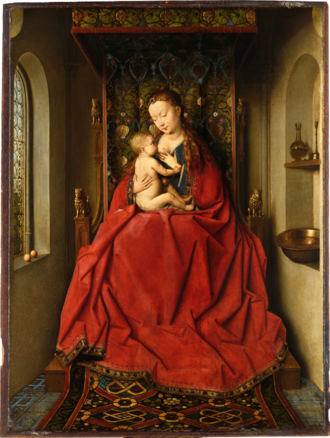 Lucca-Madonna - Jan van Eyck (1437)
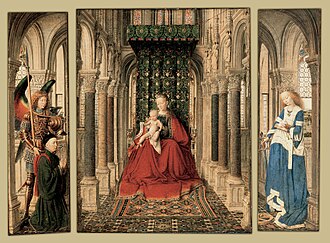 Dresdner Marienaltar - Jan van Eyck (1437)
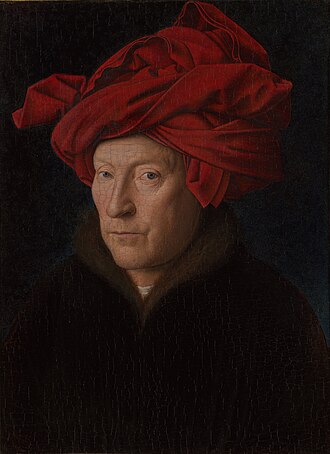 Porträt eines Mannes - Jan van Eyck (1433)
Werke verwandter Künstler
 Kreuzabnahme - Rogier van der Weyden (1440s)
 Porträt einer Dame - Rogier van der Weyden (1460)
 Die Verkündigung - Hans Memling (1480s)
 Szenen der Passion Christi - Hans Memling (1470)
 Der Garten der Lüste - Hieronymus Bosch
 Das Narrenschiff - Hieronymus Bosch (1500s)
 Die Jäger im Schnee - Pieter Bruegel the Elder (1565)
 Die niederländischen Sprichwörter - Pieter Bruegel the Elder (1551)