Giotto di Bondone
1267-1337
Giotto di Bondone gave painted saints real bodies, real weight and real feelings, and broke away from the flat Byzantine manner of his time. In the Scrovegni Chapel in Padua his people still glance, grieve and gossip as if they had just stepped off the street.
Origins
Almost everything about Giotto's early life is debated. He was born around 1267. Tradition says he was born in a farmhouse, perhaps at Colle di Romagnano or Romignano, and since 1850 a tower house in nearby Colle Vespignano has carried a plaque claiming the honour, but recent research has found documents indicating that he was born in Florence, the son of a blacksmith named Bondone. Giotto was probably his real name, though it may have been short for Ambrogiotto or Angelotto. Vasari tells a lovelier tale: Giotto was a merry, clever shepherd boy, and the great Florentine painter Cimabue found him drawing his sheep on a rock so lifelike that he took him on as an apprentice. Many scholars today treat this as legend and cite earlier sources suggesting Giotto was not Cimabue's pupil at all.
Life and turning points
Around 1290 Giotto married Ricevuta di Lapo del Pela, known as Ciuta, and they had four daughters and four sons; one son, Francesco, became a painter. He worked in Rome from 1297 to 1300, painting for the Jubilee of 1300 and designing the Navicella mosaic for the facade of Old St Peter's. By 1301 he owned a house in Florence, where he returned to live comfortably with his family between journeys, and documents of 1301 and 1304 show him holding large estates and probably running a large workshop. His fame took him to Rimini and to Padua, where around 1305 he painted the Scrovegni Chapel, his masterwork. In 1334 the Commune of Florence chose him to design the new bell tower of the cathedral, one of the few certainties of his life. He died on 8 January 1337; even his burial place is disputed.
Style and technique
Drawing on the solid, classical sculpture of Arnolfo di Cambio, Giotto turned away from the stylised, elongated figures of Cimabue and Duccio. His people are fully three-dimensional, with faces and gestures based on close observation, and their clothes hang naturally with form and weight. He experimented boldly with foreshortening and showed figures from behind, facing into the scene, to create the illusion of space, and he set them in compact settings like stage sets so the viewer seems to take part: a mocker in the Mocking of Christ, a mourner in the Lamentation. He gave faces real emotion. In the Massacre of the Innocents a soldier drags a baby away with his head sunk into his shoulders in shame. John Ruskin said that he painted the Madonna, Joseph and Christ, but essentially Mamma, Papa and Baby.
Stories and anecdotes
Vasari tells that while Cimabue was away, young Giotto painted a fly on a face in his master's picture so lifelike that Cimabue tried several times to brush it off; scholars note it echoes the ancient tale of Zeuxis painting grapes that birds tried to peck. When a messenger from Pope Benedict XI asked for a sample drawing, Giotto drew a perfect red circle freehand, and the messenger left feeling mocked until the Pope and his court marvelled at it. Boccaccio, a friend, described him as very plain, and a story goes that Dante, visiting him at work in Padua, asked how a man who painted such beautiful pictures had such plain children. Giotto answered that he made his pictures by day and his babies by night. Whether he painted the famous St Francis frescoes at Assisi remains one of art history's great disputes.
Legacy
His contemporary, the chronicler Giovanni Villani, called Giotto the most sovereign master of painting in his time, who drew his figures according to nature. Vasari saw in him the decisive break with the Byzantine style and the start of painting as we know it, reviving drawing from life after more than two hundred years of neglect. The Scrovegni Chapel's thirty-seven scenes of the lives of the Virgin and Christ are counted among the supreme masterpieces of the Early Renaissance, and painters across northern Italy learned from them. His Crucifix in Rimini helped launch the Riminese school. In the Adoration of the Magi a comet streaks across the sky, thought to be inspired by Halley's Comet in 1301, and so in 1986 a space probe sent to that comet was named Giotto.
Schon gewusst?
- The space probe Giotto, launched to Halley's Comet in 1986, was named after him.
- The Scrovegni Chapel cycle has 37 scenes arranged in three tiers.
- Much of the blue in the Scrovegni frescoes has worn away because the costly ultramarine was painted on dry plaster.
- In 1334 Florence chose him to design the cathedral's new bell tower.
Protorenaissance · Malerei in der Gotik
Gemälde von Giotto di Bondone
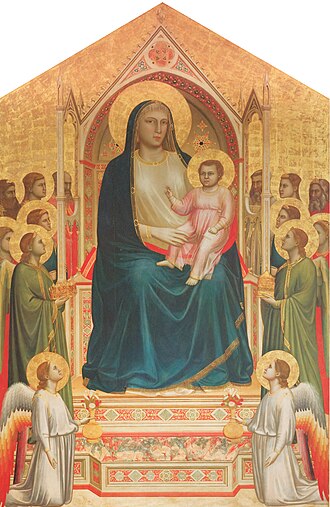 Ognissanti-Madonna - Giotto (1300s)
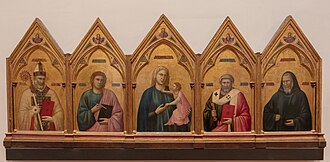 Badia Polyptychon - Giotto (1300s)
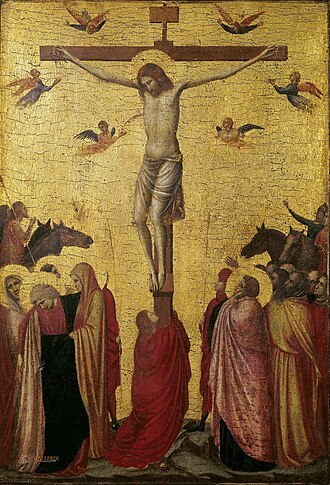 Crucifixion of Strasbourg - Giotto (1315)
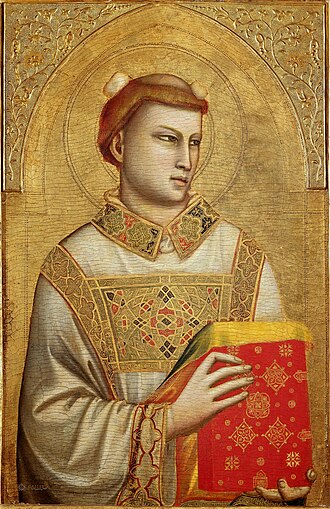 Heiliger Stephan - Giotto (1320)
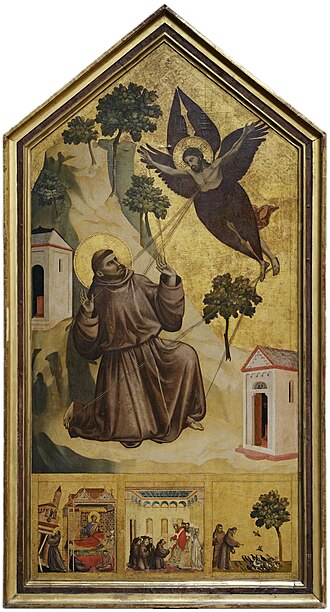 Die Stigmatisation des hl. Franziskus - Giotto (1290s)
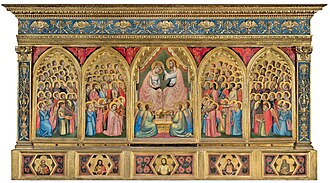 Marienkrönung mit Engeln und Heiligen - Giotto (1328)
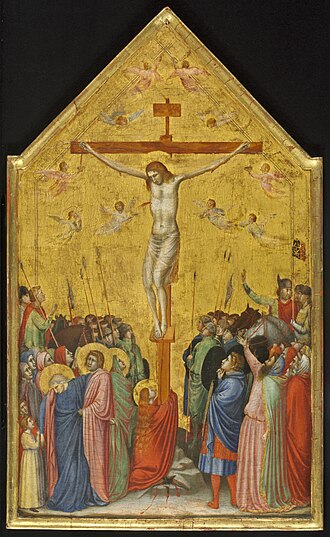 Die Kreuzigung Christi - Giotto (1310s)
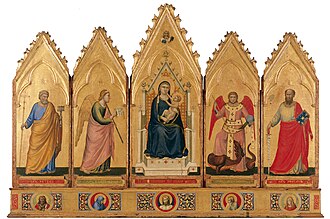 Bologna Polyptych - Giotto (1330s)
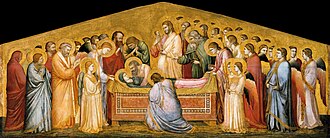 Marientod - Giotto (1312)
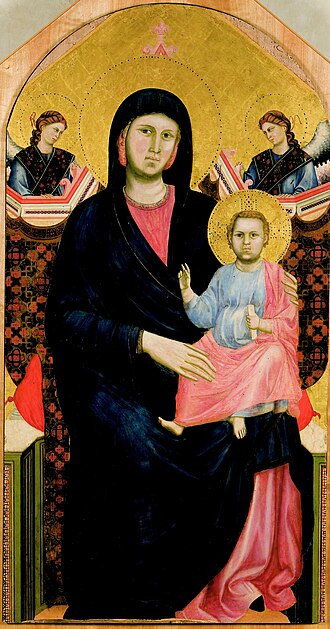 Madonna mit Kind - Giotto (1295)
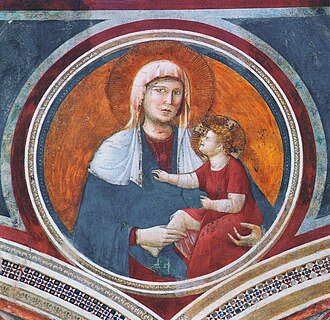 Madonna with the laughing Child - Giotto (1291)
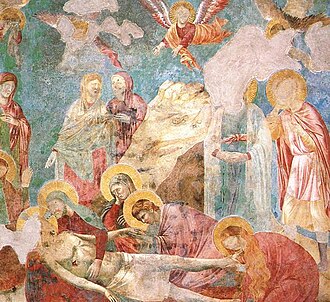 Scenes from the New Testament: Lamentation - Giotto (1291)
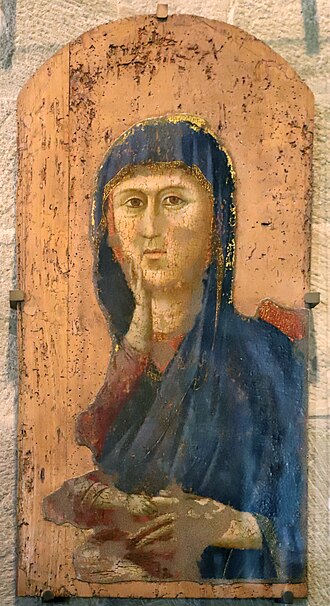 Madonna of Borgo San Lorenzo - Giotto (1290)
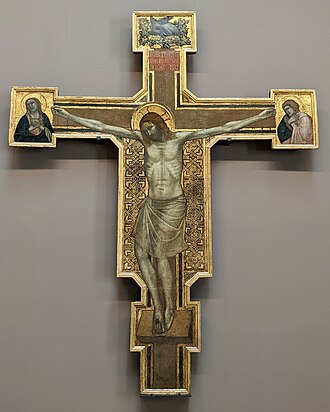 Kruzifix von Giotto und Werkstatt - Giotto (1315)
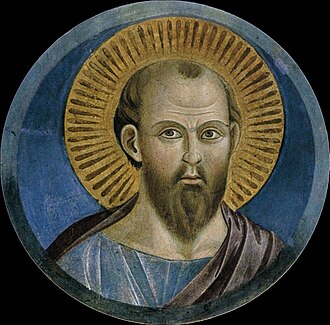 St Paul - Giotto (1291)
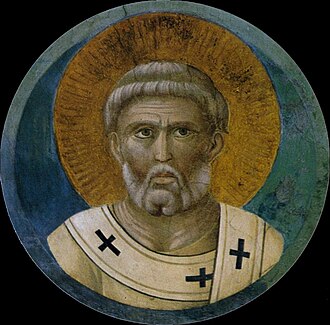 St Peter - Giotto (1291)
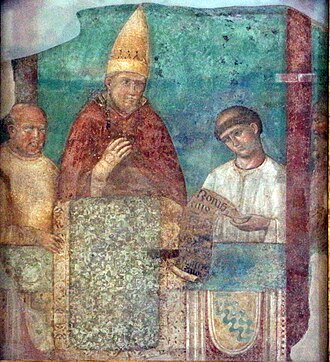 Boniface VIII declaring the Jubilee Year of 1300 - Giotto (1300)
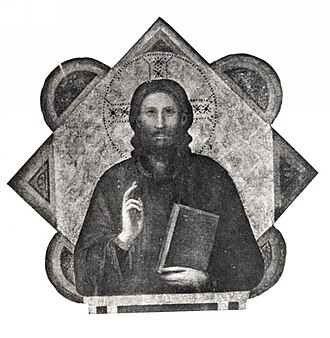 Christ blessing - Giotto (1301)
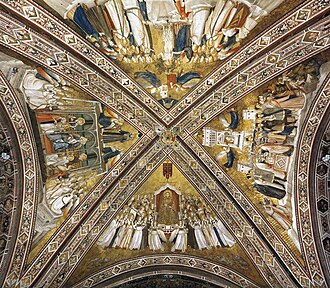 Franciscan allegories - Giotto (1334)