Die Stigmatisation des hl. Franziskus
Giotto di Bondone · 1290s
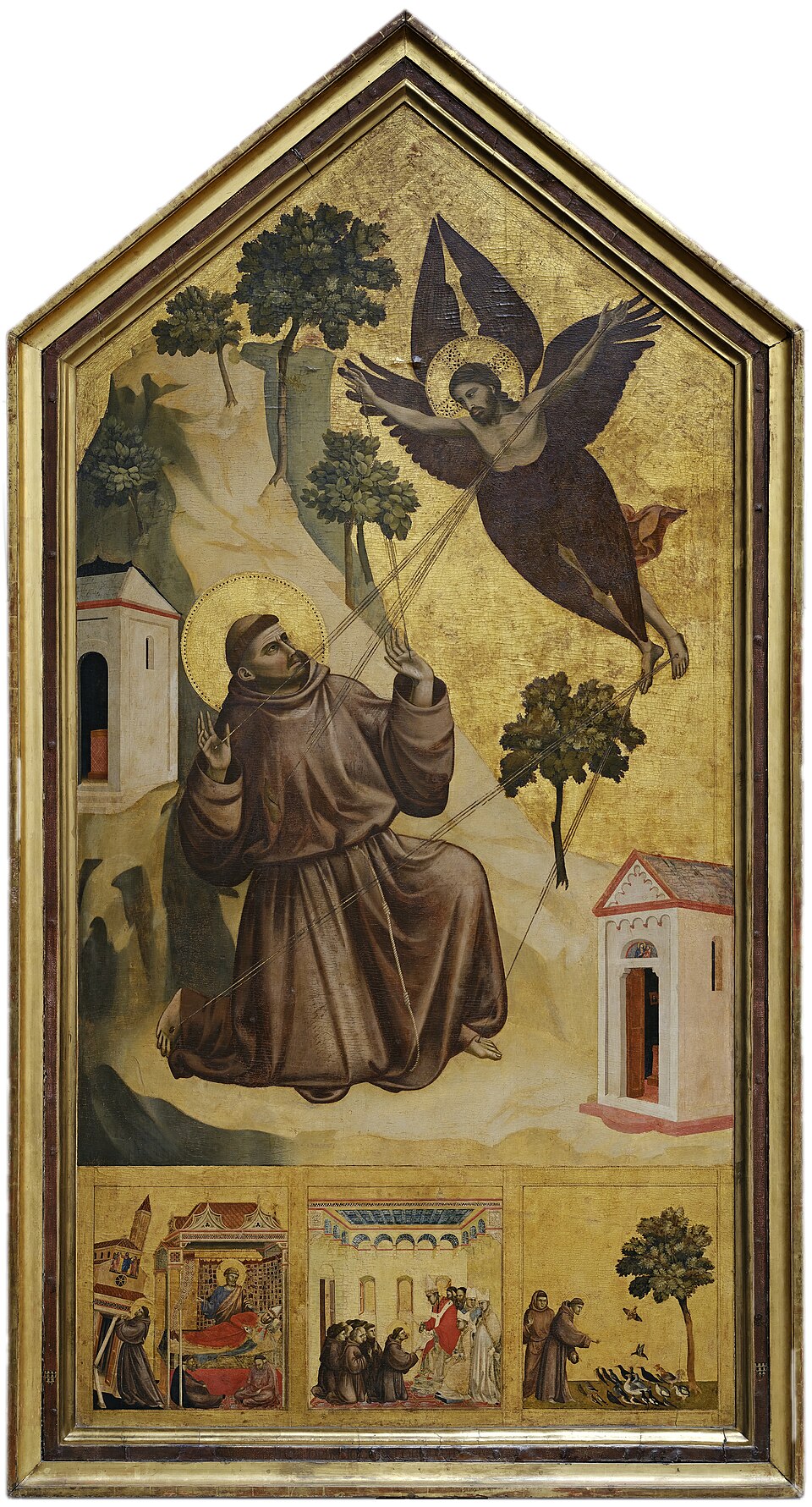
Against a gold ground, Saint Francis kneels as the wounds of Christ are given to him. Below, three small scenes tell more of his life, and along the frame runs a proud signature: the work of Florentine Giotto.
The story behind the painting
Giotto painted this tempera panel around 1295-1300 for the Church of San Francesco in Pisa. Giorgio Vasari mentions it in a transept chapel there. Its authorship was once disputed, but it is now generally recognised as Giotto's, not least because it carries the inscription OPUS IOCTI FLORENTINI, the work of Florentine Giotto, painted on a dark strip of the frame below the central predella scene. In 1813 it was taken to the Louvre as part of the Napoleonic looting of art in Italy, together with Cimabue's Maestà from the same church, and it went on display in 1814. When seized works were later returned, this panel was one of those that remained in France.
What to look for
The panel is rectangular below and rises to a triangular point, about three metres high, on a gold ground. Saint Francis receives the stigmata while praying on Mount Alverno. The painting mixes new and old ideas. The mountains are generic and the landscape is out of proportion, but the small chapels on the mountain show an attempt at geometric perspective, and the saint's face is modelled with strong light and shade. In the corners appear the arms of the Ughi or Cinquini family. Below, the predella shows The Dream of Pope Innocent III, The Approval of the Franciscan Rule and The Sermon to the Birds.
Meaning and intent
What made the painting new was its subject: not a still, expressionless holy figure at the centre, as in the Italo-Byzantine tradition, but a moment of action. Francis is caught in the instant of his mystical experience. The predella scenes carry the story forward with fresh ideas. In The Dream, the Lateran church tilts and a column breaks, and Saint Peter's presence shows that the Pope is asleep and dreaming, an innovative device. The Approval places the scene in a room with arches and shelves to create depth. The Sermon to the Birds is the simplest of all, its plain gold ground giving it a calm, almost abstract quality.
Legacy
The panel is closely tied to Giotto's Stories of Saint Francis in Assisi, painted around the same time; the Approval scene closely resembles the Assisi fresco of the same subject. The predella shows greater Gothic elegance than those frescoes and serves as a point of comparison for followers such as the Master of Saint Cecilia. Its long stay in Paris is itself part of its story, a legacy of the Napoleonic era. Today in the Louvre, visitors can meet in one object the whole arc of Francis's life, from a pope's dream to a sermon preached to birds.
Schon gewusst?
- Tempera on panel, about 1295-1300, for San Francesco in Pisa
- Inscribed OPUS IOCTI FLORENTINI on the frame
- Taken to the Louvre in 1813 during the Napoleonic looting; displayed from 1814
- Size: Wikidata 313 × 163 cm; Wikipedia 314 × 162 cm
Über den Künstler
Giotto di Bondone (1267-1337)
religiöse Kunst · Gemäldeabteilung des Louvre · Franz von Assisi
Mehr von Giotto di Bondone
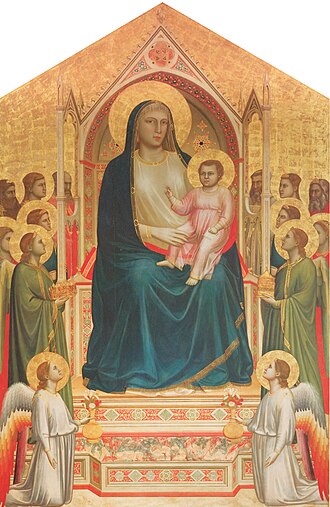 Ognissanti-Madonna - Giotto (1300s)
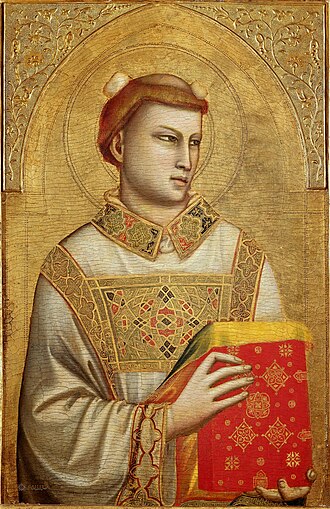 Heiliger Stephan - Giotto (1320)
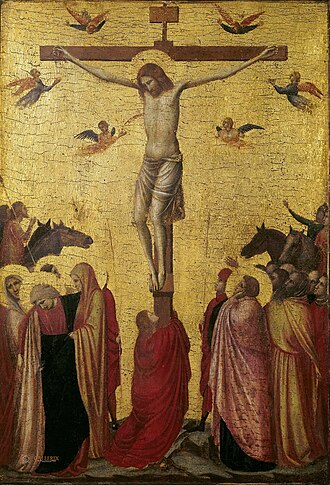 Crucifixion of Strasbourg - Giotto (1315)
 Badia Polyptychon - Giotto (1300s)
 Die Kreuzigung Christi - Giotto (1310s)
 Marienkrönung mit Engeln und Heiligen - Giotto (1328)
 Scenes from the New Testament: Lamentation - Giotto (1291)
 Madonna mit Kind - Giotto (1295)