食料貯蔵室の召使と子供
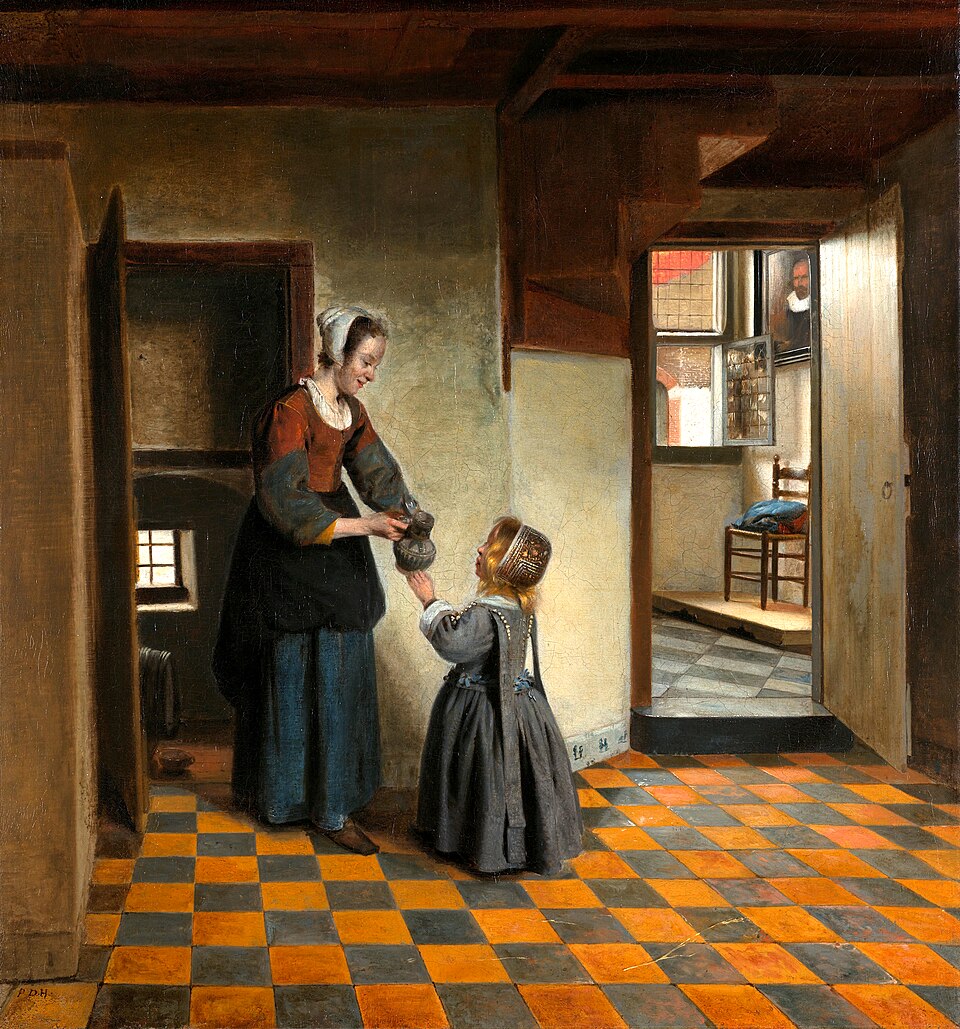
A young woman steps out of the pantry and, smiling, hands a jug to a small child in a long dress. Pieter de Hooch filled a plain Dutch house with light, open doors and one tender gesture, and the child may not be the girl it seems.
The story behind the painting
Pieter de Hooch painted A Woman with a Child in a Pantry around 1658, during the Dutch Golden Age; Wikidata gives no exact year. It is signed P.D.H. When Hofstede de Groot published his catalogue of de Hooch's work in 1910, this was the very first painting he described. It was sold in Amsterdam as early as 1712, together with a companion piece, its pendant, which by Hofstede de Groot's time was in the collection of Albert von Oppenheim in Cologne. Today the picture belongs to the Rijksmuseum in Amsterdam.
What to look for
The canvas is about 65 by 60 cm. In a room floored with yellow tiles, a young woman in a red jacket and blue skirt stands at the left, just come from the pantry, and hands a jug to a little child. Both are seen in profile. Through an open door on the left we glimpse the pantry's small window and a cask; through another door on the right, a sitting room with a cushioned chair by an open window and a portrait above it. Faint traces of a picture the artist painted over himself can still be seen on the wall above the woman's head.
Meaning and intent
Hofstede de Groot described the child as a little girl, yet the Wikipedia article points out that the tails on the dress suggest a young boy. It explains that small boys were traditionally disguised as girls to hide them from the devil. So the scene may hold a quiet household belief inside its everyday gesture. The doors opening room after room, each with its own light, lead the eye through the house, while the smile and the passing of the jug keep the warmth at the centre. An early collector, quoted in the catalogue, called it an excellent work of the master.
Legacy
The painting passed through a long line of Amsterdam sales: in 1712, in 1765 to the collector J. J. de Bruyn, at his own sale in 1798, in 1810 from the collection of P. de Smeth van Alphen, and in 1817 from the widow A. M. Hogguer. It then entered the Rijksmuseum, where it was listed as number 1248 in the 1903 catalogue, formerly 682. A good early copy was owned in London by Sir A. Hayter, a sign of how the picture was valued. It remains in the Rijksmuseum today.
豆知識
- Painted around 1658 and signed P.D.H.
- The first painting in Hofstede de Groot's 1910 de Hooch catalogue.
- The child may be a boy dressed as a girl.
- In the Rijksmuseum, Amsterdam.
画家について
ピーテル・デ・ホーホ (1629-1684)
同じ画家の作品: ピーテル・デ・ホーホ
 デルフトの家の中庭 - Pieter de Hooch (1658)
 リンゴの皮を剥く女性 - Pieter de Hooch (1663)
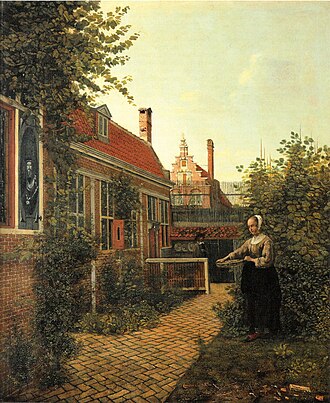 A Woman with a Basket of Beans in a Garden - Pieter de Hooch (1651)
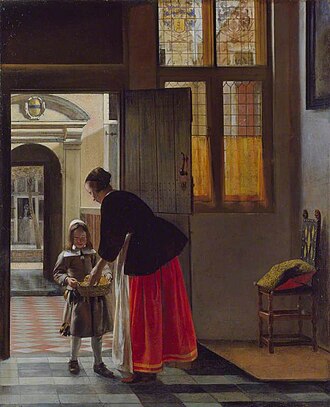 パンを持ってくる少年 - Pieter de Hooch (1663)
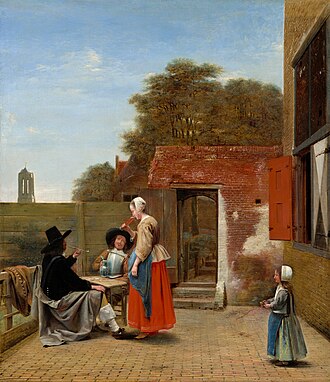 オランダの中庭 - Pieter de Hooch (1658)
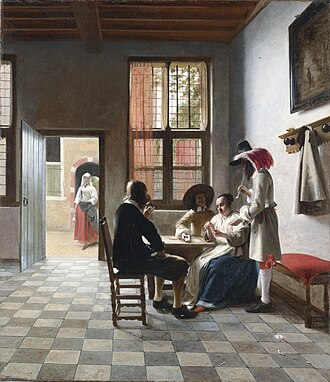 陽の当たる部屋でトランプをする人々 - Pieter de Hooch (1658)
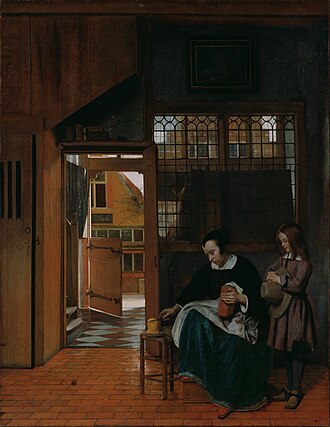 男の子のためにパンとバターを用意する女性 - Pieter de Hooch (1661)
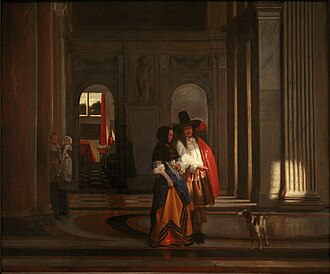 アムステルダム市庁舎内の散策 - Pieter de Hooch (1660s)