男の子のためにパンとバターを用意する女性
ピーテル・デ・ホーホ · 1661
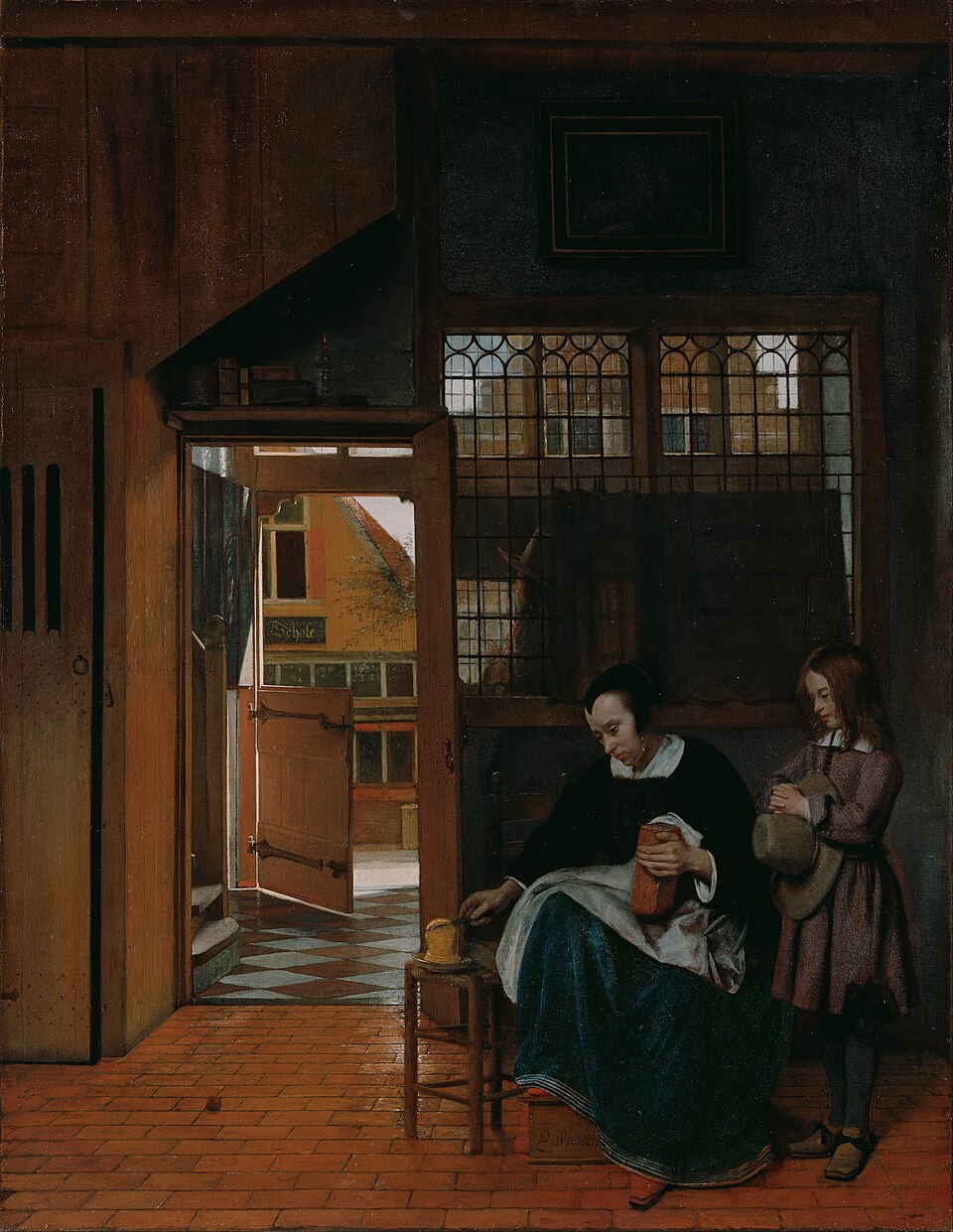
A boy stands with folded hands, hat pressed to his chest, while his mother butters his bread. Beyond them a half door opens onto a sunlit street. Pieter de Hooch made a whole world out of one small household moment.
The story behind the painting
A Woman Preparing Bread and Butter for a Boy is an oil painting by Pieter de Hooch, an example of Dutch Golden Age painting. Wikipedia dates it to between 1660 and 1663, while Wikidata gives 1661. When Hofstede de Groot catalogued it in 1908, he gave it a longer title that tells the whole story: a woman cutting bread and butter for a boy, who is saying grace. The boy is about to eat, but first he prays, and his mother waits with the loaf in her hand.
What to look for
The woman sits in a dimly lit room with a window at the back, wearing a dark jacket and a blue skirt. She holds a loaf in her left hand and takes a piece of butter from a plate set on a chair beside her. To her right the boy stands with folded hands, clasping his hat to his breast. Now let your eye travel past them: an open half door leads into a passage with a tiled floor, and beyond it the street, where the ground in front of the house opposite is bright with sunshine. The dim room and the sunny street are the heart of the picture.
Meaning and intent
The scene joins two simple things: daily food and a child's prayer. Nothing is staged for show; the mother's work and the boy's grace happen in the same quiet instant. Hofstede de Groot admitted that the picture lacks the brilliant effect so prized in de Hooch's work, yet he called it a very pleasing and satisfactory example. That modesty may be the point. Light is kept for the distant street, while the family stays in soft shade, absorbed in an ordinary ritual.
Legacy
The painting changed hands many times. It was sold in Amsterdam in 1750, again in 1800 at the Jan Gildemeester sale and in 1823, then belonged to Baron Verstolk van Soelen in The Hague, whose collection was sold as a whole in 1846. After a London sale in 1893 it went to the Drummond collection in Montreal. According to the Getty it later passed through the collections of Andrew W. Mellon and Heinrich Thyssen before the museum acquired it in 1984. It is now in the J. Paul Getty Museum in Los Angeles.
豆知識
- Dated 1660 to 1663 by Wikipedia, 1661 by Wikidata.
- Hofstede de Groot titled it a woman cutting bread for a boy saying grace.
- Once in the Drummond collection, Montreal.
- Now in the J. Paul Getty Museum, Los Angeles.
画家について
ピーテル・デ・ホーホ (1629-1684)
風俗美術 · J・ポール・ゲティ美術館 · Thyssen-Bornemisza family Collection
同じ画家の作品: ピーテル・デ・ホーホ
 デルフトの家の中庭 - Pieter de Hooch (1658)
 リンゴの皮を剥く女性 - Pieter de Hooch (1663)
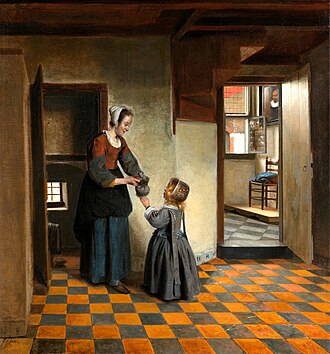 食料貯蔵室の召使と子供 - Pieter de Hooch
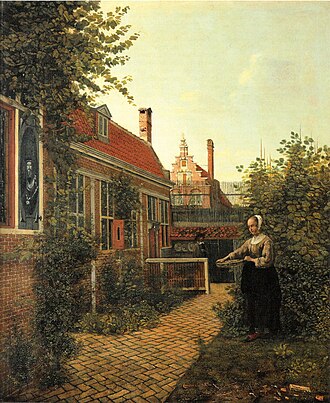 A Woman with a Basket of Beans in a Garden - Pieter de Hooch (1651)
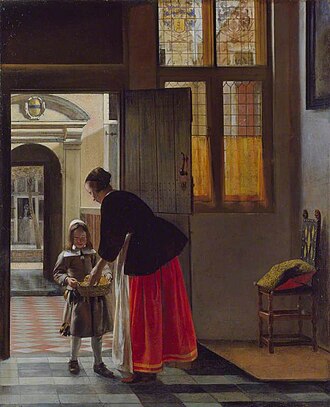 パンを持ってくる少年 - Pieter de Hooch (1663)
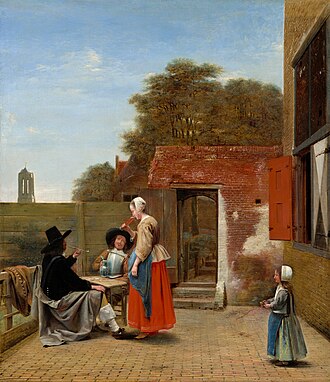 オランダの中庭 - Pieter de Hooch (1658)
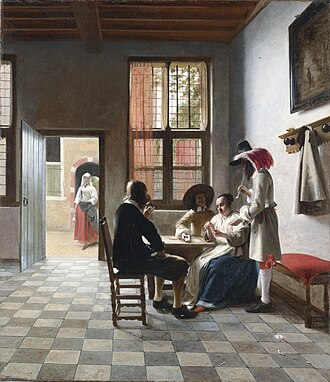 陽の当たる部屋でトランプをする人々 - Pieter de Hooch (1658)
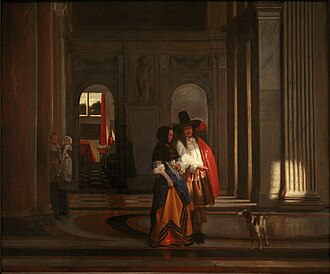 アムステルダム市庁舎内の散策 - Pieter de Hooch (1660s)