アムステルダム市庁舎内の散策
ピーテル・デ・ホーホ · 1660s
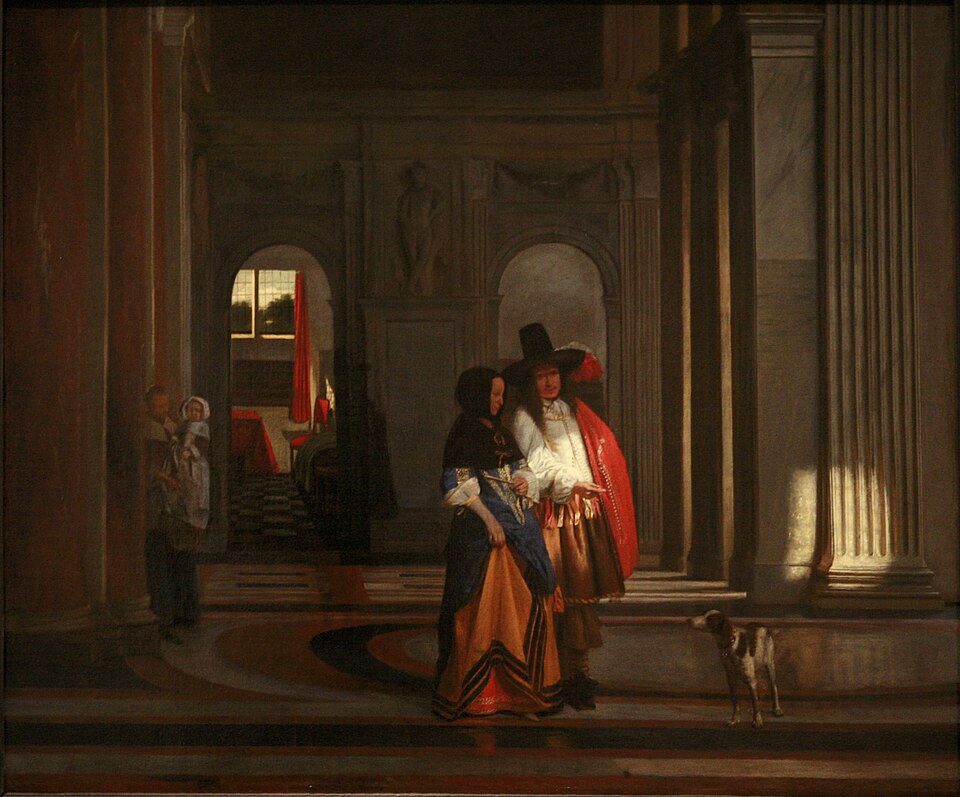
A fashionable couple strolls through the marble galleries of Amsterdam's new Town Hall, a dog at their heels and a nurse with a baby behind them. Pieter de Hooch leads the eye past columns into a room glowing with red.
The story behind the painting
Pieter de Hooch painted this scene around 1663 to 1665, most likely during his Amsterdam period, since the setting is local. Wikidata dates it more broadly to the 1660s. The building is the Amsterdam Town Hall, now the Royal Palace, which had been built only about a decade earlier. Wikipedia titles the work Going for a Walk in the Amsterdam Town Hall. It is an oil on canvas of about 72 by 85 cm, now in the Musée des Beaux-Arts de Strasbourg, inventory number 213.
What to look for
The man wears a tall, broad-brimmed cavalier hat with red and white feathers, a white shirt with ruffled sleeves and collar, and a red cloak over one shoulder. The woman wears a veil over her gold-embroidered blue bodice and lifts her yellow skirt with her right hand. A hunting dog follows on the right, and through the columns a nurse carries a baby. The floor is tiled in circles in front and squares behind. Through an open door at the back, a curtain, tablecloth and chair cushion in bright vermilion echo the man's cloak, above a black-and-white checkerboard floor.
Meaning and intent
The scene probably takes place in the south gallery. Columns on the left and pilasters on the right act as guiding lines that lead us toward that open door, the same device of looking from one space into another that runs through De Hooch's work. The circular tiles under the couple show Peace, an atlas-style image of the Earth, and the relief at the back depicts Mercury by Artus Quellinus the Elder. A grand civic building becomes a stage for a calm, elegant walk.
Legacy
The painting has changed over time. A man near the entrance of the back room was painted out, and an 1827 sale mentions a man in a black cloak, likely that figure. Analysis suggests the dog was also later repainted. Collectors nonetheless consider it a genuine De Hooch, ruling out an attribution to Abraham Janssens. It was first sold by H. Reydon in Amsterdam in April 1827, was in Howard Galton's collection at Hadzor House around 1850 to 1857, and was bought from E. Warneck by Wilhelm von Bode for the Strasbourg museum. De Hooch painted at least two more Town Hall interiors.
豆知識
- Painted around 1663-1665 in the Amsterdam Town Hall, now the Royal Palace.
- A man in the back was painted out; the dog was repainted.
- The floor shows Peace, and the relief Mercury by Artus Quellinus.
- Now in the Musée des Beaux-Arts de Strasbourg.
画家について
ピーテル・デ・ホーホ (1629-1684)
風俗美術 · イヌ · 窓 · カップル · 柱 · 赤ちゃん
同じ画家の作品: ピーテル・デ・ホーホ
 デルフトの家の中庭 - Pieter de Hooch (1658)
 リンゴの皮を剥く女性 - Pieter de Hooch (1663)
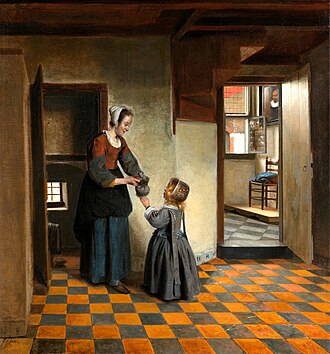 食料貯蔵室の召使と子供 - Pieter de Hooch
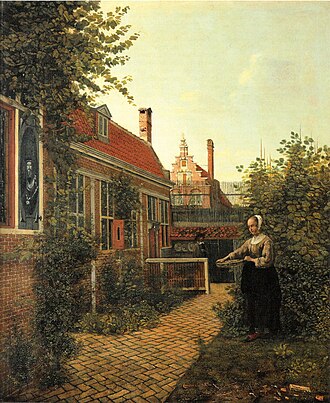 A Woman with a Basket of Beans in a Garden - Pieter de Hooch (1651)
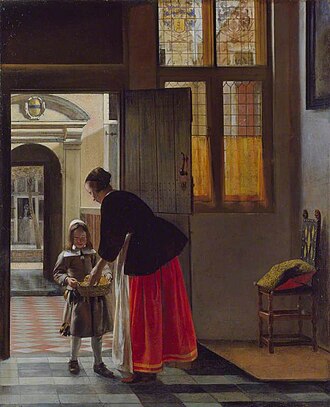 パンを持ってくる少年 - Pieter de Hooch (1663)
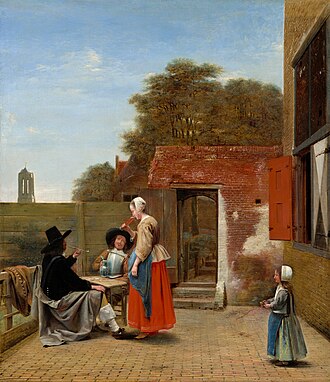 オランダの中庭 - Pieter de Hooch (1658)
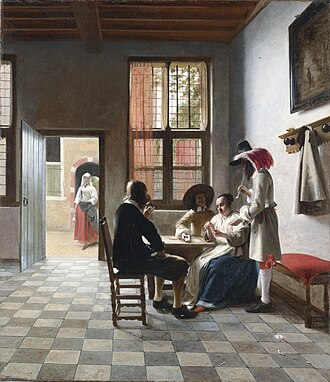 陽の当たる部屋でトランプをする人々 - Pieter de Hooch (1658)
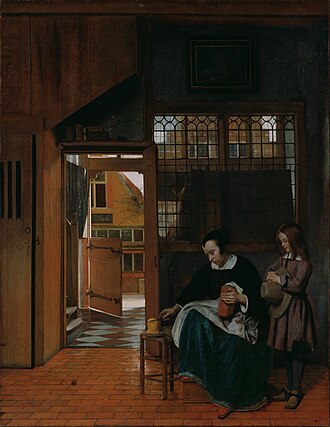 男の子のためにパンとバターを用意する女性 - Pieter de Hooch (1661)