朝日の中の婦人
Caspar David Friedrich · 1818
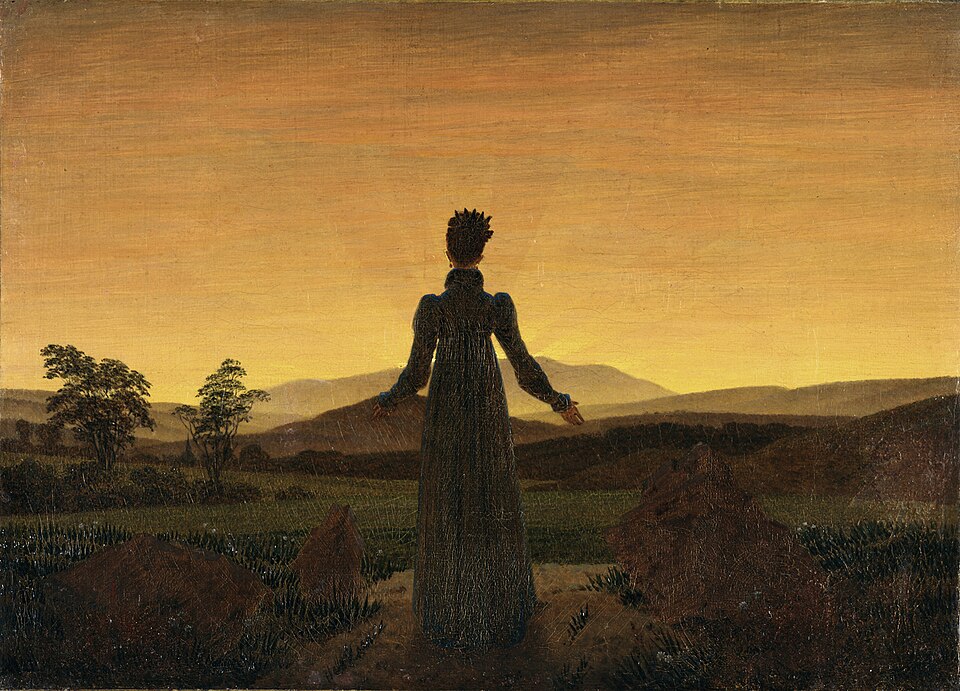
A woman with her back to us opens her arms toward a sun hidden by her own body. Friedrich's orange sky may even carry a trace of a volcano that erupted on the other side of the world.
The story behind the painting
The German painter Caspar David Friedrich made this small picture around 1818. Its German title is Frau vor untergehender Sonne, woman in front of the setting sun. It measures about 22 by 30 cm and is shown at the Museum Folkwang in Essen. The work belongs to Romanticism, and it uses the same kind of view Friedrich chose for his Wanderer above the Sea of Fog: a figure seen from behind, standing before a landscape. The viewer is invited to share her place and look out over the land with her.
What to look for
A woman seen from behind stands with her arms slightly open, facing the sun, which is hidden by her body. Before her lies a meadow that becomes gently hilly in the distance, with a few trees to the left and some rocks framing her nearby. She wears a long, dark, formal dress; the light of the setting sun touches only her wrists and shoulders, letting us guess its colour, probably blue. The rest of her lies in her own shadow. Her hair is pinned up, baring her neck. The landscape is dim, but the sky glows from yellow at the horizon to deep orange above.
Meaning and intent
The picture is sometimes wrongly translated as Woman in the Morning Sun. The image alone cannot tell sunrise from sunset, but the German title settles the question. Her open arms and the hidden sun leave the meaning open: the moment belongs to her, and to whoever stands in her place. The orange sky may also hold another story. The source suggests that Friedrich may have faithfully recorded the effects of the 1815 eruption of Mount Tambora in Indonesia, which changed the climate across the planet.
Legacy
A team led by the physicist Christos Zerefos of the National Observatory of Athens studied landscape paintings from the last five centuries against the dates of major volcanic events. Aerosols from volcanoes cloud sunlight, and the effect is especially visible at sunset. In that light, the deep orange of this small canvas becomes not only a feeling but possibly a record of a real sky after the great eruption. The painting remains in the Museum Folkwang in Essen, one of the quietest and most personal examples of Friedrich's figures seen from behind.
豆知識
- Painted around 1818; at the Museum Folkwang in Essen.
- Uses the same back view as Wanderer above the Sea of Fog.
- Sometimes mistranslated as Woman in the Morning Sun.
- Its orange sky may reflect the 1815 Tambora eruption.
画家について
Caspar David Friedrich (1774-1840)
女性 · 風景画 · フォルクヴァンク美術館 · 日の出
同じ画家の作品: Caspar David Friedrich
 雲海の上の旅人 - Caspar David Friedrich (c. 1818)
 楡の木のある僧院 - Caspar David Friedrich (1800s)
 氷の海 - Caspar David Friedrich (1820s)
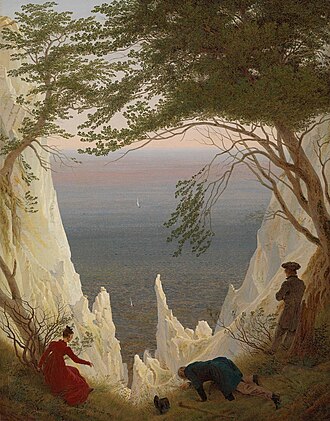 リューゲン島の白亜岩 - Caspar David Friedrich (1818)
 海辺の僧侶 - Caspar David Friedrich (1808)
 Life stages - Caspar David Friedrich (1834)
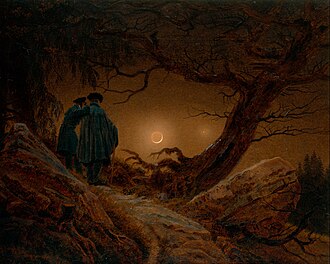 月を眺める2人の男 - Caspar David Friedrich (1810s)
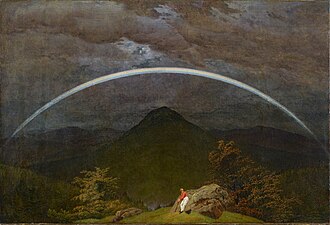 Mountain Landscape with Rainbow - Caspar David Friedrich (1809)
関連する画家の作品
 1808年5月3日 - Francisco Goya (1814)
 裸のマハ - Francisco Goya (1800)
 民衆を導く自由の女神 - Eugène Delacroix (1830)
 サルダナパールの死 - Eugène Delacroix (1827)
 戦艦テメレール号 - J. M. W. Turner (1839)
 雨、蒸気、速度 - グレート・ウェスタン鉄道 - J. M. W. Turner (1844)
 青衣の少年 - Thomas Gainsborough (1770)
 アンドリューズ夫妻 - Thomas Gainsborough (1748)