リューゲン島の白亜岩
Caspar David Friedrich · 1818
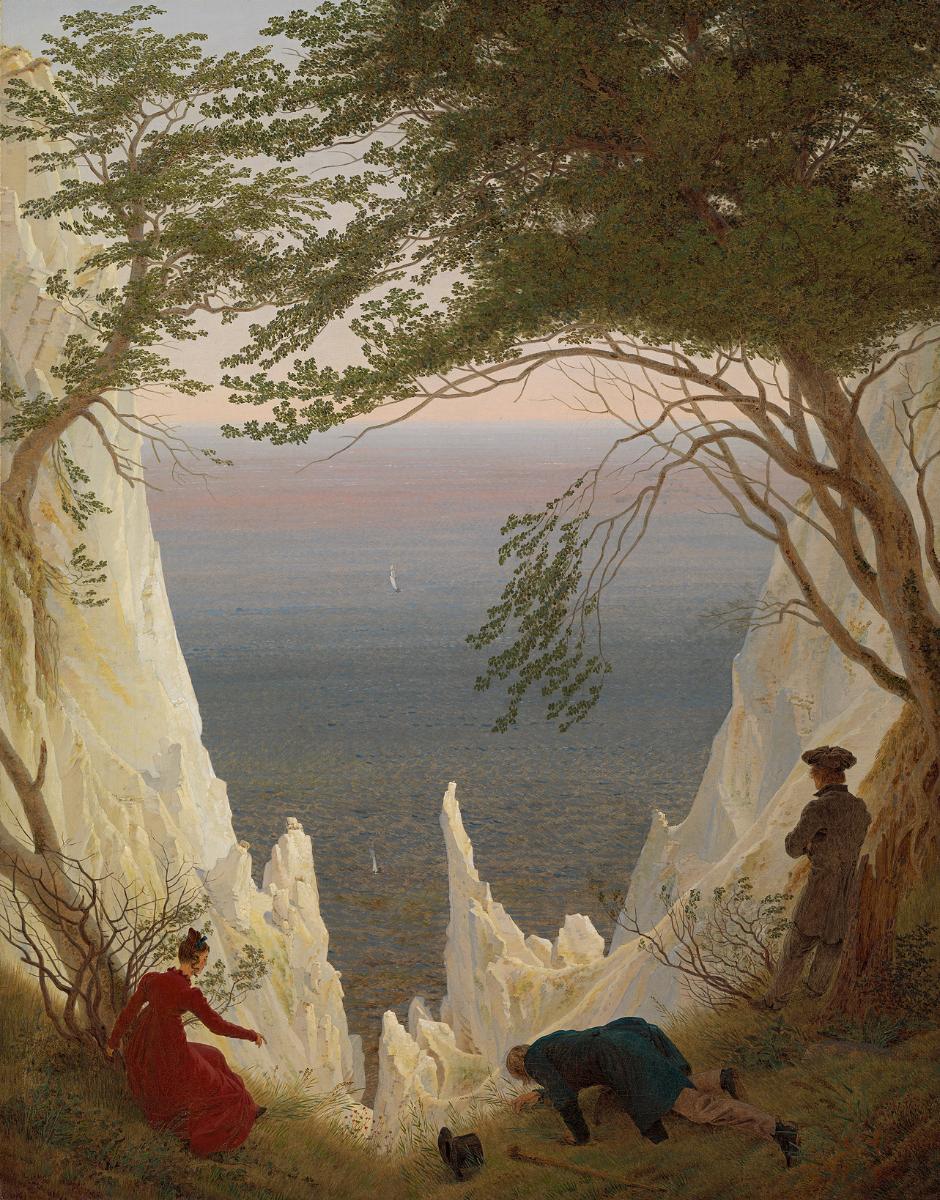
Three small figures stand at the edge of white chalk cliffs, framed by trees, looking down at a calm sea. Friedrich painted it around 1818, the year he married, and it reads like a love letter and a meditation on death at once.
The story behind the painting
In January 1818 Caspar David Friedrich married Christiane Caroline Bommer, about twenty years younger than him. On their honeymoon in July and August 1818 they visited relatives in Neubrandenburg and Greifswald, and from there made an excursion to the island of Rügen with Friedrich's brother Christian. Chalk Cliffs on Rügen, an oil painting of about 1818, about 90.5 by 71 cm, is often seen as a celebration of the couple's union. The view is from the chalk cliffs of the Stubbenkammer, then one of the island's most famous lookout points.
What to look for
Two trees frame the scene, their leaves filling the upper third of the picture. In the middle a thin man, usually read as Friedrich himself, has laid his hat beside him and gropes for a foothold in the grass as he looks into the abyss. On the right a man with crossed arms leans on a dying tree and gazes far out to sea, where two tiny sailboats drift. On the left a woman in red, usually identified as Caroline, sits by an almost dried-up shrub, only the twigs near her face in leaf, and points either at the abyss or at the flowers along its edge.
Meaning and intent
Each detail carries meaning in the usual reading. The hat on the grass is humility; the search for a foothold is the transience of life; the abyss is death. The sailboats stand for the soul opening to eternal life and echo the two men. The clothes are coloured blue, red and green, for faith, love and hope, the three Christian theological virtues. Unlike the men, the woman turns to the others, and whether she feels threatened by the drop or drawn by its beauty is left unclear. The art historian Helmut Börsch-Supan saw here Friedrich's relation to death shown more clearly than almost ever before, yet in an unusually serene mood.
Legacy
People often believe the Wissower Klinken outcrops were the model for the cliffs, but that is incorrect: those formations did not exist when the picture was painted and appeared later through erosion. Friedrich usually built his landscapes from chosen elements of different sketches, so a single real spot cannot always be pinned down. The painting endures as one of the defining images of German Romanticism, a honeymoon view in which love, faith and the nearness of death share one bright summer day.
豆知識
- Oil painting of about 1818, about 90.5 x 71 cm.
- Linked to Friedrich's honeymoon trip to Rügen in summer 1818.
- The view is from the chalk cliffs of the Stubbenkammer.
- The figures' blue, red and green clothes are read as faith, love and hope.
同じ画家の作品: Caspar David Friedrich
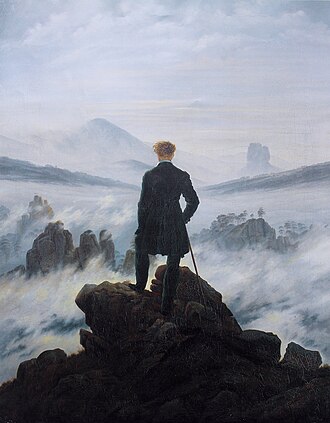 雲海の上の旅人 - Caspar David Friedrich (c. 1818)
 楡の木のある僧院 - Caspar David Friedrich (1800s)
 氷の海 - Caspar David Friedrich (1820s)
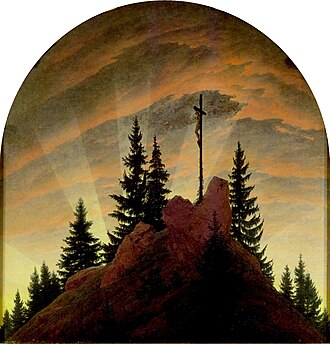 テッチェン祭壇画 - Caspar David Friedrich (1807)
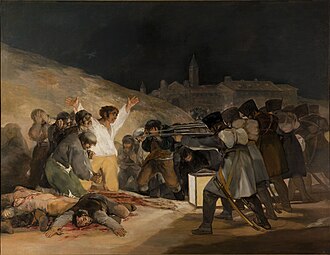 1808年5月3日
.jpg) 裸のマハ
裸のマハ