Life stages
Caspar David Friedrich · 1834
.jpg)
At dusk on a Baltic shore, an old man in a fur hat walks toward his family. Out on the water, five ships sit at different distances from land. Friedrich, near the end of his life, painted himself turning toward the horizon.
The story behind the painting
Friedrich painted this allegory about five years before his death; Wikipedia dates it 1835, while Wikidata gives 1834. Like many of his works it is a meditation on his own mortality and the passing of life. Unlike his many imagined landscapes, this place is real: Utkiek, near his birthplace of Greifswald in northeastern Germany. The figures have been identified as his family. The old man is Friedrich himself, the boy his son Gustav Adolf, the young girl his daughter Agnes Adelheid, the older girl his daughter Emma, and the man in the top hat his nephew Johann Heinrich.
What to look for
The canvas, about 72 by 94 cm, shows a Baltic harbour in the dusk. Two adults and two children, dressed as townspeople, form a semicircle on the shore. In the middle a boy holds up a Swedish flag while a girl reaches for it, and a woman leans toward them with her hand raised. On the far left the old man stands outside the circle, in a coat and fur hat while the others wear summer clothes. On the sea, a large ship draws in its sails and two small boats have almost reached land. The bow of the big ship lines up exactly with the two children.
Meaning and intent
The five people echo the five ships of the opening description, though the article later counts three sailing ships returning home, each at a different distance from shore, as stages of life and nearness to death. One reading makes the small boats in shallow water the children, just beginning their voyage, the central ship the mother, and the furthest ship, vanishing into the horizon, the old man leaving this life. Other critics reverse it: the distant ships are the parents setting out, and the big ship near shore is the old man, coming home to harbour after a full life. Both readings meet in the same quiet farewell.
Legacy
The Swedish flag is personal. Greifswald belonged to Sweden from 1630 until 1815, when it passed to Prussia, yet twenty years later Friedrich shows his children holding a Swedish pennant, looking toward the sea beyond which Sweden lies. He named his son after the Swedish king Gustav Adolf IV, and the writer Atterbom said Friedrich considered himself half-Swedish. The title is probably not his own: wary of descriptive titles, he likely left it unnamed, and it was renamed during a revival of interest in the late 19th or early 20th century. It is in the Museum der bildenden Künste, Leipzig.
豆知識
- Painted around 1834-1835, about five years before Friedrich's death.
- Set at Utkiek near Greifswald, his birthplace.
- The figures are Friedrich, his children and his nephew.
- Held by the Museum der bildenden Künste, Leipzig.
画家について
Caspar David Friedrich (1774-1840)
同じ画家の作品: Caspar David Friedrich
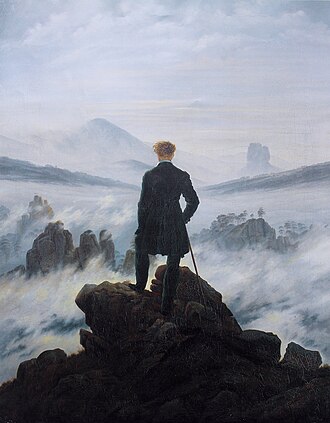 雲海の上の旅人 - Caspar David Friedrich (c. 1818)
 楡の木のある僧院 - Caspar David Friedrich (1800s)
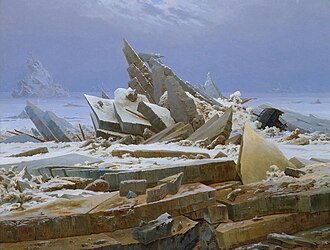 氷の海 - Caspar David Friedrich (1820s)
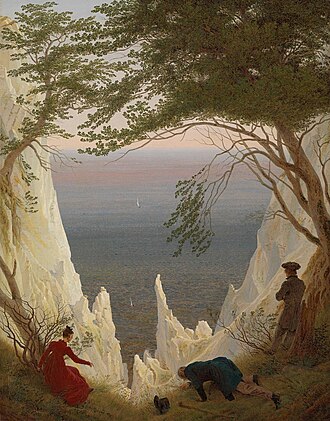 リューゲン島の白亜岩 - Caspar David Friedrich (1818)
 海辺の僧侶 - Caspar David Friedrich (1808)
 月を眺める2人の男 - Caspar David Friedrich (1810s)
 Mountain Landscape with Rainbow - Caspar David Friedrich (1809)
 テッチェン祭壇画 - Caspar David Friedrich (1807)
関連する画家の作品
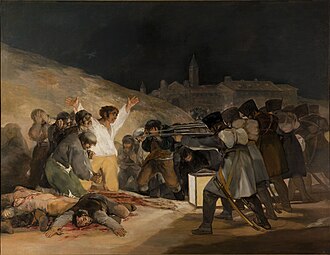 1808年5月3日 - Francisco Goya (1814)
.jpg) 裸のマハ - Francisco Goya (1800)
裸のマハ - Francisco Goya (1800)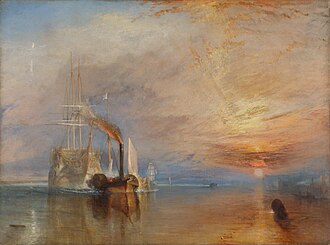 戦艦テメレール号 - J. M. W. Turner (1839)
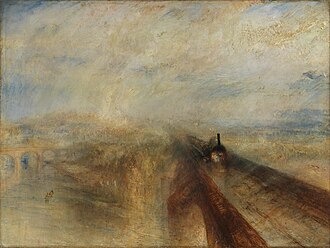 雨、蒸気、速度 - グレート・ウェスタン鉄道 - J. M. W. Turner (1844)