Triptych of the Rest on the Flight into Egypt
ハンス・メムリンク · 1475
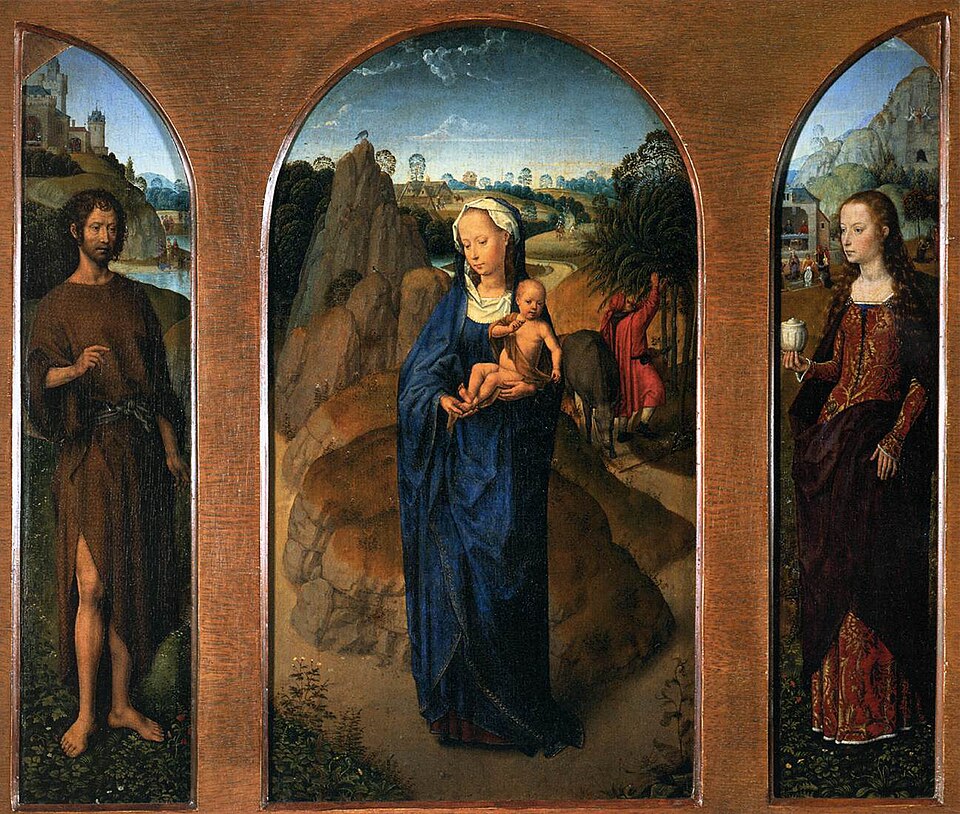
A tiny, refined triptych by Hans Memling was sawn apart, scattered between Paris and Cincinnati, and only pieced back together in the 1970s. At its heart the Virgin stands, while Joseph gathers dates from a tree that bends down to him.
The story behind the painting
This small triptych by the Flemish painter Hans Memling was taken apart long ago. The central panel, with the Rest on the Flight into Egypt, and the inner wings showing Saint John the Baptist and Saint Mary Magdalene are in the Louvre in Paris. The outer wings, painted with Saint Stephen and Saint Christopher, are in the Cincinnati Art Museum. Who commissioned it is unknown, and specialists do not agree on the date: the French Wikipedia article says about 1480, while Wikidata gives 1475. Because the paint was transferred to a new support, tree-ring dating of the panels is not possible.
What to look for
Five standing saints fill this very refined work, all on a ground scattered with flowers. Behind each, in a hilly landscape among imaginary buildings, tiny scenes tell their legends, a continuous narration typical of Memling. Behind John you can find the Feast of Herod, his beheading and the Baptism of Christ. Behind Mary Magdalene, elegantly dressed and holding her jar of ointment, are the Raising of Lazarus and Noli me tangere. In the centre the Virgin stands, though she usually sits in this subject. Joseph picks dates from a tree that bends miraculously toward him, his flask resting among its roots where a spring will rise. Lions, two monkeys, a bird of prey and a magpie populate the scene.
Meaning and intent
The central scene recalls what came before the rest in the background: the Massacre of the Innocents and the Miracle of the Wheat Field, both shown in an unusual way. Each saint is identified by a familiar sign. Stephen holds a stone, a reminder that he was stoned to death, and behind him are his dispute and his stoning. Christopher carries the Christ Child, as in the Golden Legend, with the hermit who guided him and two scenes of his martyrdom behind. Together the panels turn a small object for private devotion into a crowded world of stories that the eye can wander through slowly, scene by scene.
Legacy
The wings were already separated, and their fronts and backs cut into independent pictures, when they were in the collection of Lucien Bonaparte, sold in 1816. Their rare quarter-circle tops were sawn into half circles, and the Paris panels were given broad repainted borders. First given to Jan van Eyck, then sold to King William II as a work by Van der Goes, the panels were returned to Memling from the 1850s. The Louvre bought the inner wings and, in 1874, the central panel, after it had passed through Baron de Rothschild. The outer wings went to the Edwards collection in Cincinnati in 1924 and were given to the museum in 1955.
豆知識
- Painted by Hans Memling, about 1475 to 1480 depending on the source.
- Centre and inner wings in the Louvre, outer wings in Cincinnati.
- Reassembled as a triptych only in the 1970s.
- Once attributed to Jan van Eyck and to Van der Goes.
画家について
ハンス・メムリンク (1435-1494)
宗教美術 · 聖母マリア · イエスの幼少時代 · ルーヴル美術館絵画部門 · 初期フランドル派 · マグダラのマリア · 洗礼者ヨハネ
同じ画家の作品: ハンス・メムリンク
 受胎告知 - Hans Memling (1480s)
 キリストの受難の場面 - Hans Memling (1470)
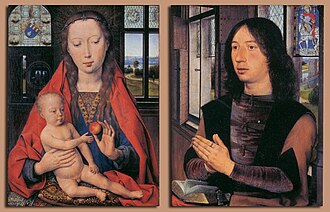 マールテン・ファン・ニューウェンホーフェの二連祭壇画 - Hans Memling (1487)
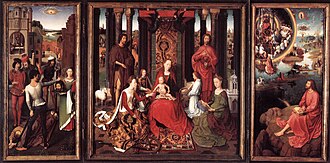 聖ヨハネ祭壇画 - Hans Memling (1479)
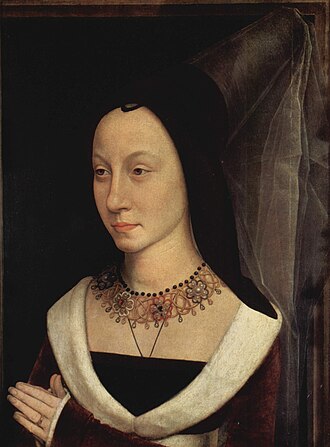 マリア・ポルティナーリの肖像 - Hans Memling (1470)
 奏楽の天使たちに囲まれたキリスト - Hans Memling (1480s)
 モレール三連祭壇画 - Hans Memling (1484)
 聖母子と聖ヤコブ、聖ドミニクス - Hans Memling (1485)
 十字架降架
 女性の肖像
 アルノルフィーニ夫妻像
 ヘントの祭壇画
 快楽の園
 愚者の船
 雪中の狩人
 ネーデルラントの諺