女性の肖像
ロヒール・ファン・デル・ウェイデン · 1460
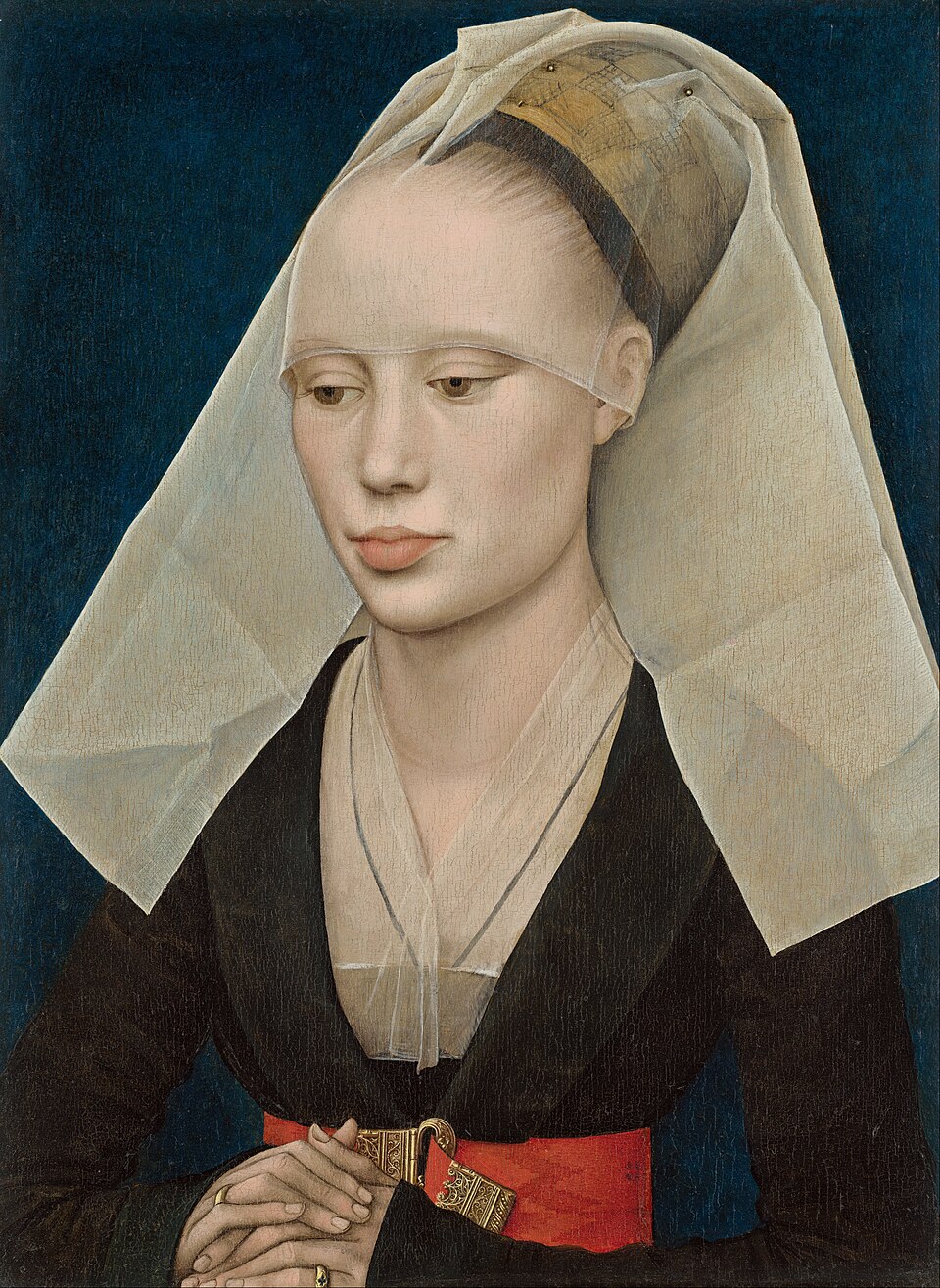
She lowers her eyes and clasps her fingers tightly, yet a transparent veil frames her face like a jewel. Nobody knows her name, but she has been called famous among all portraits of women.
The story behind the painting
Rogier van der Weyden painted this small oil-on-oak panel around 1460, near the end of his life, when he was much occupied with commissioned portraits. It is the only known portrait of a woman accepted as his own work, yet he gave it no title and the sitter's name was not recorded. Early in the 20th century, Wilhelm Stein suggested she might be Marie de Valengin, an illegitimate daughter of Philip the Good of Burgundy, but this idea is contentious and not widely held. Because her hands rest on the lower frame, scholars see it as an independent portrait rather than part of a devotional work.
What to look for
The woman, probably in her late teens or early twenties, is shown half-length in three-quarter view against a flat blue-green background that has darkened with age. She wears a fashionable low-cut black Burgundian dress with dark fur bands, cinched by a bright red sash. A buff-coloured hennin is draped with a large transparent veil, fixed with carefully painted pins, which spills over her shoulders in a diamond shape. Her hairline and eyebrows are plucked to create a high forehead. Her hands, folded in layers and set so low they seem to rest on the frame, are the most detailed part of the painting.
Meaning and intent
Van der Weyden builds the image from geometry: lines of veil, neckline, face and arms, and the fall of light on her face. Her lowered eyes and tightly grasped fingers convey humility, in contrast to her extravagant clothing. Veils were normally worn for modesty, but here it frames her face and draws attention to her beauty. Erwin Panofsky wrote that Rogier concentrated on salient features expressed mainly through lines, and spoke of a smouldering excitability. Her high forehead and full mouth have been read as hinting at a nature both intellectual, ascetic and passionate, an unresolved conflict in her personality.
Legacy
Van der Weyden belonged to the first generation of Northern Renaissance painters, with Jan van Eyck and Robert Campin, who portrayed people naturalistically rather than in idealised medieval form. Still, he flattered his sitters, and his women often resemble one another. Norbert Schneider observed that while van Eyck shows nature in the raw, Rogier improves on physical reality. His penetrating evocations of character were admired by later painters. The panel, 34 by 25.5 cm, has been in the National Gallery of Art in Washington, D.C. since its donation in 1937, and it is number 34 in the de Vos catalogue raisonné.
豆知識
- Oil on oak panel, around 1460
- National Gallery of Art, Washington, D.C., since 1937
- Only accepted female portrait by van der Weyden
- Size: 34 x 25.5 cm
画家について
ロヒール・ファン・デル・ウェイデン (1390s-1464)
女性 · 肖像 · ナショナル・ギャラリー・オブ・アート · 初期フランドル派 · Andrew W. Mellon collection
同じ画家の作品: ロヒール・ファン・デル・ウェイデン
 十字架降架 - Rogier van der Weyden (1440s)
.jpg) 最後の審判 - Rogier van der Weyden (1443)
最後の審判 - Rogier van der Weyden (1443) 聖母を描く聖ルカ - Rogier van der Weyden (1490)
 コルンバ祭壇画 - Rogier van der Weyden (1450s)
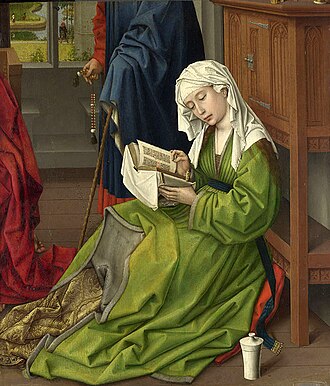 読書するマグダラのマリア - Rogier van der Weyden (1435)
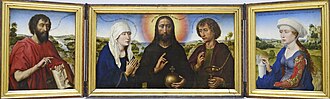 ブラック家の祭壇画 - Rogier van der Weyden (1452)
%20-%20Prado%20P02722.jpg) ドゥランの聖母 - Rogier van der Weyden (1430s)
ドゥランの聖母 - Rogier van der Weyden (1430s)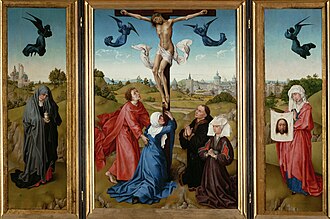 キリストの磔刑の三連祭壇画 - Rogier van der Weyden (1440s)
 快楽の園
快楽の園 愚者の船
愚者の船 アルノルフィーニ夫妻像
 ヘントの祭壇画
%20-%20Google%20Art%20Project.jpg) 雪中の狩人
雪中の狩人 ネーデルラントの諺