安息の谷
ジョン・エヴァレット・ミレー · 1850s
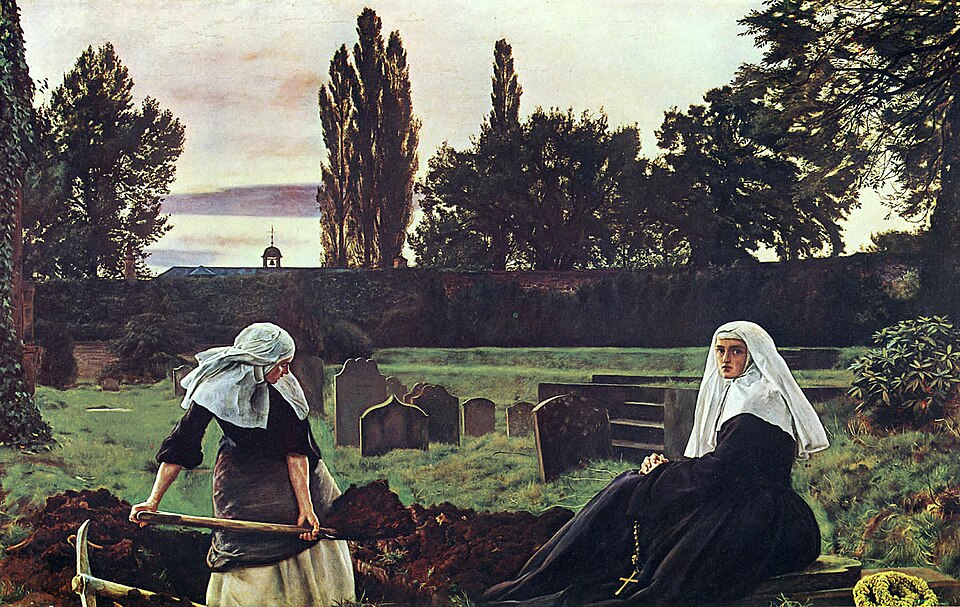
At sunset in a walled graveyard, one nun digs a grave while another sits and stares straight at us. Of all his paintings, this was the one Millais loved most.
The story behind the painting
The idea came to Millais on his honeymoon in Scotland in 1855. His wife Effie remembered how, descending the hill by Loch Awe, he was struck by its beauty when the coachman told them of monastery ruins on an island. Millais began the painting at the end of October 1858, inspired by a beautiful sunset, working outdoors for several days in the garden of Effie's family home at Bowerswell, Perth. Effie recalled that the effect lasted so short a time that he had to paint like lightning. Wikipedia dates the work 1858 to 1859, while Wikidata simply gives the 1850s.
What to look for
It is a graveyard at sunset. Beyond the wall stands a low chapel with a bell. In the foreground are two nuns, their heads level and symmetrical. One sits, a rosary with a skull hanging from her robes, funerary wreaths beside her, and looks directly at the viewer. The other digs a grave, her forearms and body straining under a shovelful of earth, her habit moving with the effort. The shrubs, wall and background come from the Gray family garden, and the gravestones were painted months later at Kinnoull old churchyard in Perth, where Effie herself would one day be buried.
Meaning and intent
The heavy symbolism of death invites us to contemplate our own mortality. The title and the subtitle, Where the weary find repose, come from Mendelssohn's part-song Ruhetal, which Millais heard his brother William sing and felt matched the mood exactly. The critic Tom Lubbock listed what it holds: graves, dusk, looming trees, nuns, still suspected in England then, female labour, something buried or exhumed, secrets and fear, a picture that pulls out all the stops. It was conceived as a companion to Millais's Spring.
Legacy
The painting was shown privately at the Langham Chambers and then at the Royal Academy in 1859, beside Spring. It did not sell there, and Millais later sold it to a dealer for the collector B. G. Windus. After the exhibition he retouched the sitting nun's face using a Miss Paton as model, and in 1862 repainted it again from a Miss Lane. Florence Claxton mocked it in her 1860 satire The Choice of Paris. Sir Henry Tate gave it to the Tate Gallery in 1894, and it hung in the 1898 Royal Academy show of Millais's works.
豆知識
- Painted by John Everett Millais in 1858 to 1859.
- Millais's favourite among his own paintings.
- Title taken from Mendelssohn's part-song Ruhetal.
- Given to the Tate by Sir Henry Tate in 1894.
画家について
ジョン・エヴァレット・ミレー (1829-1896)
風俗美術 · ナショナル・ギャラリー · ラファエル前派 · テート・ギャラリー
同じ画家の作品: ジョン・エヴァレット・ミレー
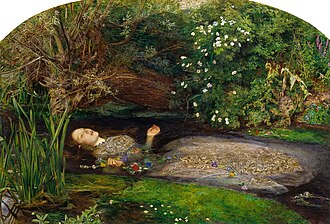 オフィーリア - John Everett Millais (1851)
%20-%20Google%20Art%20Project.jpg) 両親の家のキリスト - John Everett Millais (1849)
両親の家のキリスト - John Everett Millais (1849)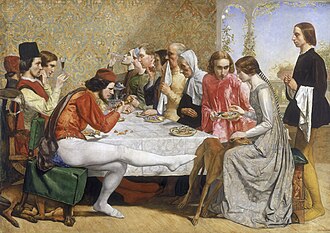 ロレンツォとイザベラ - John Everett Millais (1849)
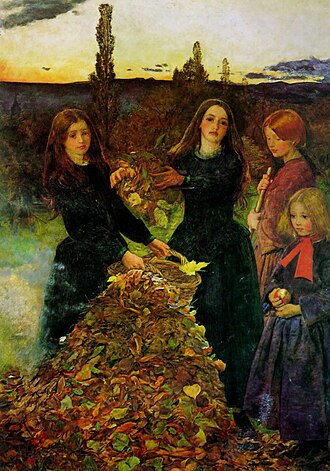 秋の落ち葉 - John Everett Millais (1856)
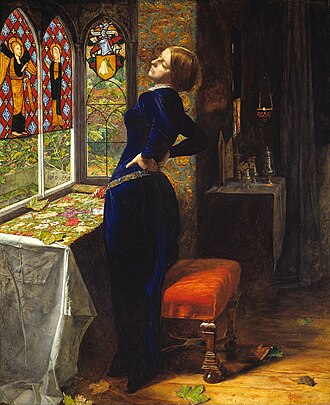 マリアナ - John Everett Millais (1851)
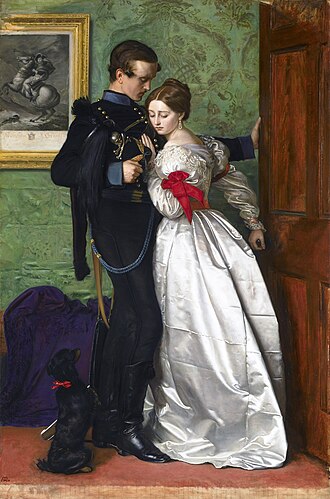 ブラック・ブランズウィッカー - John Everett Millais (1860)
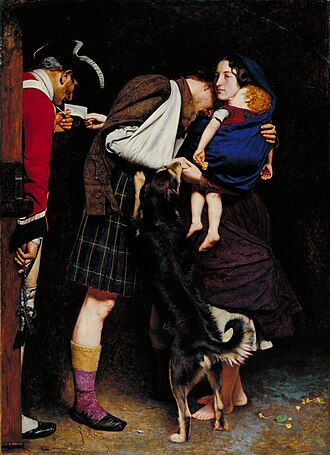 1746年の放免令 - John Everett Millais (1850s)
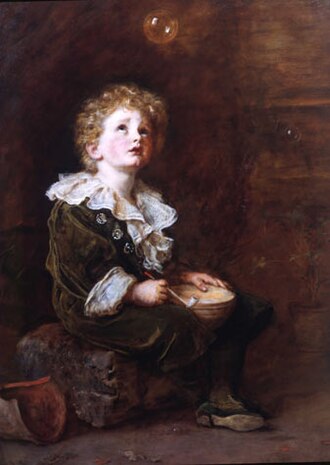 しゃぼん玉 - John Everett Millais (1886)
関連する画家の作品
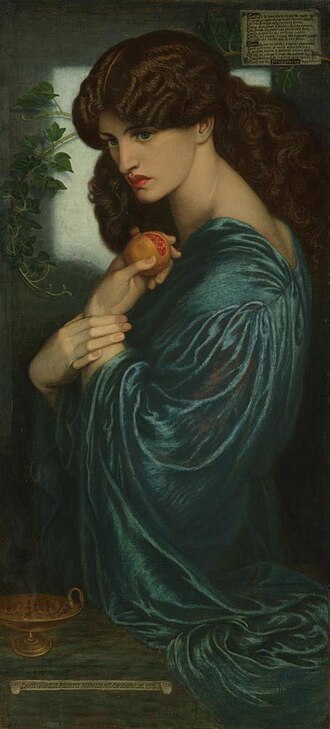 プロセルピナ - Dante Gabriel Rossetti (1874)
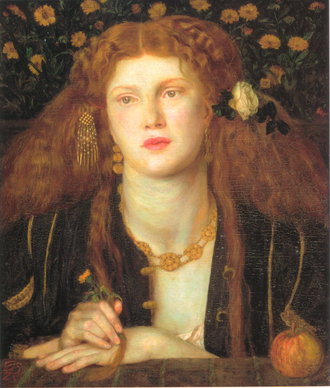 キスされた唇 - Dante Gabriel Rossetti (1859)
 ヒュラスとニンフたち - John William Waterhouse (1896)
.jpg) シャロットの女 - John William Waterhouse (1888)
シャロットの女 - John William Waterhouse (1888)