ジョン・エヴァレット・ミレー
1829-1896
John Everett Millais entered the Royal Academy Schools at eleven, helped found the Pre-Raphaelite Brotherhood in his family's London home, and painted Ophelia drifting among flowers. He ended his life as President of the Royal Academy.
Origins
John Everett Millais was born in Southampton on 8 June 1829, into a prominent family based in Jersey, the son of John William Millais and Emily Mary Millais. He spent most of his early childhood on Jersey and loved the island all his life; when the writer Thackeray once asked him when England conquered Jersey, he replied that Jersey had conquered England. The family also lived for a few years in Dinan in Brittany. His mother's forceful personality was the strongest influence on his youth. She loved art and music, encouraged her son and pushed the family to move to London to make contacts at the Royal Academy. He later said he owed everything to his mother.
Life and turning points
In 1840, at the unprecedented age of eleven, Millais won a place at the Royal Academy Schools. There he met William Holman Hunt and Dante Gabriel Rossetti, and in September 1847 the three formed the Pre-Raphaelite Brotherhood in his family home on Gower Street. The critic John Ruskin defended the group, and through him Millais met Ruskin's wife Effie, who modelled for The Order of Release. They fell in love; her marriage to Ruskin was annulled, and in 1855 she married Millais. They had eight children, and Effie became a powerful promoter of his work. He became a full member of the Academy in 1863, and in 1885 Queen Victoria made him a baronet. Elected President of the Royal Academy in 1896, he died later that year from throat cancer.
Style and technique
His early Pre-Raphaelite works were painted with great attention to detail, often dwelling on the beauty and complexity of nature. In Ophelia he built a dense surface from many natural elements, described as a kind of pictorial ecosystem. After his marriage he turned to a broader style, which Ruskin condemned as a catastrophe. Some argue he needed to paint more to support a growing family; Millais himself said that as he grew more confident he could paint more boldly, and he named Velázquez and Rembrandt as models. Some paintings of the late 1850s and 1860s anticipate the Aesthetic Movement, and from 1870 he painted large, often bleak Scottish landscapes of bog, moor and riverside in autumn.
Stories and anecdotes
Christ in the House of His Parents caused a storm because it showed the Holy Family as working people in a messy carpenter's shop. Millais found wide success with A Huguenot, a young couple about to be parted by religious conflict, and later with paintings of children, notably Bubbles, which became famous, or notorious, when it was used to advertise Pears soap. Critics such as William Morris saw this as selling out. The source notes that Effie's younger sister Sophie Gray sat for several pictures, prompting speculation about their fond relationship. His daughter Alice was a close friend of the composer Edward Elgar and is thought to have inspired themes in his Violin Concerto.
Legacy
Millais was the first artist to receive a hereditary title, and he was buried in the crypt of St Paul's Cathedral. A memorial committee chaired by the Prince of Wales commissioned a statue of him by Thomas Brock, installed outside what is now Tate Britain in 1905. Early modernist critics judged much of his later work harshly, but this view has changed in recent decades, as those pictures are now seen within the wider currents of late nineteenth century art. A 2007 retrospective at Tate Britain travelled to Amsterdam and Japan and drew over 660,000 visitors. His story with Ruskin and Effie has inspired films, plays and an opera, and Ophelia still draws crowds.
豆知識
- The Pre-Raphaelite Brotherhood was founded at 83 Gower Street, now number 7.
- He was also a successful book illustrator, notably for Anthony Trollope and Tennyson.
- His son John Guille Millais became a naturalist, wildlife artist and his father's biographer.
- Christmas Eve, painted in 1887, was his first full landscape snow scene.
関連する画家
ダンテ・ゲイブリエル・ロセッティ · ジョン・ウィリアム・ウォーターハウス
ジョン・エヴァレット・ミレーの作品
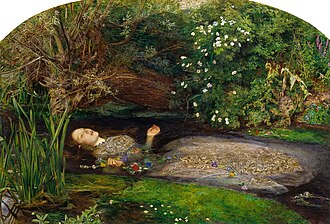 オフィーリア - John Everett Millais (1851)
%20-%20Google%20Art%20Project.jpg) 両親の家のキリスト - John Everett Millais (1849)
両親の家のキリスト - John Everett Millais (1849)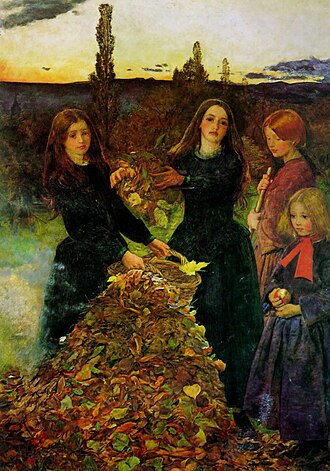 秋の落ち葉 - John Everett Millais (1856)
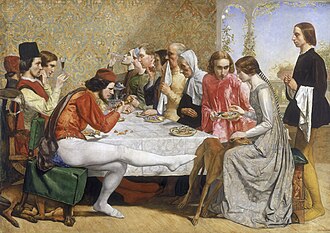 ロレンツォとイザベラ - John Everett Millais (1849)
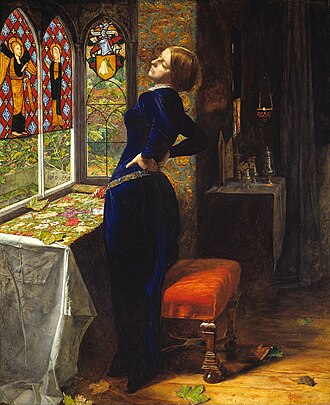 マリアナ - John Everett Millais (1851)
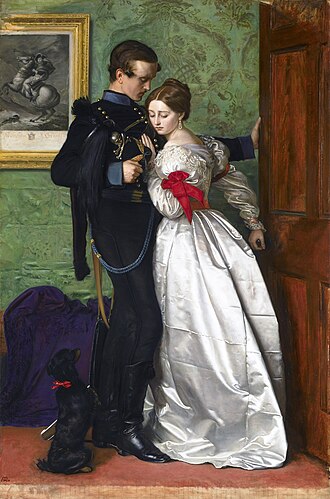 ブラック・ブランズウィッカー - John Everett Millais (1860)
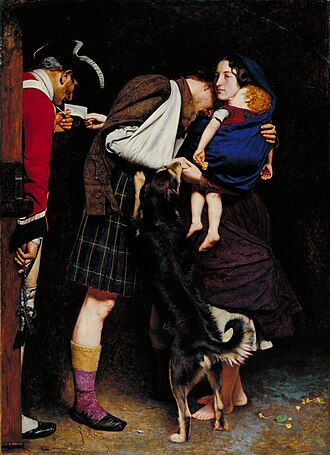 1746年の放免令 - John Everett Millais (1850s)
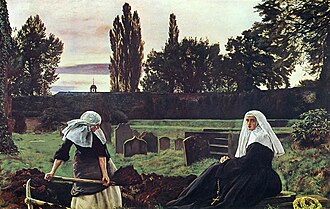 安息の谷 - John Everett Millais (1850s)
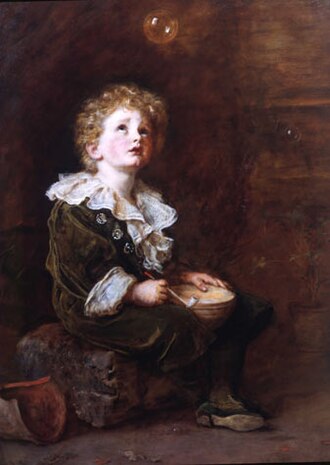 しゃぼん玉 - John Everett Millais (1886)
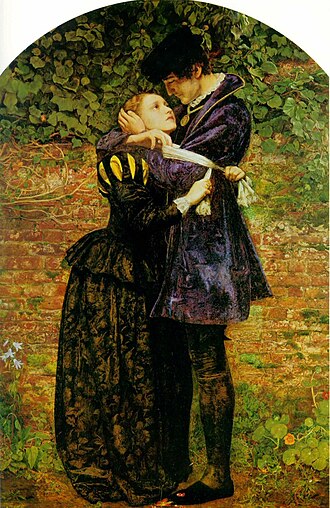 サン・バルテルミの日のユグノー - John Everett Millais (1852)