The Tulip Folly
ジャン=レオン・ジェローム · 1882
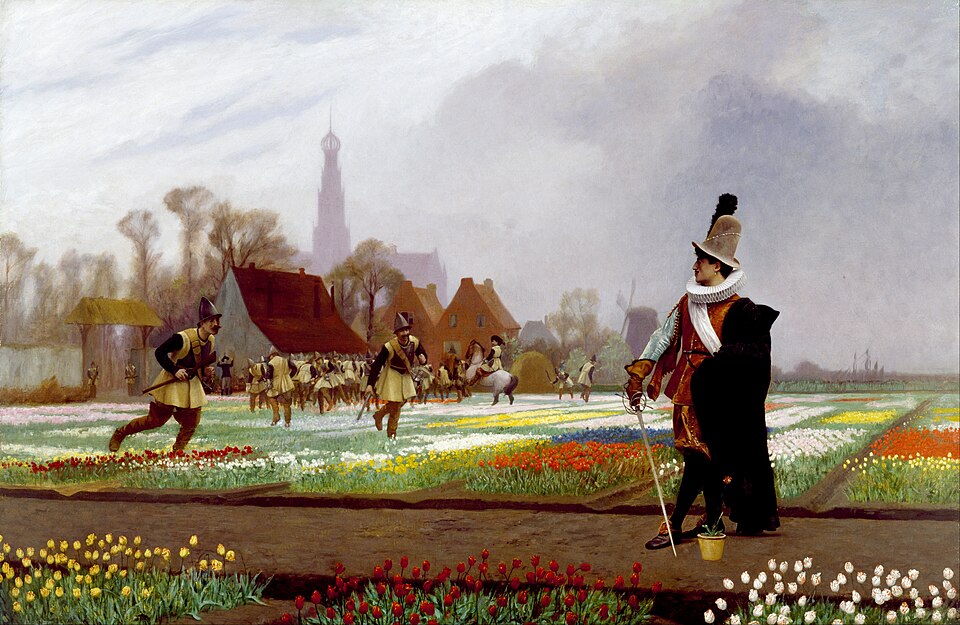
A nobleman in a ruff stands with drawn sword over a single striped tulip while soldiers trample the flower beds around him. Gérôme turned the Dutch tulip mania into a drama about beauty and money.
The story behind the painting
Jean-Léon Gérôme painted The Tulip Folly in 1882, in oil on canvas. It imagines a scene from the tulip mania of seventeenth-century Holland. The tulip, first imported from Turkey in the sixteenth century, had become an ever more valuable commodity. Variegated, or broken, tulips fetched outrageous prices, which drew more growers into a market already flooded with solid-coloured flowers. The craze peaked in 1636 and 1637, and when the market crashed, speculators were left with as little as five percent of what they had invested.
What to look for
The aristocratic owner of a broken tulip stands guard over it, defending it from government soldiers. Around him the soldiers are trampling the surrounding flower beds, trying to limit the supply of tulips so that prices do not fall even lower. In the background, look for the silhouette of St. Bavo's church in Haarlem, which places the scene in Holland. Wikidata gives the canvas as 65.4 by 100 cm, a wide format that lets the ruined field stretch out around the lone figure and his flower.
Meaning and intent
The painting can be read in two ways at once. It was seen as the connoisseur defending beauty for its own sake, a single lover of flowers standing against the logic of the market. That is how its first owner, Mary Jane Morgan, the widow of a wealthy shipping magnate, understood it. Yet in 1882 it was also a commentary on the crash of the Paris stock exchange that year, the worst financial crisis in France in the nineteenth century, which began a recession that lasted until the end of the decade.
Legacy
After Mary Jane Morgan died, the painting was sold at auction in 1886. It is now in the collection of the Walters Art Museum. The picture keeps its double message: a historical anecdote in seventeenth-century costume, and a mirror held up to Gérôme's own time, when a speculative bubble had just burst in Paris. Standing before it, the viewer is asked the same question as the soldiers and the nobleman: what is a beautiful thing worth, and who decides?
豆知識
- Painted by Jean-Léon Gérôme in 1882.
- Set during the Dutch tulip mania, with St. Bavo's church in Haarlem behind.
- Also a comment on the 1882 Paris stock exchange crash.
- In the Walters Art Museum.
画家について
ジャン=レオン・ジェローム (1824-1904)
男性 · 寓意 · アカデミック美術 · 剣 · 畑 · 兵士 · ウォルターズ美術館 · 外套 · 襞襟
同じ画家の作品: ジャン=レオン・ジェローム
 指し降ろされた親指 - Jean-Léon Gérôme (1872)
 奴隷市場 - Jean-Léon Gérôme (1866)
 アレオパゴス会議のフリュネ - Jean-Léon Gérôme (1861)
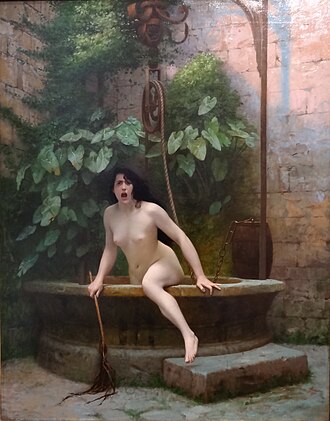 人類に恥を知らせるため井戸から出てくる〈真実〉 - Jean-Léon Gérôme (1896)
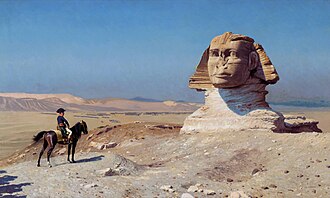 Bonaparte Before the Sphinx - Jean-Léon Gérôme (1867)
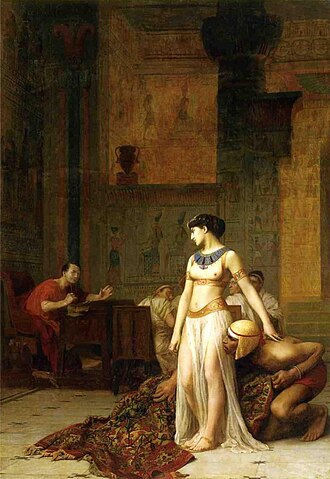 Cleopatra and Caesar - Jean-Léon Gérôme (1866)
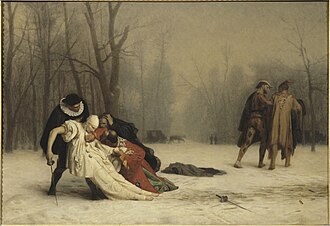 仮面舞踊会の後の決闘 - Jean-Léon Gérôme (1857)
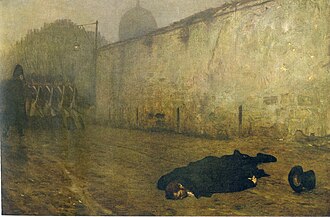 The Execution of Marshal Ney - Jean-Léon Gérôme (1868)
関連する画家の作品
 草上の昼食 - Édouard Manet (1863)
 オランピア - Édouard Manet (1863)
 世界の起源 - Gustave Courbet (1866)
 オルナンの埋葬 - Gustave Courbet (2020)
 カーネーション、リリー、リリー、ローズ - John Singer Sargent (1885-1886)
 マダムXの肖像 - John Singer Sargent (1884)
 民衆を導く自由の女神 - Eugène Delacroix (1830)
 サルダナパールの死 - Eugène Delacroix (1827)
 ソクラテスの死 - Jacques-Louis David (1787)
 ホラティウス兄弟の誓い - Jacques-Louis David (1784)
 ウォルドグレイヴ家の貴婦人たち - Joshua Reynolds (1780)
 ジョージ K. H. クースメイカー大尉 - Joshua Reynolds (1782)