ホラティウス兄弟の誓い
ジャック=ルイ・ダヴィッド · 1784
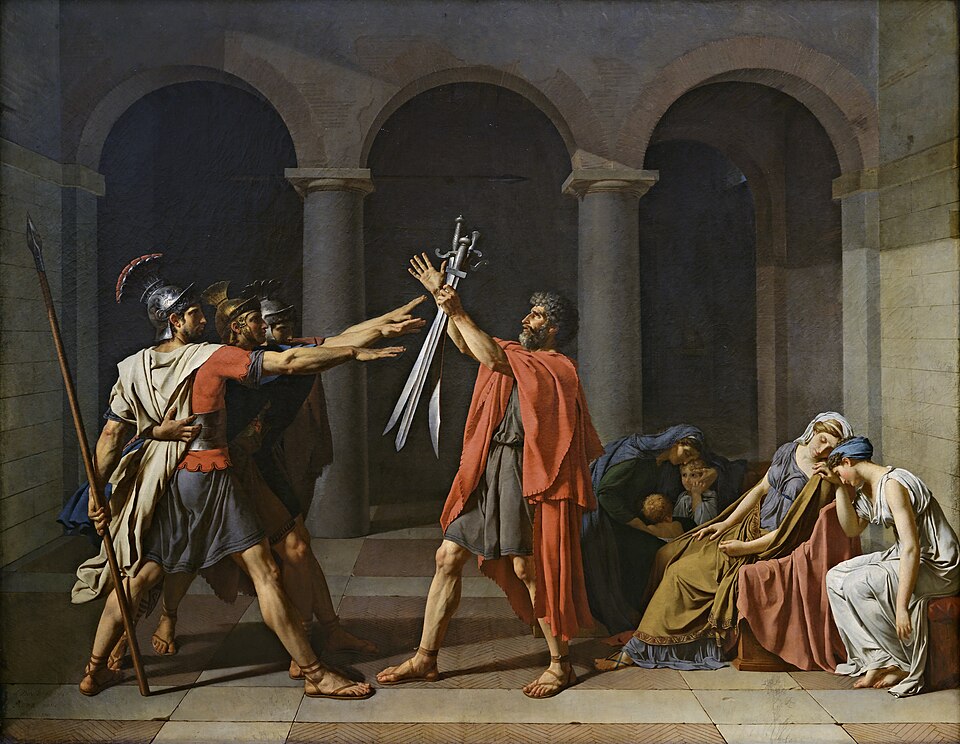
Three brothers stretch out their arms toward the swords their father holds up, while the women behind them collapse in grief. David's Oath of the Horatii was an instant success, and became a defining image of Neoclassicism.
The story behind the painting
The legend, told by Livy and elaborated by Dionysius, is set in the 7th century BC: instead of sending armies to war, Rome and Alba Longa each chose three champions, the Horatii brothers for Rome and the Curiatii for Alba Longa. The moment David shows, the oath, is his own invention. The work was commissioned for the crown by Charles-Claude Flahaut de la Billaderie, the king's assistant, as an allegory of loyalty to the state and so to the king, but David departed from the agreed scene. Studies began in Paris, but he painted it in Rome in 1784 and 1785. David first considered showing the surviving brother killing his sister, but found it too gruesome.
What to look for
The large canvas, about 330 by 425 cm, is divided in three. On the left the brothers swear on their swords, limbs taut, faces without emotion. In the centre their father holds up three swords. On the right the women weep: Camilla in white, a Horatius betrothed to one of the Curiatii; Sabina in brown, a Curiatius married to a Horatius; and a woman in black holding two children, a little girl hiding her face while the boy refuses to have his eyes shielded. The clasped swords sit in front of the vanishing point, and the straight lines of the men echo the columns behind them.
Meaning and intent
The painting stresses patriotism and masculine self-sacrifice, setting the brothers' resolute, outstretched bodies against the soft, sorrowing women. The drama, as one commentator puts it, is that the families are bound by marriage, yet the father urges his sons to fight anyway. Only one brother will survive, and he will kill Camilla for weeping over her fallen betrothed. Though painted about four years before the Revolution, it came to be seen as a progressive work shaped by Enlightenment ideas, urging loyalty to the state rather than to family or church. Its clear, hard details, invisible brushstrokes and muted colours turn away from Rococo charm.
Legacy
The painting immediately became a huge success with critics and the public. It increased David's fame and allowed him to take on his own students, and it is still one of the best-known works of Neoclassicism. His next major painting, The Lictors Bring to Brutus the Bodies of His Sons of 1789, returned to the theme of public duty over private feeling. It too was a royal commission, and a few years later David voted in the National Convention for the execution of Louis XVI. The Oath of the Horatii is on display in the Louvre in Paris.
豆知識
- Painted in Rome in 1784 and 1785.
- The oath scene is David's own invention, not in Livy.
- A royal commission that became an image of the coming Revolution.
- On display in the Louvre.
画家について
ジャック=ルイ・ダヴィッド (1748-1825)
男性 · ルーヴル美術館絵画部門 · 新古典主義 · 歴史画 · 槍 · サンダル
同じ画家の作品: ジャック=ルイ・ダヴィッド
.jpg) サビニの女たち - Jacques-Louis David (1799)
サビニの女たち - Jacques-Louis David (1799)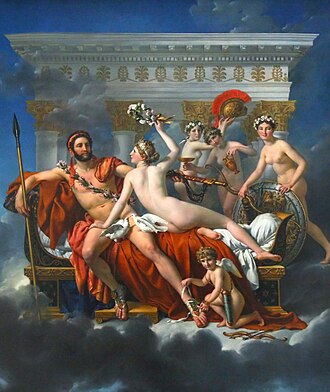 ヴィーナスと三美神に武器を取り上げられるマルス - Jacques-Louis David (1824)
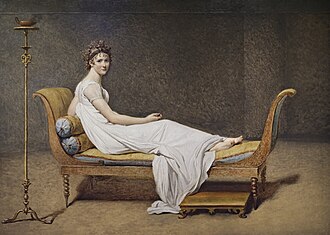 レカミエ夫人の肖像 - Jacques-Louis David (1800)
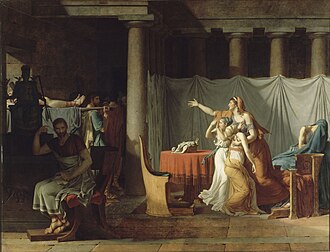 ブルートゥス邸に息子たちの遺骸を運ぶ警士たち - Jacques-Louis David (1789)
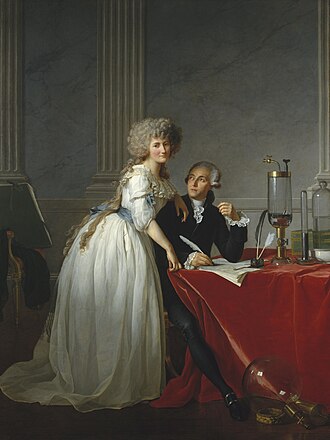 アントワーヌ=ローラン・ド・ラヴォアジエ (1743–1794年)とその妻 (マリー・アンヌ・ピエレット・ポールズ、(1758–1836年)の肖像画 - Jacques-Louis David (1788)
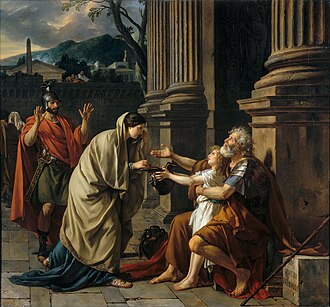 施しを乞うベリサリウス - Jacques-Louis David (1781)
クピードーとプシューケー - Jacques-Louis David (1817)
 球戯場の誓い - Jacques-Louis David (1791)
 泉
泉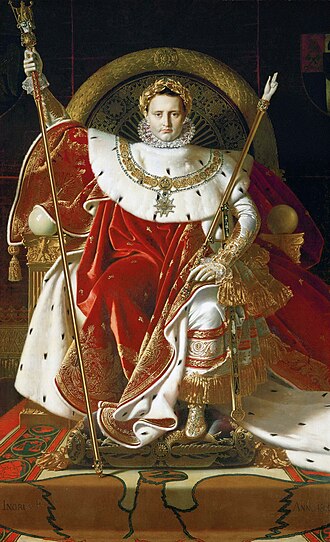 玉座のナポレオン
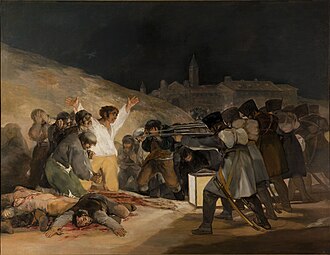 1808年5月3日
.jpg) 裸のマハ
裸のマハ