The Marketplace in Greifswald
Caspar David Friedrich · 1818
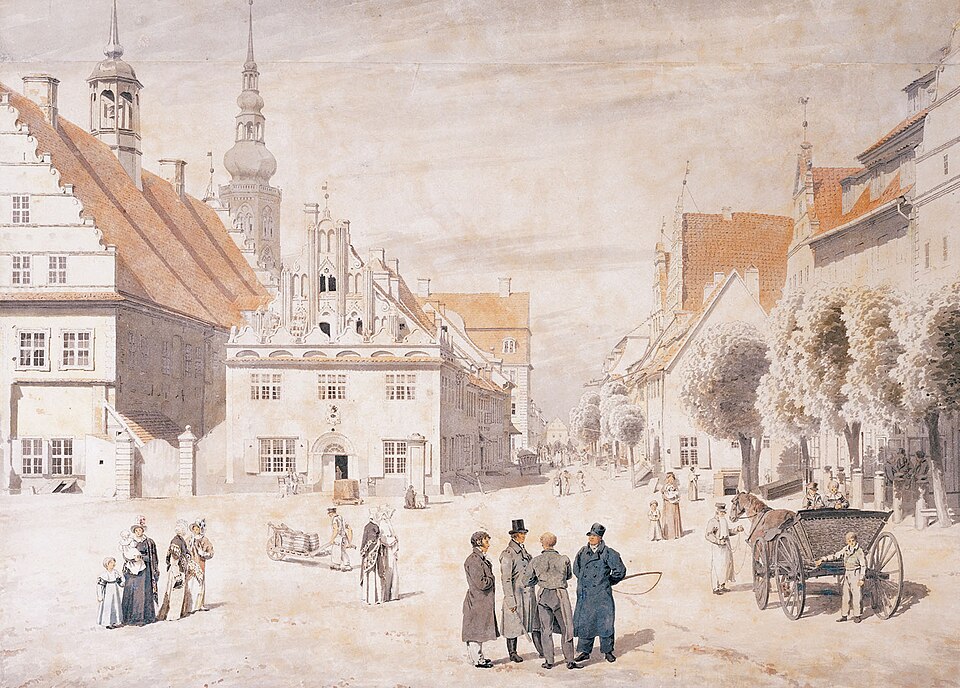
On his honeymoon in 1818, Caspar David Friedrich came home to Greifswald and drew the market square with his whole family in it. His brothers stand in front, the children peer from a cart, and the cathedral tower rises behind.
The story behind the painting
Friedrich and his young wife Caroline travelled to the island of Rügen on their honeymoon, and in July or August 1818 they stayed in his home town of Greifswald. This watercolour, also classed as a pen drawing with watercolour, was a guest gift for his brother Heinrich and shows all the family members then living in the town. The sheet is not dated, but the ages of the five children point to that visit. German Wikipedia gives its size as 54 by 67 cm, while Wikidata gives 54.5 by 67 cm. Its realistic, topographical view is unusual for Friedrich, whose work rarely records reality so faithfully.
What to look for
We look across the market square, with the town hall on the left and the council pharmacy in the centre, and down Lange Straße to the Vetten Gate, demolished in 1868. Friedrich glued on an extra strip of paper 8.7 cm wide to fit the tall bell tower of Greifswald Cathedral. The viewpoint is slightly raised, perhaps from a window opposite. The colours are brick red, grey and blue. In front stand his brothers: Adolph, the eldest, with a whip, having arrived in the carriage on the right; Heinrich, seen from behind in an apron; Christian, a cabinetmaker, with a folding rule; and a cousin, Joachim Friedrich Präfke.
Meaning and intent
The slightly oversized men in front suggest that Friedrich meant these as portraits. Beside them stand the women and children: Christian's wife Elisabeth with her daughter Lina and baby son, and Adolph's wife Grete talking with either her sister Wilhelmine or perhaps Friedrich's own wife Caroline. If it is Caroline, the scholar Börsch-Supan was wrong to say neither the painter nor his wife appears. Two veiled women behind are uncertain: Adolph's teenage daughters, passers-by, or possibly the painter's dead sisters. Boys look out of the cart, a helper holds the horse, and another carries barrels of tallow from the family candle workshop.
Legacy
The sheet stayed in Heinrich's house on the market and did not leave the family until the town of Greifswald bought it in 1953, at the urging of the district conservator Paul Schumacher. Earlier owners were the Friedrich family in 1864, Johanna Friedrich, a descendant of Heinrich, in 1906, and Sophie Siemssen, of a closely related family, in 1930. A museum director later wrote that it had already been on loan before 1934. From 2000 the town museum's collection became part of the Pomeranian State Museum, where the work is kept under inventory number K1/251.
豆知識
- Drawn in July or August 1818, during Friedrich's honeymoon visit.
- A guest gift for his brother Heinrich.
- An extra strip of paper was added for the cathedral tower.
- Stayed in the family until 1953.
画家について
Caspar David Friedrich (1774-1840)
同じ画家の作品: Caspar David Friedrich
 雲海の上の旅人 - Caspar David Friedrich (c. 1818)
 楡の木のある僧院 - Caspar David Friedrich (1800s)
 氷の海 - Caspar David Friedrich (1820s)
 リューゲン島の白亜岩 - Caspar David Friedrich (1818)
 海辺の僧侶 - Caspar David Friedrich (1808)
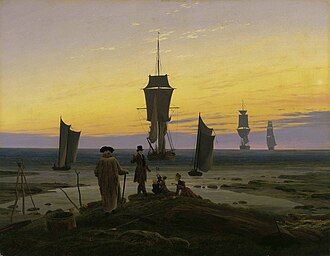 Life stages - Caspar David Friedrich (1834)
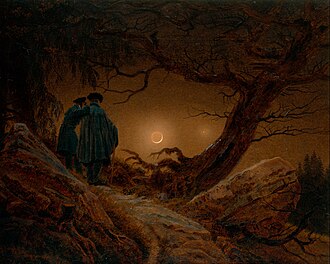 月を眺める2人の男 - Caspar David Friedrich (1810s)
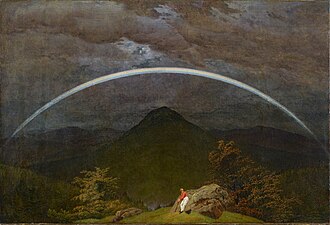 Mountain Landscape with Rainbow - Caspar David Friedrich (1809)
関連する画家の作品
 1808年5月3日 - Francisco Goya (1814)
 裸のマハ - Francisco Goya (1800)
 民衆を導く自由の女神 - Eugène Delacroix (1830)
 サルダナパールの死 - Eugène Delacroix (1827)
 戦艦テメレール号 - J. M. W. Turner (1839)
 雨、蒸気、速度 - グレート・ウェスタン鉄道 - J. M. W. Turner (1844)
 青衣の少年 - Thomas Gainsborough (1770)
 アンドリューズ夫妻 - Thomas Gainsborough (1748)