The Garden Terrace
Caspar David Friedrich · 1810s
.jpg)
A woman reads on a bench beneath two chestnut trees, a red cloth beside her, while beyond the garden wall a bright land rolls away to a distant peak. Caspar David Friedrich built this calm view in 1811 like a stage set, from places that do not actually line up.
The story behind the painting
In June 1811 Friedrich set out from Dresden with the sculptor Christian Gottlieb Kühn on a journey to the Harz mountains. They began with a stay of several days in Ballenstedt at the house of the Bardua family. Caroline Bardua, then 27, had just finished her art studies in Dresden; her greatest success had been a portrait of Friedrich himself, shown in 1810. The family lived by the palace, near the chestnut avenue leading to the town. Friedrich filled his sketchbook with drawings of the palace grounds and views of the Brocken. A pencil study dated 25 June 1811 gave him the foothills and the outline of the mountain, and in September in Dresden he drew the two trees.
What to look for
The composition is strictly symmetrical. A shaded, geometrically laid out park is closed off by a wall in the middle ground. At the centre is a round flower bed with the statue of an ancient goddess, framed by two tall chestnut trees. At the foot of the right tree a woman in a dark dress sits reading on a bench, a wicker basket beside her partly covered with a red cloth. She is not seen from behind, as in many Friedrich figures, but from the side, as a recognisable person. In the wall is an openwork gate flanked by two lions. Beyond it, bright meadows, wooded hills, village houses and a castle ruin rise towards a mountain cone. The canvas is about 53.5 by 70 cm.
Meaning and intent
Friedrich composed the picture as a compilation. Like scenery on a stage, he brought into one line of sight things that in Ballenstedt lay in different directions: the old park wall, the avenue of chestnuts planted in 1800, the foothills and the Brocken, pulled unnaturally close. The woman on the bench is the anchor around which the landscape is moved. Readings have changed with the times: contemporaries saw a garden in French style, which in the Napoleonic wars could be read as anti-Napoleonic; later writers saw peace entering the human heart; Helmut Börsch-Supan in 1969 found a cross in the gate; Werner Hofmann in 2000 saw an allegory of the young woman's reading; Peter Märker in 2007 a political contrast between French garden and free nature.
Legacy
The painting was shown in Dresden in March 1812 and in Berlin in autumn 1812, where the Prussian royal house bought it. It moved between royal residences in Berlin, Erdmannsdorf and Potsdam, and today is in the Neuer Pavillon in Berlin, though Wikidata lists Charlottenhof Palace and gives the 1810s as its date. It is the only work by Friedrich where such a topographical compilation can be proven, revealing how he arranged fragments of reality in other pictures. It is also his first painting to set an apparently personal figure in symbolic relation to nature, and the first of his pictures of women in landscape painted before his marriage in 1818, with red read as the colour of love.
豆知識
- Painted in 1811 after Friedrich's stay in Ballenstedt.
- The only Friedrich painting whose compilation of real places can be proven.
- Bought by the Prussian royal house in 1812.
- Wikipedia places it in the Neuer Pavillon, Berlin; Wikidata at Charlottenhof.
画家について
Caspar David Friedrich (1774-1840)
風景画 · ロマン主義 · ベルリン=ブランデンブルク・プロイセン宮殿・庭園財団
同じ画家の作品: Caspar David Friedrich
 雲海の上の旅人 - Caspar David Friedrich (c. 1818)
 楡の木のある僧院 - Caspar David Friedrich (1800s)
 氷の海 - Caspar David Friedrich (1820s)
 リューゲン島の白亜岩 - Caspar David Friedrich (1818)
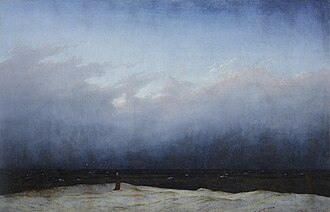 海辺の僧侶 - Caspar David Friedrich (1808)
.jpg) Life stages - Caspar David Friedrich (1834)
Life stages - Caspar David Friedrich (1834)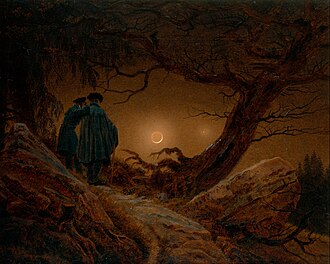 月を眺める2人の男 - Caspar David Friedrich (1810s)
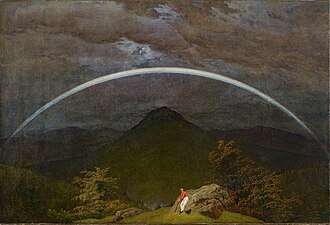 Mountain Landscape with Rainbow - Caspar David Friedrich (1809)
関連する画家の作品
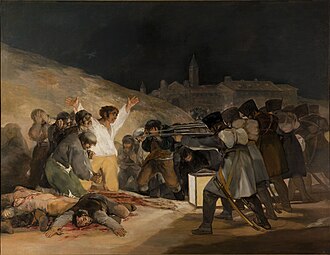 1808年5月3日 - Francisco Goya (1814)
.jpg) 裸のマハ - Francisco Goya (1800)
裸のマハ - Francisco Goya (1800)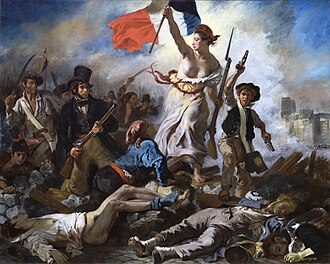 民衆を導く自由の女神 - Eugène Delacroix (1830)
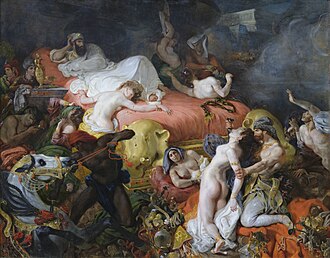 サルダナパールの死 - Eugène Delacroix (1827)
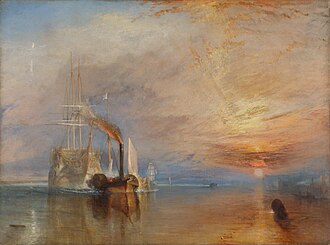 戦艦テメレール号 - J. M. W. Turner (1839)
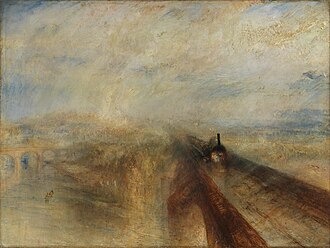 雨、蒸気、速度 - グレート・ウェスタン鉄道 - J. M. W. Turner (1844)
.jpg) 青衣の少年 - Thomas Gainsborough (1770)
青衣の少年 - Thomas Gainsborough (1770).jpg) アンドリューズ夫妻 - Thomas Gainsborough (1748)
アンドリューズ夫妻 - Thomas Gainsborough (1748)