The Four Doctors
John Singer Sargent · 1906
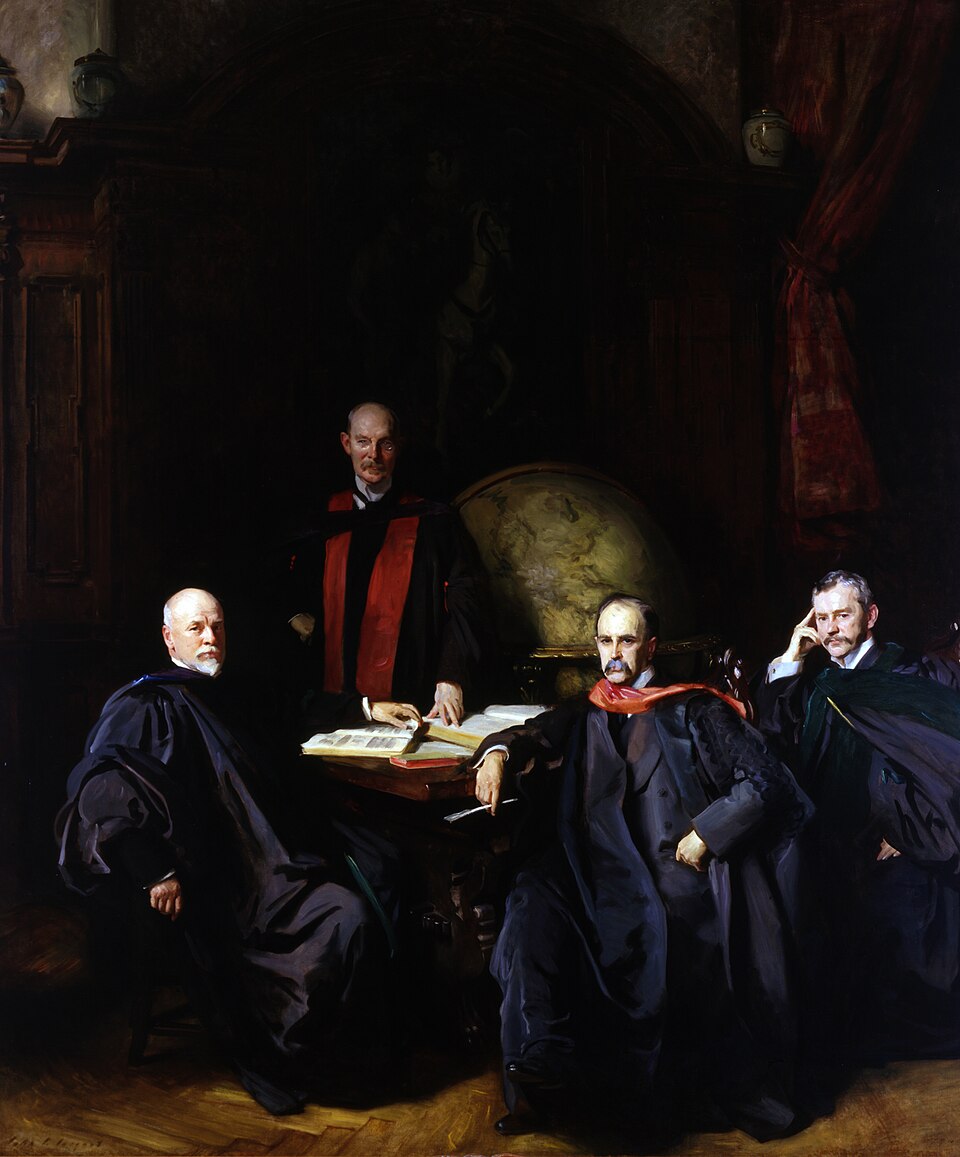
Four doctors in academic robes stand before a fireplace in London, a huge globe behind them. It took four years just to get them into the same room, and Sargent had to remove part of a doorframe before the picture finally worked.
The story behind the painting
The idea came in 1899 from Mary Elizabeth Garrett, a benefactress whose gift had enabled the Johns Hopkins Medical School to open, and whom Sargent had already portrayed. In 1903 she persuaded him to paint a group portrait of the faculty members she most admired: William H. Welch, Howard Atwood Kelly, William Stewart Halsted and William Osler. After four years of failed attempts to match their schedules, the four posed together on 9 June 1905 at Sargent's studio at 33 Tite Street, London. The painting took more than a year to finish.
What to look for
The four men wear their academic robes in front of the studio fireplace. Welch holds a 1515 volume of Petrarch, and Halsted stands directly in front of a large Venetian globe. Behind them hangs a replica of El Greco's St. Martin and the Beggar, painted by El Greco's son Jorge Manuel Theotocopuli. The canvas is about 328 by 277 cm, made of four finely woven linen panels stitched together. Sargent tried several arrangements and was satisfied only once the globe was brought in, which meant removing part of the doorframe.
Meaning and intent
Sargent found Osler the hardest sitter. He refused to paint him in his scarlet Oxford gown, remarking that he knew all about that red, and struggled to capture Osler's unusually olive complexion. The artist Edwin Austin Abbey felt that Osler came across as the most striking of the four. Yet by turning four physicians into the founders of Johns Hopkins, the painting has been criticised for playing down others, such as Franklin Paine Mall and John Jacob Abel. A long-told myth that Sargent used fading paint to make Halsted disappear has been discredited.
Legacy
Completed in 1906, the painting was first shown at the Royal Academy in London, then unveiled in Baltimore on 19 January 1907, where it caused a sensation. It now hangs in the William H. Welch Medical Library at Johns Hopkins School of Medicine. It has twice appeared on the cover of the Journal of the American Medical Association, and in 2025 it inspired the Johns Hopkins Four Doctors Awards. More than a century later, the faces in it still stand for the founding of a medical school.
豆知識
- Commissioned at the urging of Mary Elizabeth Garrett.
- The four sitters posed together in London on 9 June 1905.
- Unveiled in Baltimore on 19 January 1907.
- Twice on the cover of the Journal of the American Medical Association.
画家について
John Singer Sargent (1856-1925)
同じ画家の作品: John Singer Sargent
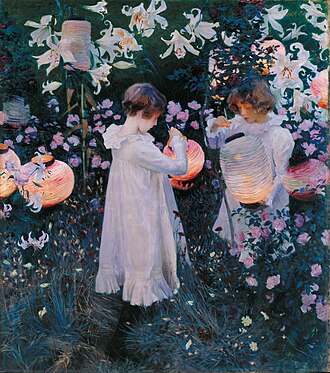 カーネーション、リリー、リリー、ローズ - John Singer Sargent (1885-1886)
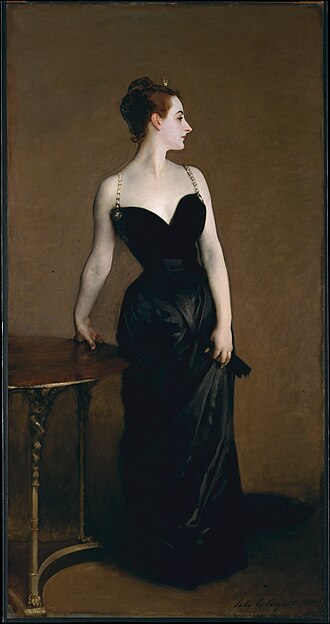 マダムXの肖像 - John Singer Sargent (1884)
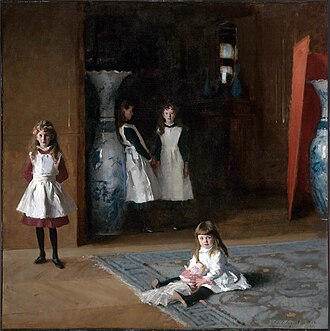 エドワード・D・ボイトの娘たち - John Singer Sargent (1882)
 毒ガスをあびて - John Singer Sargent (1919)
 ロクノーのレディ・アグニュー - John Singer Sargent (1892)
 The Wyndham Sisters: Lady Elcho, Mrs. Adeane, and Mrs. Tennant - John Singer Sargent (1899)
 El Jaleo - John Singer Sargent (1882)
 Street in Venice - John Singer Sargent (1882)
関連する画家の作品
 指し降ろされた親指 - Jean-Léon Gérôme (1872)
 奴隷市場 - Jean-Léon Gérôme (1866)
 草上の昼食 - Édouard Manet (1863)
 オランピア - Édouard Manet (1863)
 世界の起源 - Gustave Courbet (1866)
 オルナンの埋葬 - Gustave Courbet (2020)
 民衆を導く自由の女神 - Eugène Delacroix (1830)
 サルダナパールの死 - Eugène Delacroix (1827)
 ソクラテスの死 - Jacques-Louis David (1787)
 ホラティウス兄弟の誓い - Jacques-Louis David (1784)
 ウォルドグレイヴ家の貴婦人たち - Joshua Reynolds (1780)
 ジョージ K. H. クースメイカー大尉 - Joshua Reynolds (1782)