毒ガスをあびて
John Singer Sargent · 1919
.jpg)
A line of young soldiers, eyes bandaged, blinded by gas, is led by an orderly toward a dressing station at sunset. Around their feet lie the wounded. Sargent saw this scene himself in August 1918.
The story behind the painting
In May 1918 the British War Memorials Committee asked Sargent, an American, to paint a large work on Anglo-American co-operation. At 62 he went to the Western Front with Henry Tonks. He wrote that the Ministry expected an epic, and that one of the few fine subjects with masses of men was a harrowing sight: a field full of gassed and blindfolded men. That was on 21 August 1918, at a dressing station at Le Bac-du-Sud near Arras. Tonks recalled the gassed men led in parties of about six by an orderly, on a fine evening with the sun setting.
What to look for
The canvas is huge, 231 by 611 cm, and the central group of eleven soldiers is nearly life-size. Ten blinded men walk in a line along a duckboard toward the dressing station, marked by ropes on the right, guided by an orderly. Dead and wounded men lie all around them, and a second line of wounded advances behind. Look up: biplanes fight in the evening sky, the moon rises, and in the distance uninjured men play football in blue and red shirts, as if unconcerned by the suffering beside them.
Meaning and intent
The tall, blond soldiers form a frieze with the feel of a religious procession. Sargent recalls Bruegel's The Parable of the Blind and Rodin's Burghers of Calais. The painting is a powerful testimony to chemical weapons: mustard gas attacks the skin, eyes and mucous membranes, bringing blisters, blindness and choking, and suffering could last for weeks. Opinions split from the start. Churchill praised its brilliant genius and painful significance; E. M. Forster found it too heroic, and Virginia Woolf attacked its patriotism.
Legacy
Finished in Sargent's Fulham studio in March 1919, Gassed was voted picture of the year at the Royal Academy that summer. It now belongs to the Imperial War Museum in London, with charcoal studies for it. For decades its sickly greenish-yellow tone was read as a deliberate evocation of poison. A major restoration in 2023 showed that yellowed varnish from the 1970s was to blame. Under it were Sargent's real pinks, mauves and greens, a rosy sunset and a sunlit football match, perhaps a more hopeful vision of life going on after the horror.
豆知識
- Sargent witnessed the scene near Arras on 21 August 1918.
- Measures 231 by 611 cm, with figures nearly life-size.
- Voted picture of the year at the Royal Academy in 1919.
- A 2023 restoration revealed its original pinks and mauves.
同じ画家の作品: John Singer Sargent
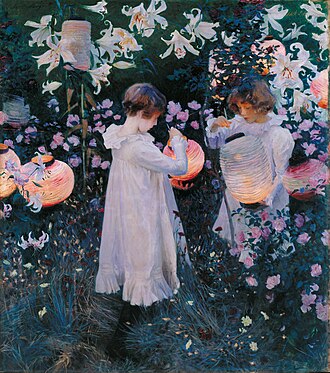 カーネーション、リリー、リリー、ローズ - John Singer Sargent (1885-1886)
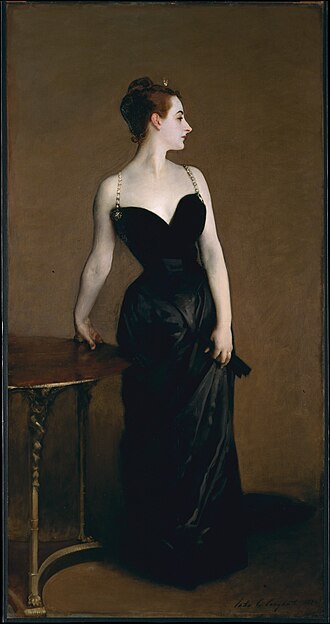 マダムXの肖像 - John Singer Sargent (1884)
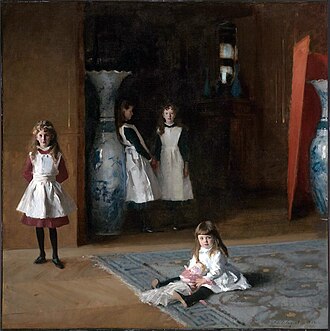 エドワード・D・ボイトの娘たち - John Singer Sargent (1882)
.jpeg) ロクノーのレディ・アグニュー - John Singer Sargent (1892)
ロクノーのレディ・アグニュー - John Singer Sargent (1892)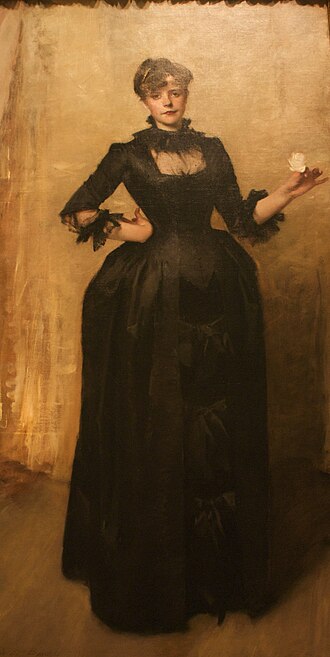 Lady with the Rose - John Singer Sargent (1882)
関連する画家の作品
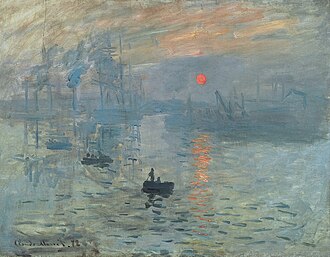 印象・日の出 - Claude Monet (1872)
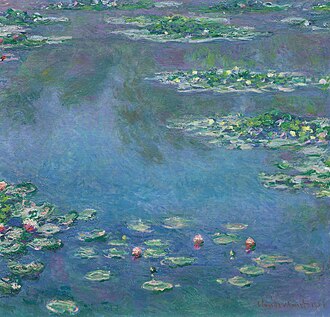 睡蓮 - Claude Monet (1906)
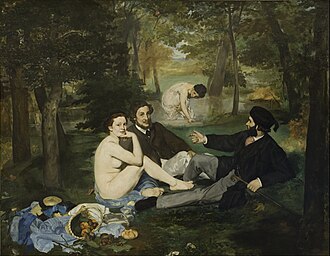 草上の昼食 - Édouard Manet (1863)
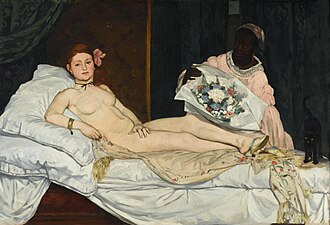 オランピア - Édouard Manet (1863)
 ムーラン・ド・ラ・ギャレットの舞踏会 - Pierre-Auguste Renoir (1876)
 舟遊びの昼食 - Pierre-Auguste Renoir (1881)
 戦艦テメレール号 - J. M. W. Turner (1839)
 雨、蒸気、速度 - グレート・ウェスタン鉄道 - J. M. W. Turner (1844)
 星月夜 - Vincent van Gogh (1889)
.jpg) 夜のカフェテラス - Vincent van Gogh (1888)
夜のカフェテラス - Vincent van Gogh (1888)