刺客
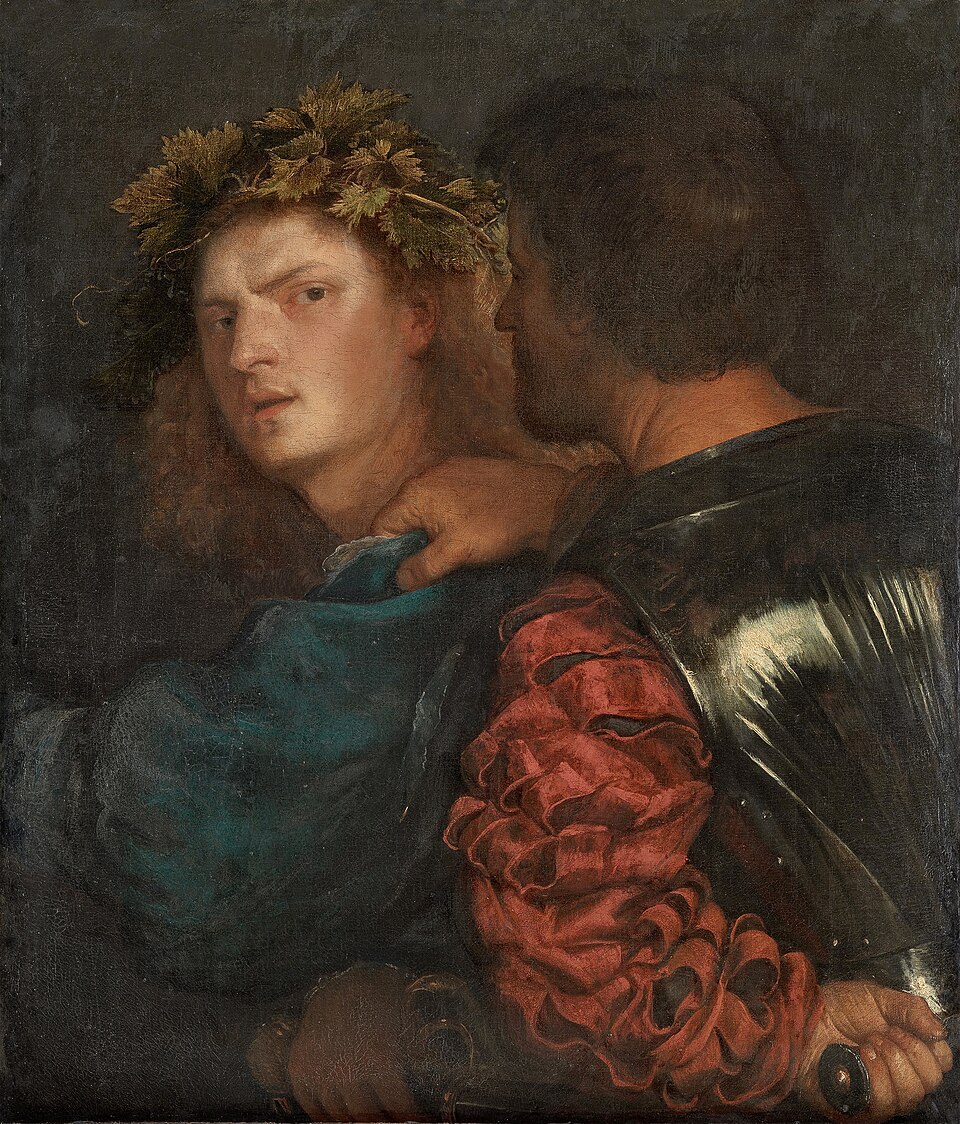
A hand on a shoulder, a sudden turn, two hidden hilts. Titian's The Bravo freezes the second before violence, and nobody has ever agreed on who these two men are.
The story behind the painting
The Bravo is an oil painting usually attributed to Titian and dated to around 1516-17. It belongs to a group of Venetian paintings of the 1510s that show two or three half-length figures with their heads close together, their expressions and dealings left enigmatic. Most of these are anonymous Giorgionesque genre subjects. Titian's The Tribute Money, similar in style, and his Lucretia and her Husband, also in Vienna, belong to the same family. The source gives no exact year, and Wikidata leaves the date blank as well.
What to look for
Against a dark background stand two men, one in front of the other. The man in front, dressed in armour, taps the other on the shoulder and makes him turn sharply. His second hand hides a dagger or sword of which only the hilt shows, so an attack seems about to happen. His head is turned away from us. The rear figure is a young man with flowing blonde hair and a garland of vine leaves, and he too has reached for his weapon, its hilt dimly visible at the bottom centre. Wikidata records the panel at 75 by 67 cm.
Meaning and intent
Many have tried to tie the scene to a specific story from myth or history. One suggestion is the arrest of Acoetes, a follower of Bacchus, by Pentheus, king of Thebes, which would explain the vine leaves in the young man's hair. An x-ray showed that the head of the foreground figure once wore a crown, a detail that fits a king. Still, the painting keeps its secret: we are given the touch, the turn and the hidden blades, and left to imagine what follows.
Legacy
The painting was probably in the Venetian collection of Zuanantonio Venier in 1526, described as two half-figures attacking each other by Titian. In 1636 it was sold to the Duke of Hamilton, who took it to London. After Hamilton's execution it went to Archduke Leopold Wilhelm of Austria, and from the Habsburg collection to the Kunsthistorisches Museum. David Teniers the Younger showed it in his gallery paintings and an etching gave it to Giorgione. Roberto Longhi attributed it to Titian, which remains usual, but John Steer thought it surely by Palma Vecchio.
豆知識
- Usually attributed to Titian, around 1516-17.
- Other attributions: Giorgione in the past, and Palma Vecchio.
- An x-ray shows the foreground figure once wore a crown.
- Now in the Kunsthistorisches Museum, Vienna.
画家について
ティツィアーノ・ヴェチェッリオ (1488-1576)
肖像 · 男性 · 盛期ルネサンス · ヴェネツィア派 · 美術史美術館
同じ画家の作品: ティツィアーノ・ヴェチェッリオ
.jpg) ウルビーノのヴィーナス - Titian (1538)
ウルビーノのヴィーナス - Titian (1538)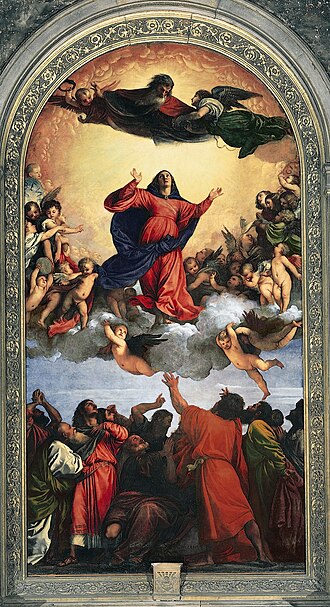 聖母被昇天 - Titian (1510s)
FXD.jpg) 聖愛と俗愛 - Titian (1510s)
聖愛と俗愛 - Titian (1510s)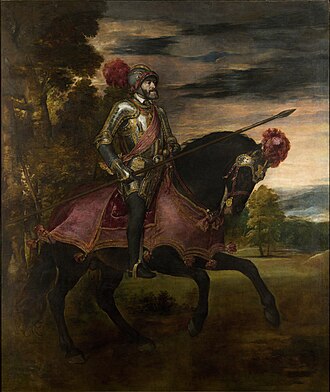 騎乗像 - Titian (1548)
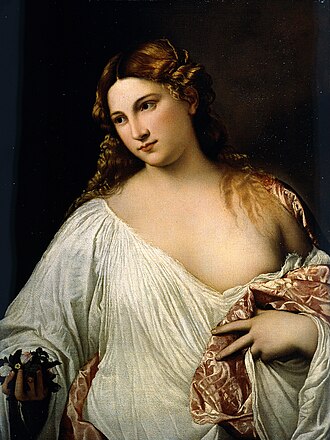 フローラ - Titian (1517)
 賢明の寓意 - Titian (1550)
 バッカスとアリアドネ - Titian (1520s)
%20nave%20left%20-%20Altar%20of%20Madona%20di%20Ca'Pesaro.jpg) ペーザロ家の祭壇画 - Titian
ペーザロ家の祭壇画 - Titian